How to Write Rap Lyrics: 6 Steps From a Blank Page
How to write rap lyrics when the page is still blank: find the moment, fit the syllables to the bar, get the rhyme off the line ends, and cut what you trip on.
Most people write the first two bars ten times and never reach the third. That isn't a talent problem. You're doing four jobs in the same pass — picking a subject, finding a rhyme, fitting the syllables, sounding like yourself — and they fight each other, which is how everyone ends up with the same eight bars about grinding.
Here's how to write rap lyrics one job at a time.
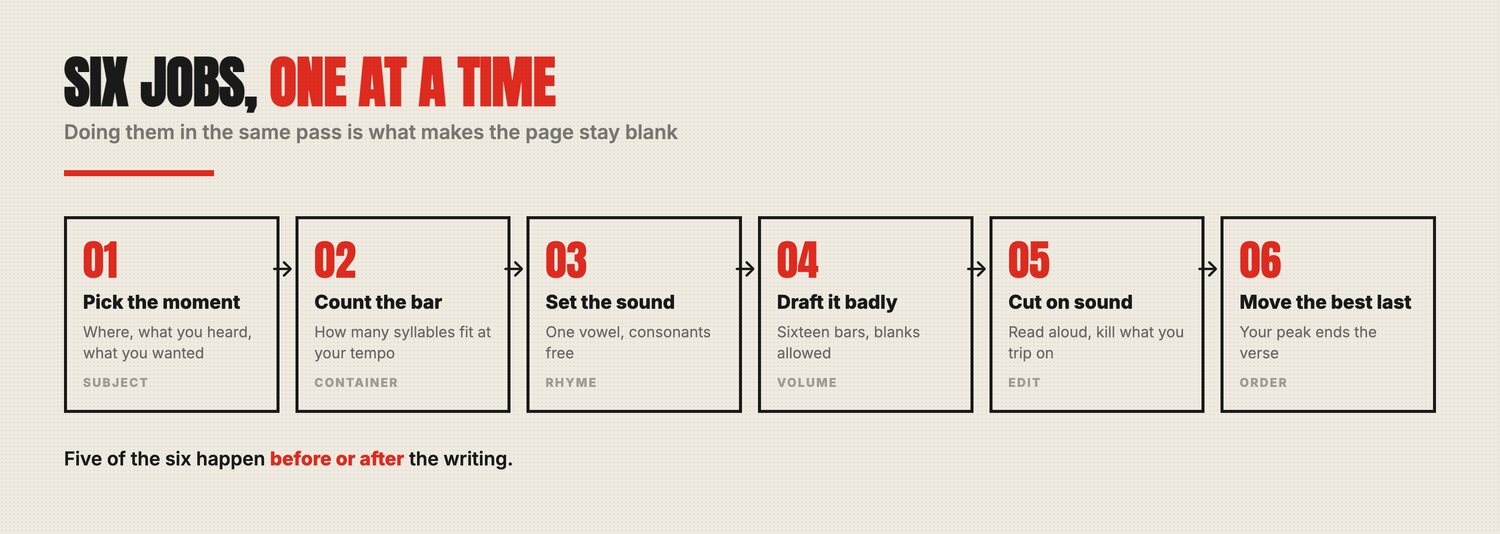
1. Start from a moment you can still see
Stuck verses usually start as a topic. Struggle. Loyalty. Making it. Categories have no objects in them, no sounds, no time of day, and nothing to rhyme toward.
So the first pass isn't bars. Take two minutes and answer three questions about one specific moment, longhand if you can: where were you, what could you hear, and what did you want that you didn't have. The third one is where the tension is, and tension is the difference between a verse and a description.
When you can't think of a moment at all
Blank on the moment too? Don't reach for a big one. The memories that write well are small and slightly embarrassing, because those are the ones nobody else has.
Three prompts that reliably produce something:
- The last time you were somewhere at an inconvenient hour. A shift, a station, a hospital corridor. Time of day does a lot of work.
- Something you own that you shouldn't still own. A jacket, a phone with a cracked screen, a key to a flat you moved out of.
- The last conversation you replayed afterwards. Not the argument you won — the one where you thought of the right line too late.
None of these is a subject yet. Each one gives you objects, and objects are what you rhyme toward.
2. Count how many syllables fit in a bar
A bar is four beats. Put a syllable on every eighth note and you get eight in a bar; put one on every sixteenth and you get sixteen. That's why most rap lives in that range — it isn't a rule, it's where the grid is. Double-time flows go well past it and a slow, spacious one sits well under it.
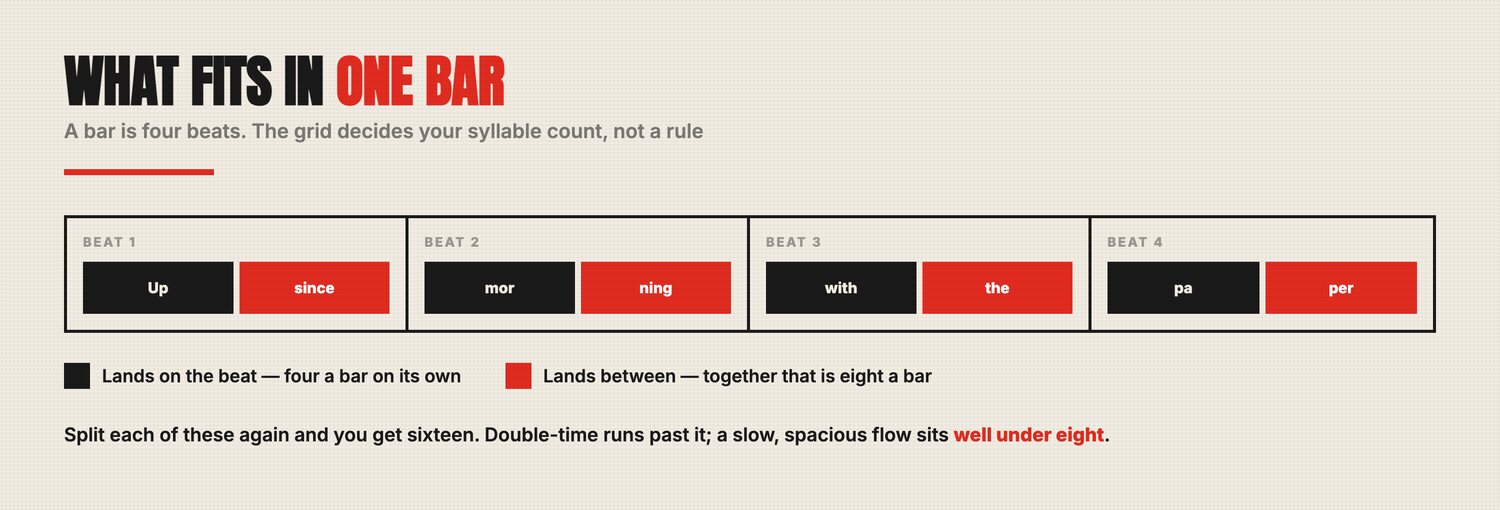
Knowing your number is what stops a line from being a sentence you hope will fit. Here is a bar that doesn't — twenty syllables, and you can feel the last four getting rushed:
I been up since the morning tryna get the paperwork over to my uncle
Same fact, thirteen syllables, sitting still:
Up since morning with the paperwork, uncle waiting
Nothing was lost except the words that were only there to hold the sentence together.
Do this once, before the draft, not on every line — you're setting the container, not editing. Put on the beat you plan to use, say nonsense over one bar until you know how many syllables sit in it comfortably, and write to that number.
If you have no beat and no headphones — on a train, in a queue — pick a tempo by walking. One step per beat at a normal walking pace is around 100 BPM, which is slow-to-mid for rap. Four steps is one bar.
Where the count lands by style
Tempo and syllable count pull against each other: the faster the beat, the fewer syllables you can fit before the words stop being audible. Rough starting points, not rules — every one of these has famous exceptions.
| Style | Typical tempo | Syllables a bar | What it asks of you |
|---|---|---|---|
| Boom bap | 85–95 BPM | 8–12 | Sit behind the beat; leave air at the end of the bar |
| Trap | 130–150 BPM (half-time feel) | 8–14 | Space between stressed syllables; ad-libs fill the gaps |
| Drill | 138–145 BPM | 10–16 | Staccato attack, consonants doing the rhythm |
| Double-time | any | 16–24 | Every syllable must survive being said fast |
| Melodic | 70–90 BPM | 6–10 | Vowels held; the line is sung as much as spoken |
If you don't know where to start, take the middle of the boom bap row. It is the most forgiving to write against and the easiest to hear your own mistakes over.
3. Get the rhyme off the ends of the lines
End rhyme is the rhyme landing at the end of the line, from the last stressed syllable onward. It doesn't have to be a whole word, and it doesn't have to be the very next line — ABAB is end rhyme too.
It's the first thing anyone learns and the hardest way to write, because you're hunting one exact word to close a line that already exists. Two moves open it up.
Internal rhyme puts the echo inside the bar. Instead of searching for one word, you're placing sounds anywhere across two lines, which is far more room.
Slant rhyme, also called near rhyme, lets a sound be close instead of exact. Cold and told is exact — same vowel, same ending. Cold and bones holds the vowel and drops the ending, and your ear still hears it. That's the whole move: keep the vowel, let the consonants go.
Both at once:
Cold on the road in a coat that won't close, bone tired, home is a phone with no charge.
Seven rhyming sounds, one of them at the end of a line. All seven are the same vowel and the consonant behind it is doing whatever it likes — which is why you never ran out of words to choose from.
Build the family before you write the line
The reason those two bars have seven rhymes in them is that the sound was chosen first. It's a pre-writing move and it takes about ninety seconds.
Take one word from your moment — say the jacket is worn. Say it out loud and write down everything that holds that vowel, ignoring the endings completely: worn, born, storm, morning, corner, warning, water, daughter, order, longer. Half of those aren't rhymes in the strict sense. All of them will pass.
Now you're not writing lines and hunting for rhymes. You're writing lines out of a pile of words you already know will land, which is a completely different job and a much easier one.
Exact rhymes run out fast, and when they do they start steering the meaning: you end up saying something you didn't mean because it rhymed. Slant rhyme hands the sentence back.
4. Write the whole thing badly, on purpose
Polishing line one before line two exists is the most common way to lose an afternoon. You'll feel busy the whole time.
Write sixteen bad bars. Leave the words you couldn't find as blanks, or as the wrong word in capitals. Get to the end.
The reason is structural: you can't tell whether a line is good until you know what it sits next to. A bar that looks flat alone is often the setup that makes the next one land, and a bar you loved in isolation often turns out to be doing nothing. Neither is visible until the sixteen exist.
5. Cut on sound, not on meaning
Read the sixteen out loud at the tempo you actually plan to rap them. Not in your head — in your head every line is fluent, because you already know where it's going.
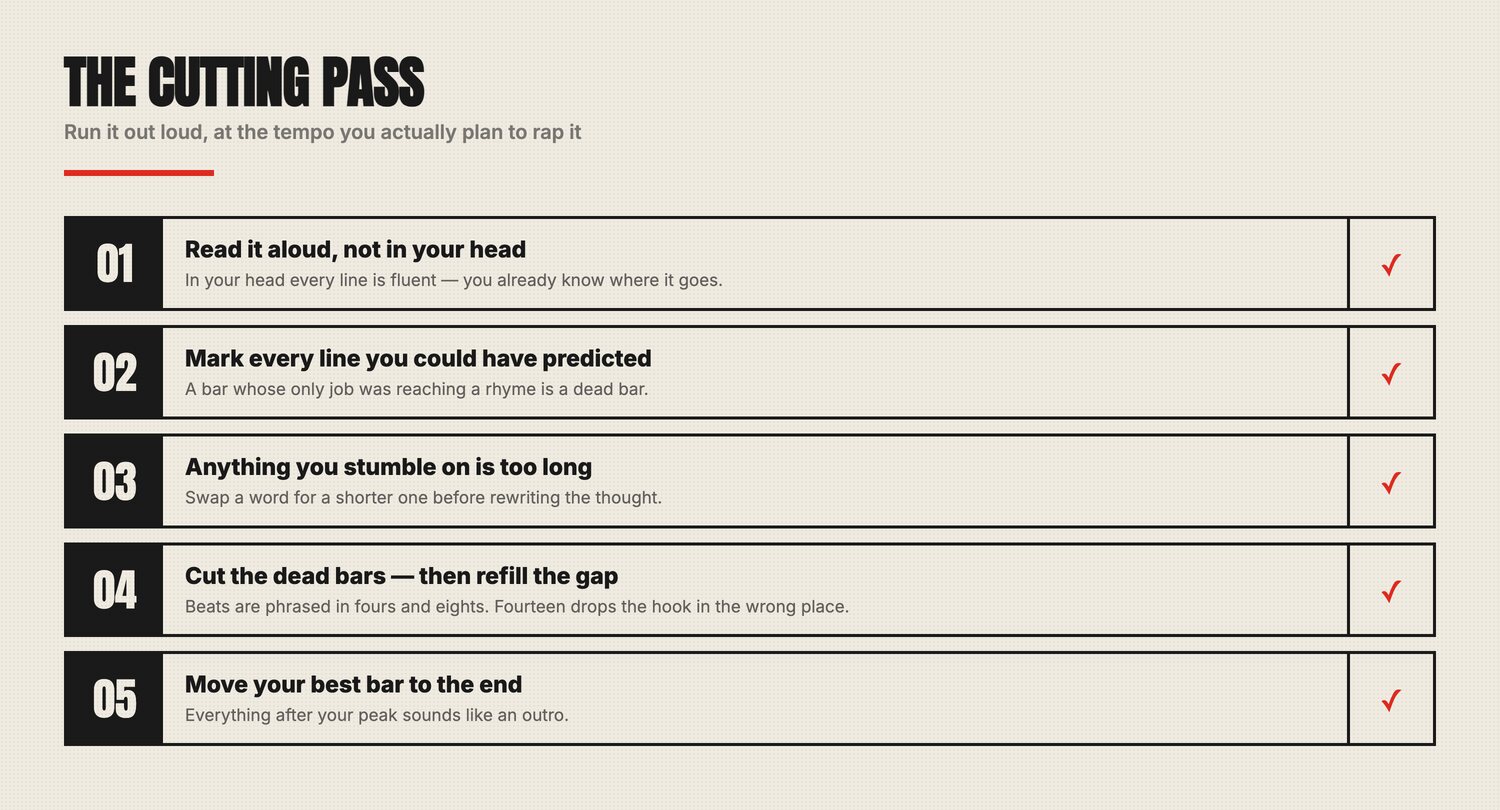
Mark anywhere you could have predicted the line from the one before it. That's a dead bar, and it's usually a bar whose only job was to reach a rhyme.
Then cut the dead ones. Fourteen bars that all move beat sixteen with two dead ones — but you can't just hand over the fourteen. Beats are phrased in fours and eights, so a verse that stops two bars short drops the hook in the wrong place. Cut the dead bars, then write two better ones into the gap.
6. Put the best line where it gets heard
The strongest bar goes last. Everything after your peak sounds like an outro, so a great line in bar nine spends the rest of the verse being undercut by whatever follows it.
This is also the one decision worth making twice. Once you have a finished sixteen, try moving your best bar to the end and reading it again. If the verse got better, it was in the wrong place — and it usually was, because the best line tends to arrive early, while you still had the whole idea in front of you.
Four things that make a verse sound amateur
These are the ones that show up in almost every first draft, and all four are cheap to fix once you can hear them.
Filler at the start of bars. And I, so I, yeah I, but I. They exist to give you a running start into the line. Cut every one and the verse gets faster without losing a word of meaning.
The rhyme arriving before the thought. You can hear this: the line makes a small, convenient claim that exists only because the word fit. If you can't defend a bar's content when read as a sentence, the rhyme wrote it.
Every line the same length. Sixteen identical bars is a metronome, not a flow. Vary two or three deliberately — a short one after three long ones lands like a punch.
Explaining the punchline. The bar after your best bar is the most dangerous one in the verse, because the instinct is to make sure it was understood. Let it sit.
Three things you can stop worrying about
Vocabulary. Long words are usually a symptom of reaching for a rhyme. Plain words in an order nobody expected will outlast them.
Writing fast. Written bars are supposed to be slow. Freestyle is a separate skill with its own value — if that's what you're after, the freestyle rap generator runs a practice game on random words, which trains something written verses never will.
Sounding like your favourite rapper. Copy whoever you like for a year. It stops working when you take their subjects as well as their cadence, because then you're writing about a life you haven't lived.
When you want a second opinion
Rate my rap scores a verse and tells you which bars are carrying it, which is faster than guessing at your own draft. If you want single lines to practise the counting on rather than a whole verse, the rap bars generator does one thought at a time. And if you want to see a finished shape before you have one of your own, the rap lyrics generator writes two sixteen-bar verses and a hook with the section tags already in place — a skeleton to write against, not the thing you release.
The short version
So: how to write rap lyrics, from nothing, in the order the jobs come.
Find a moment with an object in it. Count the bar before you write a word. Keep the vowel and let the consonants go. Get to sixteen without stopping. Read it out and cut what you trip on. Move the best bar to the end.
Five of those six happen before or after the writing. The writing itself is the short part.
Keep reading
- Best Rap Battle Lines: What Actually Lands — twelve written for the piece, and why each one works.
- How to Win a Rap Battle — the seven things that decide a round, only two of which are the bars.
- What Does MC Mean in Rap? — where the title came from, and what it still asks of you.