How to Memorize Rap Lyrics: A 7-Pass Method That Sticks
Memorize rap lyrics by learning meaning, rhythm, entrances, and recovery separately. This seven-pass method prepares a verse for the booth or stage.
Reading a verse twenty times creates a dangerous feeling: every line looks familiar, so the brain mistakes recognition for recall. Close the page and the second bar disappears. That is not bad memory. It is the wrong test.
The reliable way to learn a verse is to store several kinds of cues: the story, the sound pattern, the first word of each section, the physical breath, and a recovery route. If one cue fails on stage, another can still pull the next line forward.
This seven-pass method for how to memorize rap lyrics uses those cues one at a time. It is designed for a sixteen-bar verse, but the same sequence works on a hook or full song. Expect a focused first session of about forty minutes, then short recalls across the next few days.
1. Divide the verse by thought, not by line count
Four groups of four bars are easy to count and often meaningless to remember. Instead, draw boundaries where the thought changes.
An original sixteen-bar verse might contain these sections:
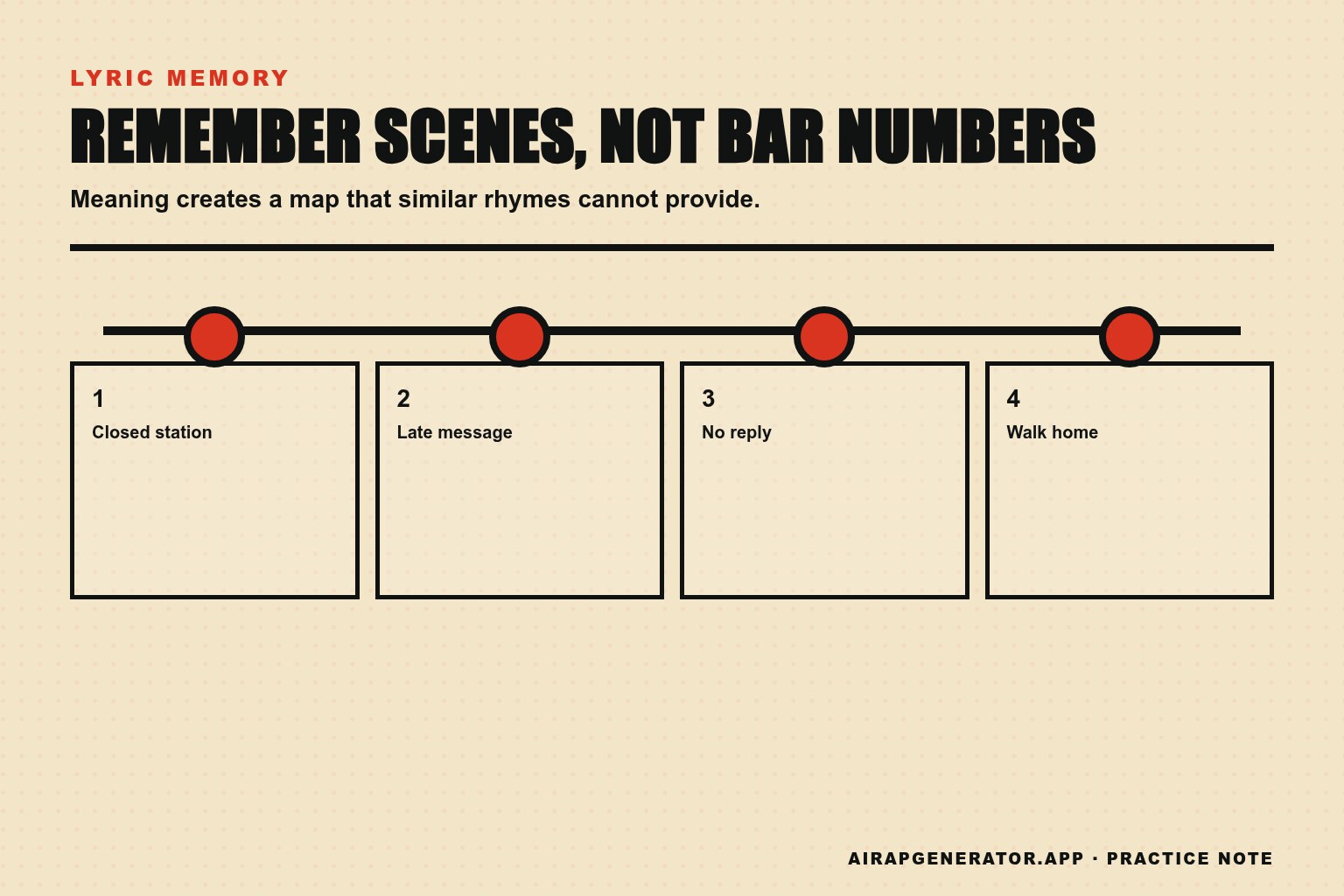
- waiting outside a closed station;
- noticing a message that arrived too late;
- deciding not to answer;
- walking home with a different plan.
Those are four scenes. A scene gives the brain a place, action, and direction. “Bars five through eight” gives it arithmetic.
Write a two- or three-word label beside each scene: closed station, late message, no reply, walk home. Cover the lyrics and retell the four labels in order. Do not move on until the story can be recalled without rhyme.
Why meaning comes before sound
Rhyme is an excellent cue inside a line but a poor map of the whole verse. If three end words belong to the same sound family, remembering one can summon the wrong bar. The story labels tell you which similar-sounding line belongs here.
2. Mark the entrance word for every scene
Most blanks happen at transitions. The rapper remembers the middle of each section but cannot find the first word that opens it. Create a separate list containing only the entrance word or phrase for each scene.
For the example above, the list might be:
- Last train
- Screen lit
- Thumb froze
- Sun up
Say the four entrances in order, then in reverse, then in random order while naming the scene each opens. This feels detached from performance because it is. You are building handles.
Keep the entrance short. A full first line becomes another piece to memorize; two vivid words are enough to retrieve it.
3. Speak the rhythm without the exact words
Now protect the flow from the memory task. Put on the beat and perform the verse using placeholder sounds wherever a word disappears. Keep the entrances, stressed syllables, pauses, and bar lengths.
For example:
Last train / da-da by the gate
Rain hit / da-da-da / running late
Do not stop to repair the missing word. Stopping teaches the body that an error ends the performance. Placeholder sounds teach it that time continues.
Build the rhythm skeleton
On a clean copy of the lyrics, mark:
- stressed syllables in bold;
- planned breaths with a slash;
- full-beat gaps with a double slash;
- the rhyme family with a light underline or color.
Then look only at the marks and speak the rhythm. The goal is not perfect notation. It is a visual cue showing that the line has a shape beyond its text.
4. Learn by expanding chains
The familiar method of repeating bar one until it sticks creates a strong first bar and weak transitions. Use expanding chains instead:
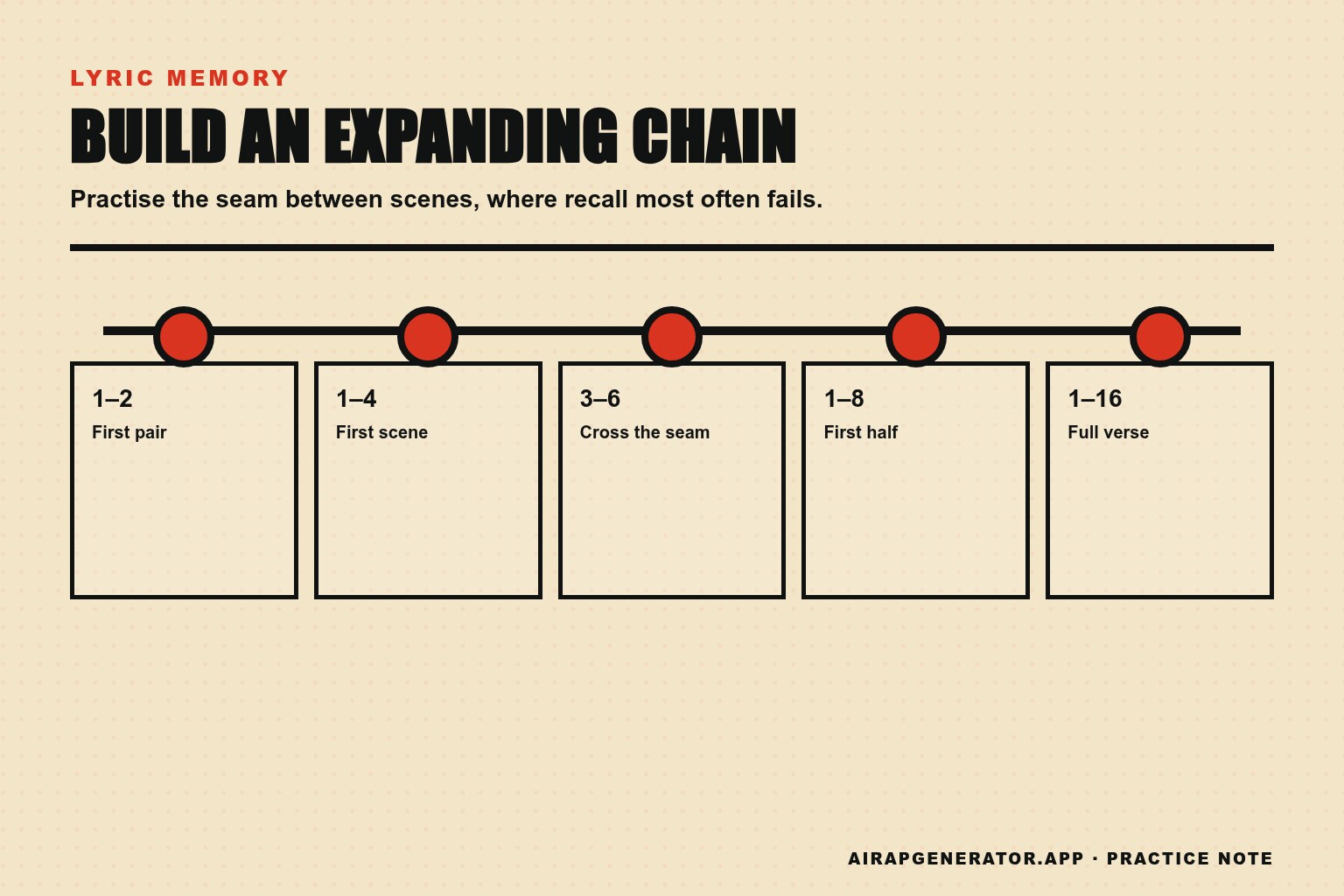
- Perform bars one and two from memory.
- Add bars three and four.
- Return to bar one and perform all four.
- Learn the next scene separately.
- Join the last two bars of scene one to the first two bars of scene two.
That fifth step is the important one. It rehearses the seam, which is where memory usually fails.
Use the table as a progress sheet:
| Chain | Attempts without stopping | Ready to expand? |
|---|---|---|
| Bars 1–2 | 3 | Yes / No |
| Bars 1–4 | 3 | Yes / No |
| Scene 1 into scene 2 | 3 | Yes / No |
| First eight bars | 2 | Yes / No |
| Full verse | 2 | Yes / No |
Three perfect repetitions are not magic. They simply prevent one lucky run from being mistaken for learning.
5. Test recall away from the page
Memory becomes dependable when it survives a change of context. After the first clean run, turn off the screen and perform in a different position. Stand if you were sitting. Face away from the desk. Use a quieter version of the beat.
Then run four tests:
- Cold start: begin from the first line with no read-through.
- Middle start: begin at scene three.
- Silent start: count one bar internally, then enter without a spoken count-in.
- Distraction start: wait two minutes while doing something simple, then perform.
The middle start is the best truth detector. If you can only reach scene three by reciting everything before it, you know one long chain rather than four accessible sections.
Do not peek after one second of hesitation. Give yourself five seconds, name the scene label, and try the entrance word. Only then uncover the line.
6. Rehearse a recovery route
Stage memory is not the absence of blanks. It is the ability to keep the song moving when one happens.
Choose one recovery option for each scene:
- repeat the previous complete line;
- hold the last word for a beat;
- use a prepared neutral phrase;
- jump to the entrance of the next scene.
The neutral phrase must fit the song and should not pretend to be profound. Something like “still moving, let it ride” is useful because it preserves time. Write your own phrase and practice it intentionally; an unplanned filler can lead to a second blank.
Practise the mistake on purpose
During one run, stop yourself at a random bar. Do not restart. Use the recovery route and re-enter at the next known landmark.
This changes the emotional meaning of a blank. Instead of becoming proof that the verse is lost, it becomes a rehearsed event with a next action. That reduction in panic often makes the original line easier to retrieve.
7. Space the recalls across three days
One long rehearsal improves short-term access. Spaced recalls reveal whether the verse is still available after attention moves elsewhere.
Use this schedule:
| Time | Test | Rule |
|---|---|---|
| End of session | Full verse with beat | No screen |
| 20 minutes later | Speak scenes and entrances | No beat |
| Before sleep | One quiet full run | Do not drill errors for an hour |
| Next morning | Cold start | Check only after completing the attempt |
| Next evening | Performance-energy run | Stand and use the real instrumental |
| Day three | Record one take | Keep moving through mistakes |
Short, difficult recall is more informative than another comfortable read. The point is not to punish yourself; it is to ask the brain to produce the verse rather than recognize it.
Sleep, breaks, and ordinary life between attempts are part of the test. If the verse survives them, it is becoming available outside the rehearsal bubble.
8. Run the seven passes in order
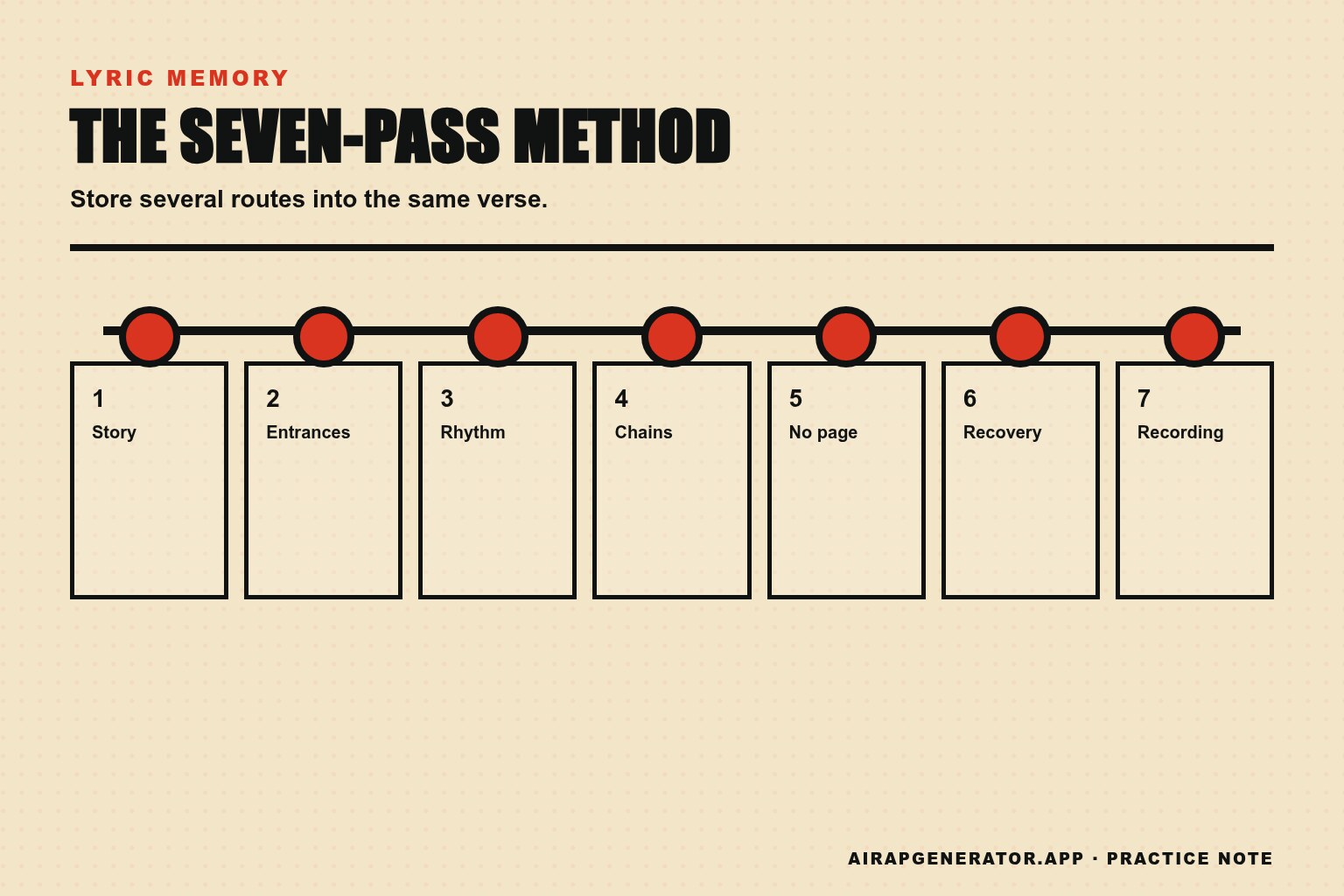
Here is the complete first session:
- Story pass: label each scene and retell the sequence.
- Entrance pass: memorize the first phrase of every scene.
- Rhythm pass: keep time with placeholder sounds.
- Chain pass: expand from two bars and rehearse every seam.
- No-page pass: change position and remove visual cues.
- Recovery pass: force one blank and continue on purpose.
- Recording pass: capture a full take, then write the exact failure points.
Limit correction after the recording to three spots. Return to the smallest chain containing each spot, fix it, and then run the whole verse once. Endless full-song repetitions are tiring because fifteen secure bars do not need the same attention as one unstable seam.
When the words are your own, revise any line that repeatedly refuses to stick. A memory problem can be a writing signal: the image may be vague, the sentence may be unnatural, or the rhythm may fight normal speech. A memorable line usually has a clear action, a strong sound, or a surprising turn. Give the weak line one of those.
What to do when one line never stays
Diagnose the failure before adding repetitions.
| Failure | What it suggests | Fix |
|---|---|---|
| You know the thought but not the wording | Wording is generic | Replace one verb or object with a concrete one |
| You enter the line late | Previous breath is misplaced | Move the breath earlier |
| You jump to a similar rhyme | Rhyme is overriding the story | Say the scene labels before the chain |
| You forget after a long pause | Entrance cue is weak | Choose a more visual two-word entrance |
| You only remember while reading | Recognition is doing the work | Increase no-page cold starts |
| You blank when recording | Attention shifts to performance | Record low-stakes daily takes |
The solution is not a heroic number of repetitions. It is multiple routes into the same verse. Meaning tells you where you are, entrances start each section, rhythm carries partial recall, and recovery keeps one lost line from taking the rest with it.
Scale the method from one verse to a full song
For a full track, treat each song section as a large scene. Give the intro, first verse, hook, second verse, and outro their own labels. Then make a second entrance list containing the first phrase after every transition.
Hooks need a different test from verses. Because the words repeat, familiarity arrives quickly, but small differences between repetitions can become traps. Decide whether both hooks are identical. If the second contains one changed line, mark that change prominently and practise the two bars before and after it as one chain.
Run the full song with reduced lyrics rather than a complete page. A useful cue sheet might contain only section names, entrance phrases, and one danger word beside each transition. The gradual reduction can look like this:
- full lyrics with scene boundaries;
- first line of every four-bar scene;
- two-word entrances only;
- section names only;
- blank page.
Do not remove a level because the previous run felt easy. Remove it after a cold start succeeds. For a live set containing several songs, randomize the order during rehearsal so the opening of one track is not dependent on always following the same previous track.
Finally, rehearse the spoken moments around the music: the count-in, an introduction, the pause before the instrumental starts, and what happens after the last line. Memory often fails where the practised object begins or ends because those edges received no cues.
Frequently asked questions
Should I memorize lyrics with or without the beat?
Use both. The beat stores timing and entrance cues; no-beat recall proves the words are not attached to only one audio context. Learn the story without music, build rhythm with the beat, then test cold recall in both conditions.
Is it better to write lyrics by hand?
Handwriting can slow the first pass and make you notice structure, but it is not required. The useful part is active reconstruction: writing scene labels or entrance words from memory. Copying the full verse while looking at it is still recognition-heavy.
How many times should I repeat a verse?
Count successful recalls of specific chains rather than total repetitions. Three clean two-bar runs, three clean four-bar runs, and two full no-screen performances provide more information than twenty read-alongs. If the same seam fails, isolate it.
What if I change a word every time?
Decide whether the exact wording matters. For a recorded song or coordinated performance, mark the chosen word and drill the surrounding two bars. For a loose freestyle or solo rehearsal, a consistent meaning and rhythm may be enough. Do not call variation a failure when the format allows it.
Three things you can stop worrying about
Repeating the whole verse a huge number of times. Short cold recalls expose the unstable seam faster.
Keeping the lyric sheet until every word feels certain. Removing visual cues in stages is how recall becomes independent.
Never blanking. A practised recovery route protects the rest of the verse when one entrance disappears.
The short version
The reliable method for how to memorize rap lyrics is to learn the story, scene entrances, rhythm, expanding chains, no-page recall, recovery, and one complete recorded take.
Keep reading
- How to improve rap flow once the words are secure enough to vary the pocket.
- How to win a rap battle for recovery tactics when a live line disappears.
- How to write rap lyrics for revising lines that remain hard to say or remember.