How to Improve Rap Flow: A 20-Minute Timing Practice
Improve rap flow by separating pocket, stress, syllable count, and breath. This practical routine turns one stiff verse into several controlled deliveries.
A stiff flow is rarely caused by a lack of rhythm. More often, the rapper is trying to solve too many things at once: remember the words, hit the rhyme, sound confident, breathe, and stay near the drums. The result is a delivery that follows the beat without ever settling into it.
If you have been searching for how to get better flow while rapping, start by making the job smaller. Keep one eight-bar verse and one beat. Change only one variable per pass. That turns flow from a mysterious talent into a set of choices you can hear, compare, and repeat.
This is a twenty-minute practice built around that idea. It does not promise a signature style in one session. It gives you a clean way to find which part of your timing is holding you back.
1. Separate flow from speed
Flow is the pattern made by stressed syllables, pauses, phrase lengths, and the places where your voice meets or avoids the drums. Speed is only how quickly the syllables arrive. A fast verse can have a flat flow, and a slow verse can move through several pockets in four bars.
Say this original line at a steady pace:
Late bus, rain on the glass, name in the steam.
Now stress late, rain, glass, name, and steam. Then stress bus, on, the, and in instead. The words and tempo remain the same, but the line leans differently. That change is flow.
Before trying to rap faster, make one line feel convincing at half energy. If it still sounds stiff, more speed will hide the problem for a moment and make it harder to diagnose.
The four controls you are actually moving
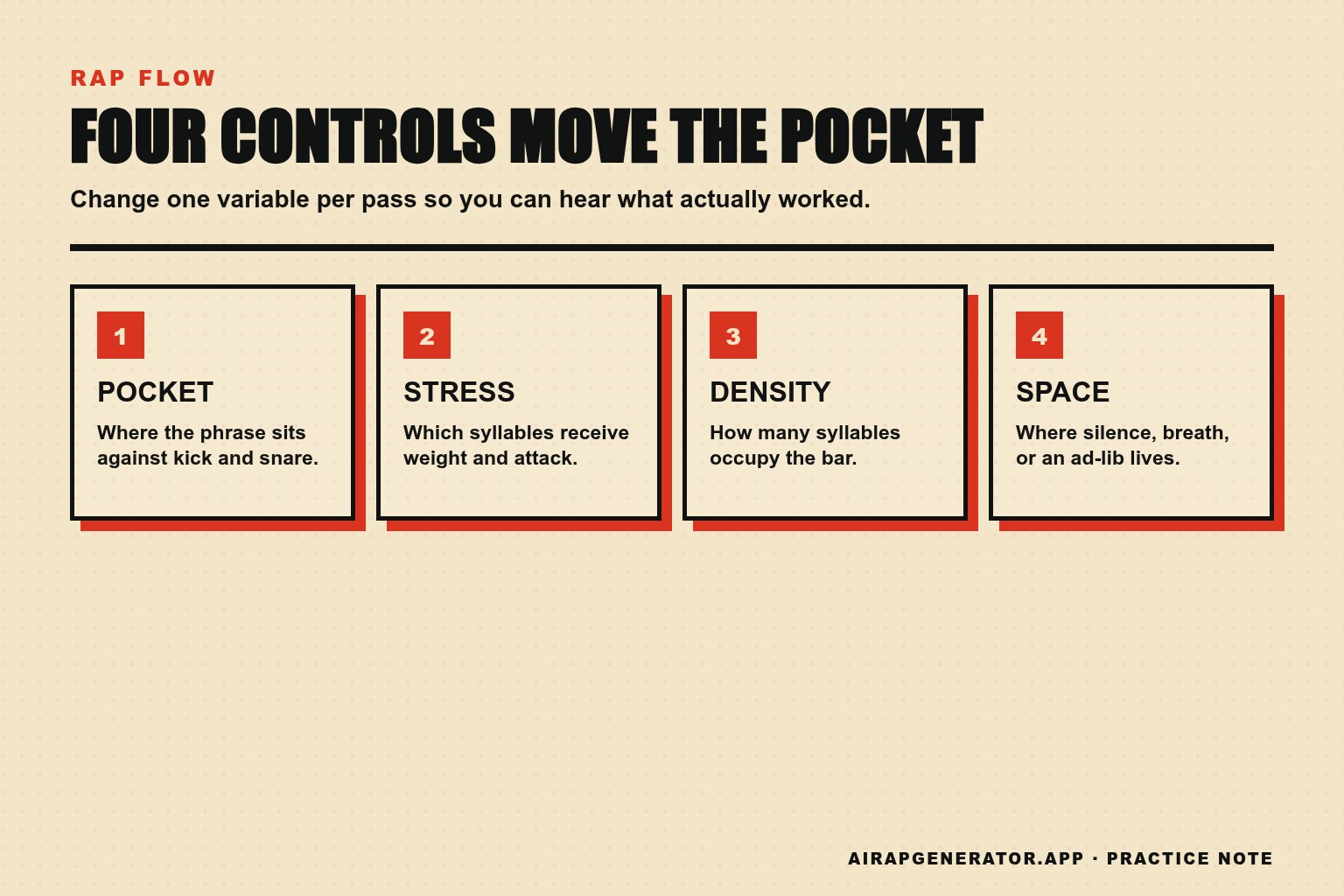
Think of a delivery as four separate controls:
- Pocket: where the phrase sits relative to the kick and snare.
- Stress: which syllables get weight.
- Density: how many syllables occupy the bar.
- Space: where you stop, breathe, or let an ad-lib answer.
You can change any one without changing the other three. That is the basis of the whole practice.
2. Mark the drum anchors before the words
Loop four or eight bars of an instrumental. Do not rap yet. Tap the main snare with one hand and the kick with the other. You do not need to identify every percussion sound; you need two dependable landmarks.
Next, speak a neutral phrase such as “one more time, let it land” over the loop. Put one on a kick and land on a snare. Repeat until those two contacts feel automatic. Then move the phrase slightly late, so the consonant arrives just after the drum. Finally, try it slightly early.
The goal is not to discover one correct placement. It is to feel three placements on purpose:
| Placement | What it feels like | Common risk | Useful for |
|---|---|---|---|
| On the drum | Direct and stable | Mechanical repetition | Clear openings and hooks |
| Just behind | Heavy and relaxed | Dragging out of time | Conversational or laid-back verses |
| Just ahead | Urgent and tense | Rushing the next bar | Builds and aggressive passages |
Record all three. What feels late in your body may sound comfortably behind the beat on playback. Your first judgment while performing is useful, but the recording is the evidence.
Text timing needs to follow those vocal entrances too. When preparing a lyric presentation, use the rap lyric-video worksheet to mark the voice separately from the beat grid.
3. Reduce the verse to rhythm sounds
Take the first two bars of your verse and replace every word with a neutral sound. “Da” is fine. Keep the same number of syllables and the same stresses:
DA-da-da / DA-da / da-DA / DA
This can feel childish, which is why people skip it. It is also the fastest way to find out whether the rhythm works independently of the meaning. If the pattern feels awkward without words, rewriting synonyms will not rescue it.
Build a three-pass rhythm test
Perform the pattern three ways:
- Pass A: every stressed sound meets a drum.
- Pass B: the first stress meets a drum, then the phrase drifts between them.
- Pass C: remove one sound and replace it with silence.
Keep the version that makes your head move before you remember what the lyric says. Then restore the words. You may find that one word refuses to fit the winning pattern. That word is now an editing problem, not a vague flow problem.
4. Cut syllables before adding technique
Crowded writing makes a rapper sound late even when the internal clock is accurate. The mouth is forced to squeeze the final phrase into the remaining space, so the next bar begins with a recovery instead of an intention.
Use a ruthless first edit. Circle the stressed words that carry the image or action. Everything else has to justify its place.
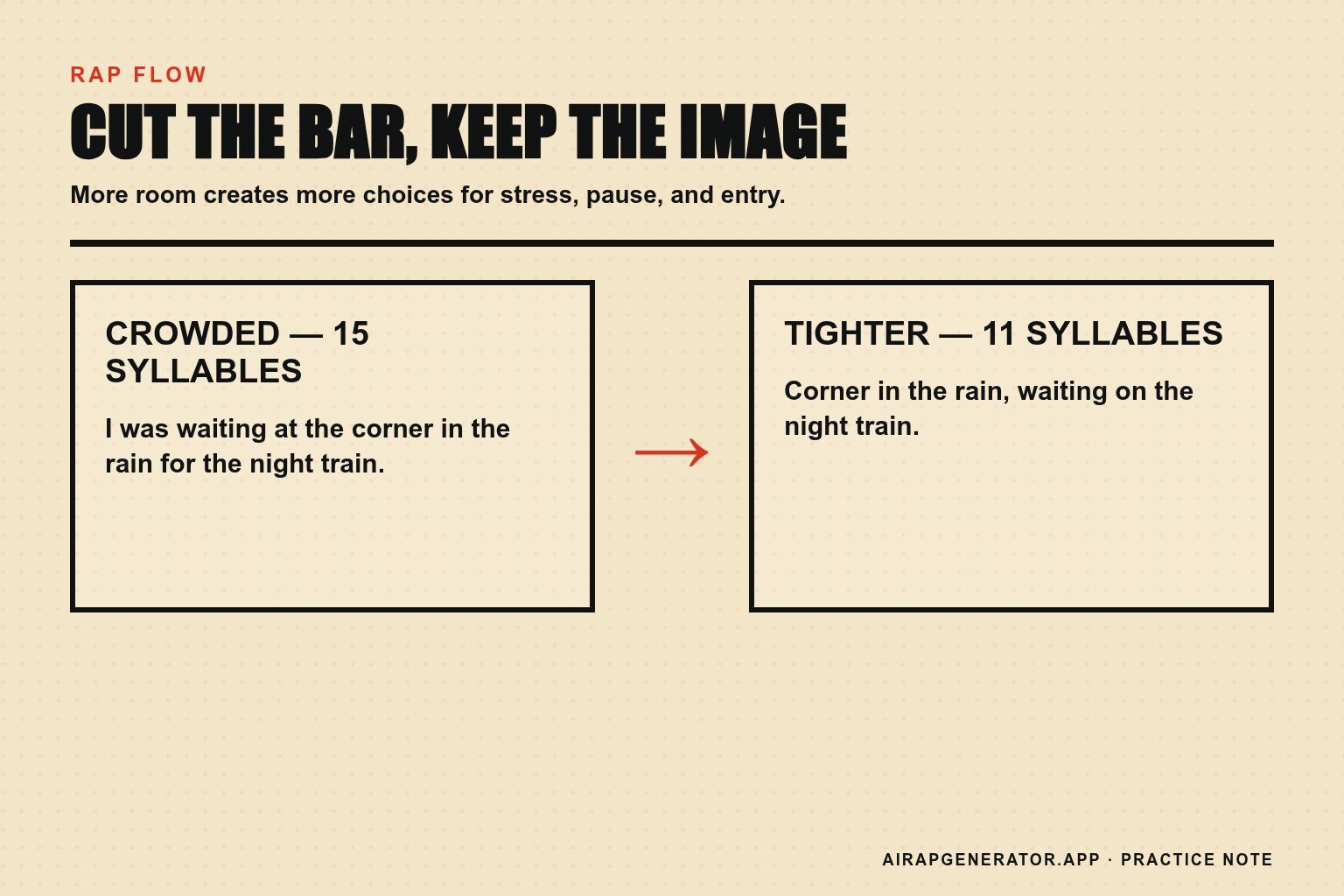
Original draft:
I was waiting at the corner in the rain for the night train.
Tighter draft:
Corner in the rain, waiting on the night train.
The first line has fifteen spoken syllables in a natural reading; the second has eleven depending on how you say “waiting.” More importantly, the second leaves choices. You can stretch rain, pause before waiting, or push night train across the bar line.
Do not cut every line to the same length. Uniform density is another kind of stiffness. Cut enough that you can choose where the pressure goes.
5. Move one stress in every second bar
A common beginner pattern puts the strongest word at the end of every line. It creates dependable rhymes and predictable motion. After four bars, the listener knows exactly when each thought will land.
Keep the end rhyme, but move the loudest moment earlier in bar two. Here is a deliberately simple pair:
I kept the ticket from the train that never came
Red ink on my thumb, but I still wrote the name
The end words still answer each other. The second bar gains a new center because thumb carries the strongest attack. Try the pair again with still as the stress. The meaning barely changes; the movement does.
For an eight-bar verse, mark one unexpected stress in bars two, four, six, and eight. That is enough variation to stop the verse marching without turning every line into a trick.
6. Use silence as a written part
Most weak flow advice focuses on where to put more syllables. Better flow often comes from deciding where a syllable will not go.
Write a slash wherever you will leave a short gap and a double slash for a full-beat pause:
Door clicked / hall dark // keys in my fist
Perform it without filling the gaps with “yeah,” “uh,” or a repeated word. The silence should survive. If it feels exposed, that is useful: exposed space reveals whether the next entrance is confident and in time.
Three places where a pause earns its keep
Use a pause when it does one of these jobs:
- Before the image: the gap makes the concrete word arrive larger.
- After the punch: the listener gets time to understand it.
- At the breath: the next phrase begins controlled rather than desperate.
Do not scatter pauses randomly. A pause without a job sounds like forgotten lyrics. Mark it in the text and repeat it in the same place three times; consistency turns hesitation into arrangement.
7. Change pocket without changing the lyric
Now perform the same four bars in three pockets. This is the part most directly connected to building range.
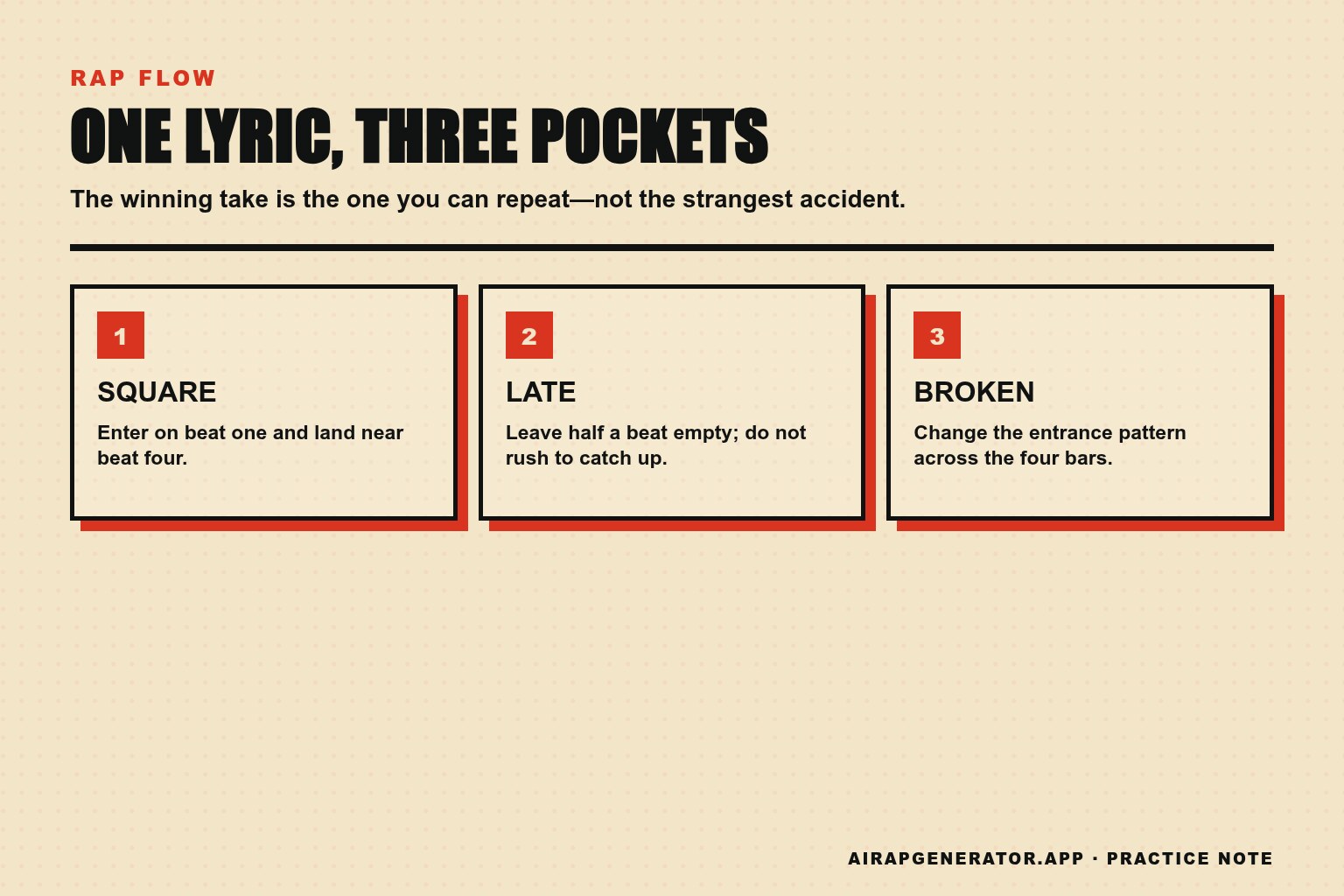
Square pocket: begin each line on beat one and land the rhyme near beat four. This is your control version.
Late pocket: leave the first half-beat empty and enter after beat one. Do not speed up to catch the bar; let the final word cross the line if necessary.
Broken pocket: start bar one normally, begin bar two early, and leave the opening of bar three empty. The asymmetry is the exercise.
Record each as a separate file and name it. “Take 1, take 2” is not enough; use “square,” “late,” and “broken.” Listen without looking at the waveform. Score each take from one to five on clarity, movement, and control.
| Take | Clarity | Movement | Control | Keep? |
|---|---|---|---|---|
| Square | ||||
| Late | ||||
| Broken |
The most interesting take is not automatically the best. A pocket you cannot repeat is an accident. Keep the version you can perform three times with the same entrances.
Once a delivery is settled, rehearse against that same recording before filming. The rap music-video shot plan explains how to capture a continuous performance and check alignment before adding detail shots.
8. Run the complete twenty-minute session
The drill works because it has a clock. Without one, people polish the first bar until the practice turns back into writing.
Use this sequence:
- Minutes 0–2: tap the kick and snare; say no lyrics.
- Minutes 2–5: speak the verse as rhythm sounds.
- Minutes 5–8: cut any line that forces a rushed ending.
- Minutes 8–11: mark alternate stresses in every second bar.
- Minutes 11–14: add two intentional pauses.
- Minutes 14–18: record square, late, and broken pockets.
- Minutes 18–20: choose one take and write one reason.
That last reason matters. “Take two is better” teaches you nothing. “The late entrance makes the first image clearer, but bar four drags” gives you the next session.
Repeat the routine for five days with the same verse before changing material. Familiar words remove memory from the task, which lets timing become the only variable. On day six, use a new verse and see which choices transfer.
The direct answer is to record controlled variations of the same short passage, keep the one you can repeat, and name why it works. Randomly trying harder produces energy; comparison produces control.
A quick diagnosis when the flow still feels wrong
Use the symptom, not your mood, to decide what to change.
| What you hear | Likely cause | Next edit |
|---|---|---|
| The last words get crushed | Too many syllables | Cut setup words before changing tempo |
| Every line lands the same | End-heavy stress | Move one strong word into the middle |
| The verse sounds nervous | No planned space | Mark a full-beat pause after a complete thought |
| The delivery sounds sleepy | Stress is too even | Exaggerate two consonants per bar |
| The take changes every time | Pocket is not learned | Loop two bars and repeat one entrance |
| The words work but the take does not | Performance issue | Stand, project, and record farther from the screen |
Flow improves fastest when the diagnosis is narrow. “I sound bad” gives you no next move. “I rush the last four syllables of bar six” gives you one.
Frequently asked questions
How long does it take to improve rap flow?
You can make one verse noticeably more controlled in a session because cutting syllables and moving stresses have immediate effects. A flexible personal style takes longer because it depends on repeating those choices across different beats. Measure progress by repeatability, not by days: if you can deliver the same pocket three times, it is becoming a skill.
Should I copy another rapper's flow to practise?
Copying a short rhythmic pattern can teach placement, especially if you replace every word and use a different beat. Do not build a full track around an identifiable cadence. Treat imitation like tracing letters: useful for learning the motion, temporary by design.
Do I need music theory?
No. You need to hear a repeating count of four, identify a few drum anchors, and compare recordings. Theory can give names to what you notice later, but it is not the entrance fee.
The useful test is practical: mark the count, predict the landing, record the line, and check whether the stressed word arrived where you intended.
Can a lyrics analyzer hear my flow?
Not from text alone. Written analysis can spot density, rhyme placement, repeated sentence shapes, and likely stress problems. It cannot hear whether you enter late, swallow a consonant, or run out of breath. Use the notes to revise the page, then use a recording to judge the performance.
Three things you can stop worrying about
Rapping faster. Speed can hide a weak pocket. Control one slow passage before raising the tempo.
Using complicated rhymes in every bar. A clear stress pattern and intentional silence can create more movement than another internal rhyme.
Finding one perfect take. The useful take is the version you can reproduce and explain, not a lucky performance you cannot repeat.
The short version
The practical answer to how to get better flow while rapping is to separate pocket, stress, density, and space; change one at a time; then compare recordings of the same eight bars.
Keep reading
- How to write rap lyrics when the problem begins with crowded lines.
- How to memorize rap lyrics when remembering the verse is stealing attention from timing.
- How to write your first rap song when the verse works alone but not inside a full arrangement.