How to Write Your First Rap Song: 8 Steps to a Full Track
How to write your first rap song from nothing: pick the beat first, map the sections before filling them, write the hook before the verses, and know when it is done.
There's a folder on almost every beginner's phone with eleven half-verses in it and no songs. Every one of them stops somewhere around bar twelve, and the reason is always the same: they were started as writing, not as a song.
A verse is a piece of writing. A song is a container with a shape, a length, and a place where the repeated part goes. If you build the container first, sixteen bars stop being an endurance test and become a slot you have to fill.
Here's how to write your first rap song in the order that gets you to the end of one.
1. Get the beat before you write anything
Writing without a beat feels productive and puts you in a hole. Words written in silence carry a rhythm you invented in your head, and when a real beat arrives underneath them, roughly half of them turn out to be the wrong length. Then you're editing something you were proud of an hour ago.
The beat comes first because it decides three things you'd otherwise be guessing: how fast you're talking, how many words fit before you run out of bar, and what the song is allowed to be about. A slow, heavy loop won't hold a bright song no matter how bright your writing is.
You don't need to buy anything for a first song. Free type beats are everywhere, and for one that will never be released, one of those is fine. Pick one you'd listen to for three minutes on its own — you're about to hear it four hundred times.
One thing to check before you commit
Play the beat and count "one, two, three, four" over it, out loud, at the speed that feels natural. That group of four is one bar, and everything in the rest of this article is measured in them.
Then keep counting to sixteen, four times through. If sixteen bars feels like it goes past in a blink, the beat is fast and your lines want to be shorter. If it feels like a long walk, you've got room. That's the whole test, and it takes forty seconds.
2. Learn the map before you fill it in
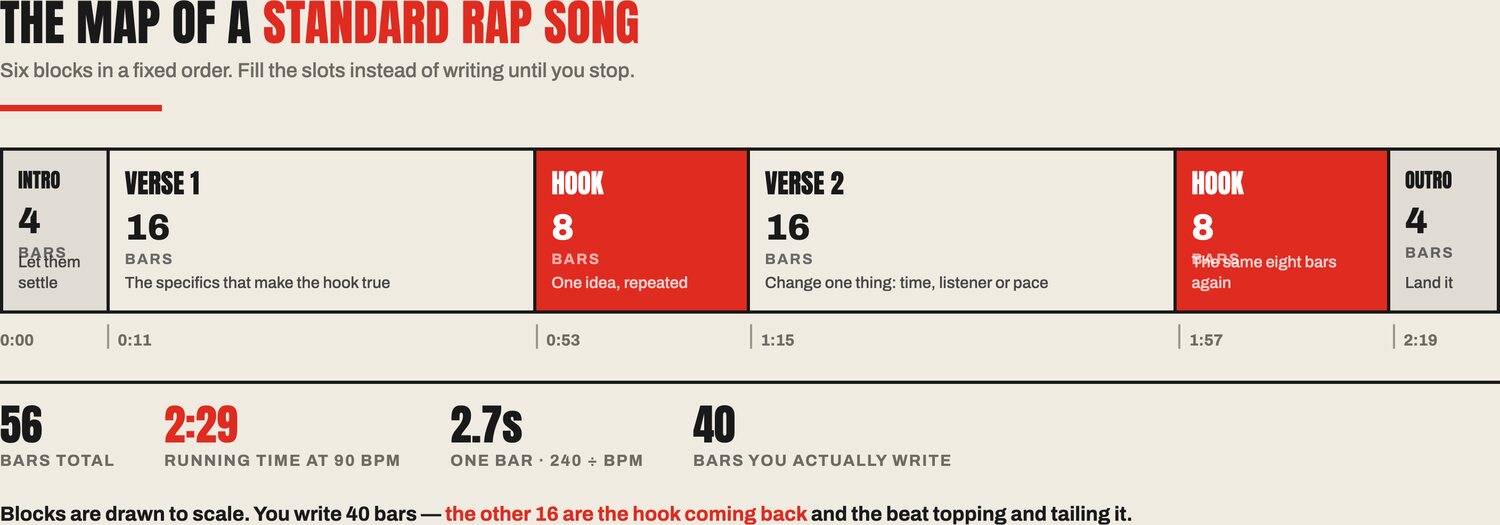
A rap song is not a continuous stream of talking. It's a handful of blocks in a repeating order, and the order is boringly standard on purpose — people need to know where they are in a song without paying attention.
Five blocks cover essentially everything:
- Intro — usually four bars, often just the beat playing with an ad-lib or a phrase over it. Its only job is to let the listener settle.
- Verse — sixteen bars, the part where the actual content lives. This is where you say things.
- Hook — eight bars, the repeated part, the one people remember. Also called the chorus.
- Bridge — eight bars that break the pattern, usually only in the third minute. Skip it on your first song.
- Outro — four bars to land the plane.
Put those in order and you have a song. The order almost every rap song uses is intro, verse, hook, verse, hook, outro — and that shape is already familiar to you from every song you've ever liked, which is exactly why it works.
How long that actually is
Bars convert to minutes, which is worth knowing before you write three verses and discover you've made a six-minute song nobody will finish.
One bar is four beats. So at 90 BPM, one bar takes 240 ÷ 90 = 2.7 seconds. Multiply by the number of bars and you have the running time.
| Structure | Bars | Length at 90 BPM | What it's for |
|---|---|---|---|
| Demo — verse, hook | 24 | 1:04 | Proving to yourself you can finish something |
| Two verses, no intro | 48 | 2:08 | A tight first song; nothing to hide behind |
| Standard — intro, verse, hook, verse, hook, outro | 56 | 2:29 | The default. Start here |
| Hook first, then two verses | 56 | 2:29 | When the hook is the strongest thing you have |
| With a bridge | 68 | 3:01 | A second song, once the shape is familiar |
At 140 BPM those same 56 bars run about 1:36, which is why fast songs tend to carry more sections. Work out the number for your beat once and write it at the top of the page.
The row to pick is the bolded one. Fifty-six bars is two sixteen-bar verses and some furniture — a real song, and small enough to finish this week.
3. Write the hook first
This is the step that separates people who finish songs from people who have eleven half-verses, and it's the one nobody does, because starting with the verse feels like starting at the beginning.
It isn't the beginning. The hook is the part the song is about. Verses written before the hook exists tend to wander toward whatever the last rhyme suggested, and then the hook has to somehow cover all of it. Verses written after the hook have a target — they only need to make the hook feel earned.
A hook has one idea in it. Not two. Whatever the song is about, the hook says that thing and then says it again.
Here's one written for this article, over an imaginary slow beat:
Same road, same rain, same time, I'm still here, I'm still here. Ain't moved a mile but I moved my mind, I'm still here, I'm still here.
Four lines, one idea, and half of them are the same three words. That repetition is not laziness — it's the entire mechanism. The repeated line is what a listener can join in with on the second play, and joining in is what "catchy" actually means.
Compare it with a hook that tries to carry information:
I been at the depot since the summer my brother left the city, and my mother keeps on saying that the money would be better if I finished up the course
Everything in there is true and specific and it would be perfectly good in a verse. As a hook it's unusable: you can't repeat it, you can't remember it, and by the second time round the listener has stopped trying.
Information goes in verses. Hooks hold one idea and repeat it. If your hook has two ideas in it, one of them is a verse line that wandered in.
A hook you can write in ten minutes
Say the thing your song is about in one plain sentence, like you're telling a friend. I haven't left this town and I'm okay. No rhyme, no craft, just the sentence.
Now cut it to under eight words and say it out loud over the beat until it sits in the bar comfortably. That's your repeated line. Write two more lines around it that lead into it, and you have four. Repeat the four and you have an eight-bar hook.
It'll feel too simple. Every hook you've ever loved is that simple; it just has a finished record around it.
4. Write verse one toward the hook
Now the verse has a job, which is a much easier thing to write than a verse with a blank brief. The job: get the listener to the hook believing it.
If the hook says I'm still here, verse one is what makes "still" mean something. The specifics that prove the sentence — the road, the shift, the year that didn't move. You're not arguing the point, you're just showing enough of it that the hook lands as a conclusion instead of a slogan.
Practically, that means the last line before the hook matters more than the rest of the verse. It's the handoff. Write it so the hook sounds like the natural next thing rather than an interruption:
Sixteenth of the month and the bus still comes, nothing in this town changed but some.
Then the hook arrives and it's already true.
For the line-level work inside those sixteen bars — how many syllables fit, where to put the rhymes, how to cut what doesn't land — that's a separate craft with its own moving parts, and how to write rap lyrics covers it properly. This article is about the container.
5. Make verse two change the song
After the first hook, the listener already knows the setting and the main claim. Give verse two one new job: expose missing evidence, raise the cost, answer a doubt or complete a choice. Write that job in plain prose before you reach for another rhyme.
That is enough for a first-song plan. If the page is still empty, the dedicated guide to why second rap verses get stuck has a turn map, an evidence inventory and seven checks for making the returning hook mean something new.
6. Say the whole thing out loud, over the beat, before you believe any of it
Everything up to here happened on a page. Pages lie. A line you can read fluently can be physically unsayable at tempo, and you will not find out until your mouth is doing it.
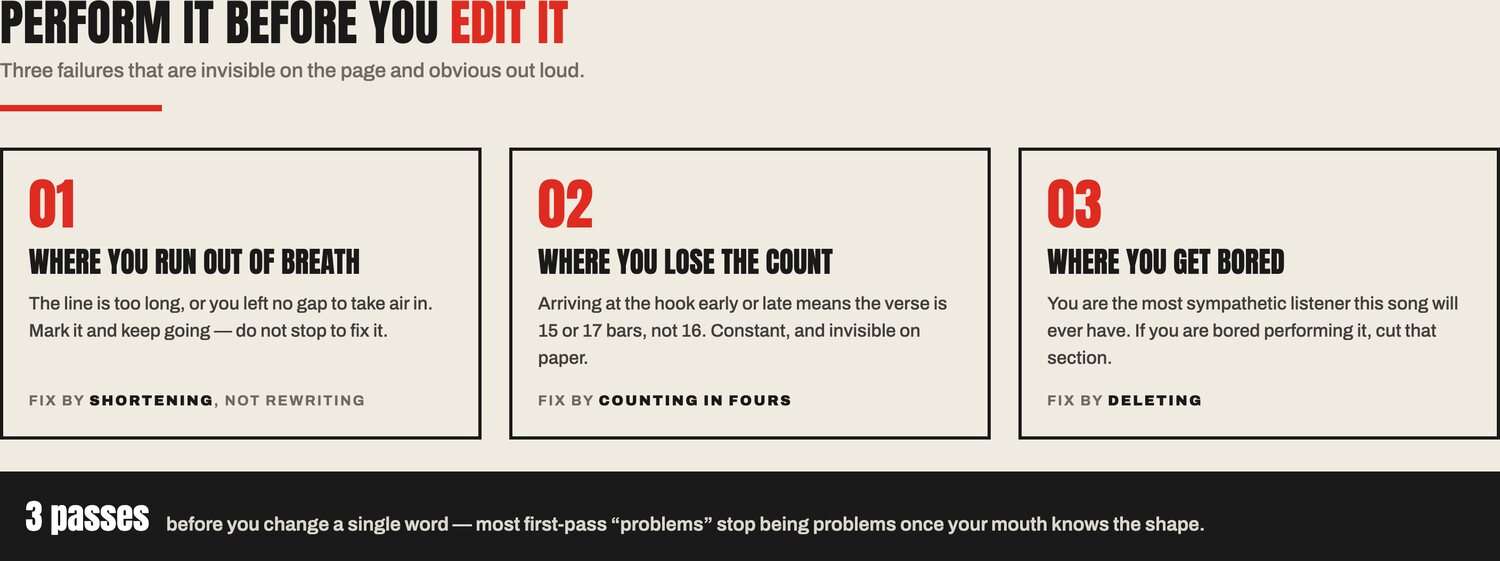
Play the beat and perform the whole song, start to finish, without stopping to fix anything. Standing up. You're looking for three specific failures:
- Where you run out of breath. That's a line that's too long, or a place where you didn't leave a gap. Mark it and move on.
- Where you lose the count. If you arrive at the hook a bar early or late, the verse isn't sixteen bars. It's fifteen or seventeen, which happens constantly and is invisible on paper.
- Where you get bored. If you're bored performing your own song, that's the section to cut. You're the most sympathetic listener it will ever have.
Do that pass three times before you change a single word. Most of what you'd have "fixed" after one run stops being a problem by the third, once your mouth knows the shape.
7. Record it badly, on purpose
Your first song should be recorded on your phone, in a room with soft things in it, standing up, in one take.
The reason is not that phone recordings sound good. It's that a song stays theoretical until it exists as a file, and people who wait for the right microphone are usually waiting for permission. A rough recording does two things a page can't: it tells you what the song actually sounds like at tempo, and it converts a document into a thing you've made.
You'll hate the first playback. Everyone does — partly because the song has problems, and partly because recorded voices sound wrong to their owners for reasons that have nothing to do with rap. Separate those. Listen once for how you feel, then throw that listen away and listen again with a pen, only for the three failures in step 6.
8. Decide it's finished
First songs don't usually get abandoned at the writing stage. They get abandoned at the polishing stage, where there's always one more line that could be better and no signal that says stop.
So define "done" before you get there. A first song is finished when:
- It has a hook, two verses, and a beginning and end that aren't abrupt.
- You can perform it start to finish without losing the count.
- There's no line in it you're embarrassed by.
Notice what isn't on that list: nothing about it being good. Your first song is not going to be good, in the same way a first anything isn't, and the value of it isn't the song. It's that the second one starts from a completely different place — you'll know what a hook does, you'll know what sixteen bars feels like, and you'll never again have to guess how long a song is.
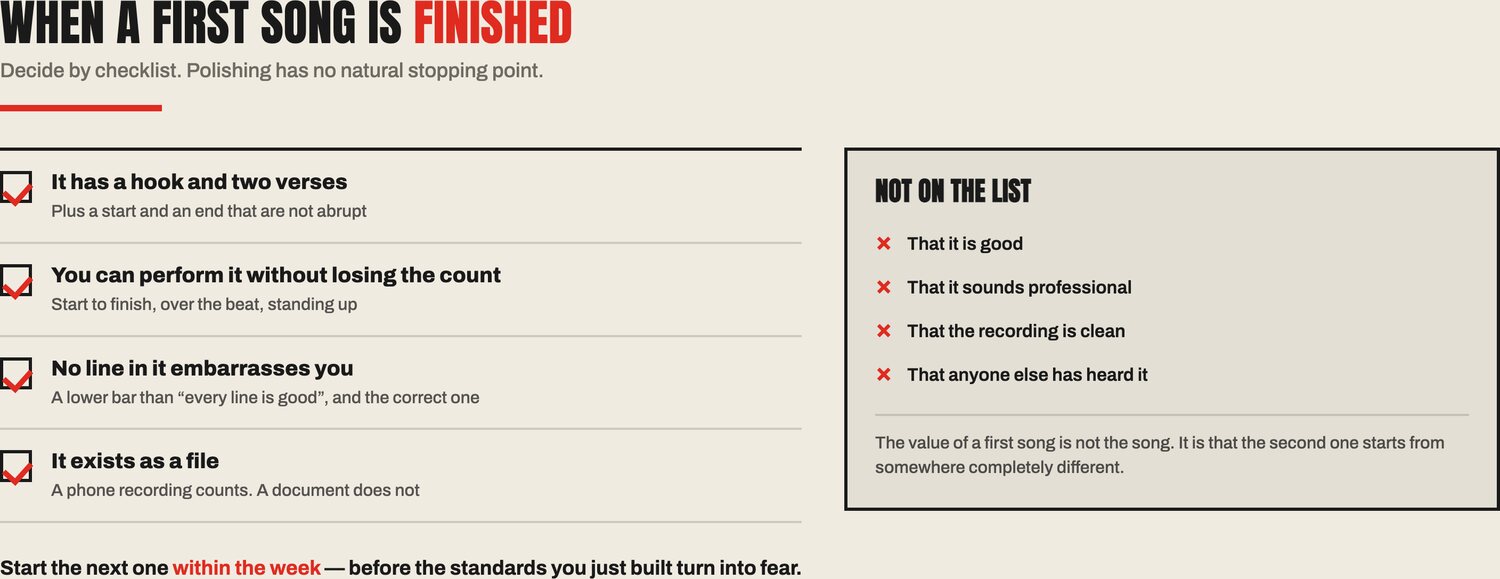
Then start the next one within the week, before the standards you just built have time to become fear.
Three things you can stop worrying about
Your voice. Beginners spend enormous energy trying to sound like someone with a deeper, rougher, more regional voice than theirs. It reads as costume immediately. Your actual speaking voice, saying things you'd actually say, is the only thing you have that nobody else does.
Equipment. A phone in a room with a duvet in it is a completely adequate way to make a first song. Everything you would buy instead is a way of postponing this one.
Whether the subject is big enough. Small subjects make better first songs than big ones. "Struggle" is a category and everyone's already written it. A bus at six in the morning is a scene, and scenes have objects in them that you can actually rhyme toward.
When a finished skeleton would help
Reading a completed structure is faster than imagining one. The rap lyrics generator turns one theme into two sixteen-bar verses and a hook, tagged by section — useful at this stage as something to write against, so you can see where the repeated part sits relative to the verses before you have built that instinct yourself.
If you've written a verse and can't tell whether it's working, rate my rap scores what you wrote and points at which lines are carrying it. And when the words are done and you want to hear the whole thing as an actual track rather than your phone recording, the rap generator turns lyrics into a song with a beat and vocals — which is the fastest way to hear whether your hook survives repetition.
The short version
So: how to write your first rap song, in the order that gets you to the end.
Pick the beat first and count a bar over it. Choose a fifty-six bar shape and write the number of minutes at the top of the page. Write the hook before anything else, with one idea in it and a line that repeats. Point verse one at the hook, then change one thing for verse two. Perform the whole song out loud three times before editing a word. Record it on your phone. Decide it's finished by a checklist rather than by feel.
The writing is maybe a third of that. The rest is the container — and the container is the part that turns eleven half-verses into a song.
Keep reading
- How to Write Rap Lyrics — the line-level craft that goes inside the container: syllables, rhyme families, and the cutting pass.
- Best Rap Battle Lines — four mechanisms that make a single line land, with twelve built on them.
- What Does MC Mean in Rap? — the job the title describes, and why some people still insist on the distinction.