Why Do Rappers Not Write Second Verses? 7 Fixes
Why do rappers not write second verses? The first verse uses the obvious material. These 7 moves turn what remains into a verse that changes the song.
The hook has looped for twenty minutes. Verse one is open in your notes, the first four bars of verse two have been deleted three times, and every new line sounds like a weaker version of something you already said. That is the real answer to why do rappers not write second verses: the first verse took the obvious material, while the second has to discover what the song has not done yet.
You do not need another sixteen facts. You need one change that makes the returning hook mean something different. The seven moves below are ways to find that change and turn it into bars.
1. Give verse two a job before you give it a rhyme
A first verse can survive on arrival. It introduces the voice, the room, the problem, the flex or the memory. A second verse arrives after the listener already knows all of that. If it only introduces the same thing again, the song stops moving.
Write a one-sentence job above the blank verse. Use a verb that changes the situation:
- reveal what the narrator hid;
- test the promise made in the hook;
- show the cost of the win;
- answer the accusation;
- make the small problem irreversible.
“Say more about the breakup” is a subject, not a job. “Show the moment I knew I would not go back” gives the verse somewhere to land.
Here is a four-line sketch. The first version adds description but leaves the song where it started:
Packed up the shirts from the side of the bed
Took down the photo and stared at the frame
Drove through the rain with your voice in my head
Every red light kept repeating your name
The second version performs a job: it reveals that leaving was not final.
Packed up the shirts, left the key by the sink
Made it three blocks, then I circled the lane
Parked by your window, went still in the rain
Watched your light die and I drove off again
The details are not automatically better. The movement is. At the start, the narrator may return. At the end, they do not.
2. Write the change between the hooks
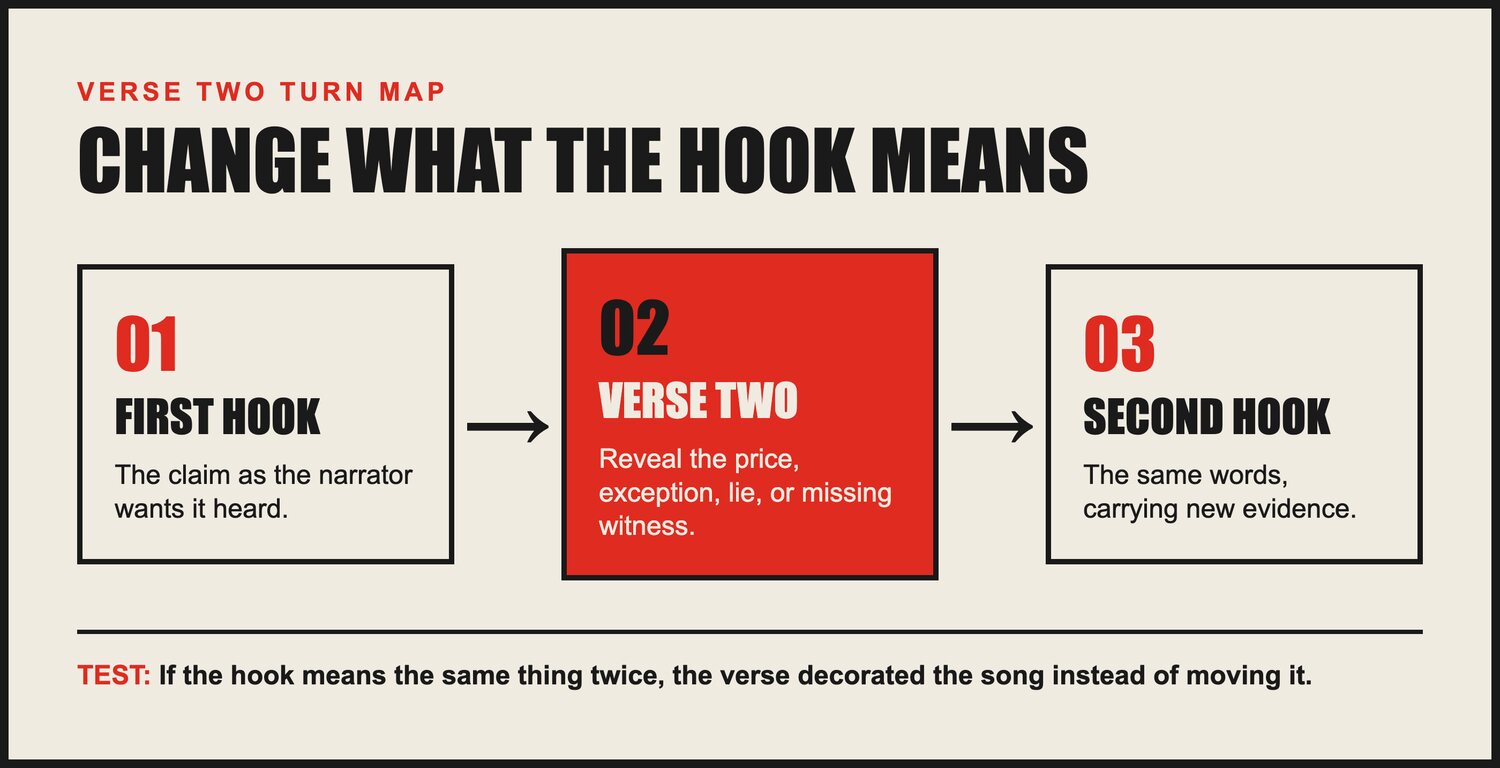
Copy the hook twice into a scratch document. Leave a gap between the copies. Then finish this sentence:
The first time the hook plays, it means ____. The next time it plays, it means ____.
That sentence is the map for verse two. If the hook says “I knew I would make it,” its first appearance might sound like confidence. After a verse about the friend who paid for the first studio session and never got to hear the record, the same hook can sound like a debt.
The useful question is not “What happens next?” It is “What does the listener understand differently next?” Plot can move while meaning stands still. A new club, a new car and a new city may be three fresh details that make the same point. One old voicemail can change the entire claim.
Use this small map before writing bars:
| Part | What the listener knows | What is still unstable |
|---|---|---|
| Verse one | The claim and the visible evidence | Whether the claim is true |
| First hook | The line as the narrator wants it heard | The price, exception or lie |
| Verse two | The missing evidence | How the narrator responds to it |
| Second hook | The same words with a changed meaning | Nothing essential |
If the last cell still contains the same uncertainty as the first, verse two has probably decorated the song instead of advancing it.
3. Move the camera, not just the calendar
Changing “now” to “five years ago” can work, but time is only one camera control. You can also change distance, witness or field of view.
Put the camera one foot away
Verse one says the apartment was tense. Verse two stays with one hand hovering above a send button. A close camera replaces summary with behavior.
Thumb on the message, the screen turning dim
Typed out “I miss you,” then changed it to “hey”
The line does not announce indecision. It lets the thumb perform it.
Give the camera to the other person
Do not impersonate their whole inner life. Show the one thing they could reasonably observe. A boastful first verse about touring can become a second verse seen by the sibling who keeps finding unopened mail at home.
Your name on the flyer is ten feet high
Your name on these envelopes fades by the door
The second camera creates friction without requiring a new event.
Pull the camera all the way back
A close first verse can widen into consequence. The narrator who stole one night to chase a dream can notice the people covering the shift, waiting in the car or making an excuse on their behalf. The song grows because the frame admits somebody else.
This is different from randomly switching perspective. The new camera must expose evidence the first camera could not see.
4. Make one line from verse one testify again
Choose the line in verse one that carries the largest claim. Copy it above verse two and interrogate it.
Suppose verse one ends:
I built this whole room, every brick got my name.
Verse two can test the line in at least four ways:
- proof: name one brick and what it cost;
- exception: identify the part somebody else built;
- consequence: show what maintaining the room now demands;
- reversal: admit the room has become a trap.
An answer might begin:
My brother laid wiring, I called it my light
My mother paid rent while I printed the claim
Now the first line remains in the song, but it can no longer be heard as uncomplicated self-reliance. That is development.
Do this with only one claim. Cross-examining every bar turns the second verse into annotations. One chosen line gives the verse a spine and leaves room for sound, surprise and momentum.
5. Build an evidence inventory before a rhyme list
Writers often open a rhyme finder when verse two stalls. That solves the final sound before it solves the missing thought. The result is a neat chain of words looking for a reason to exist.
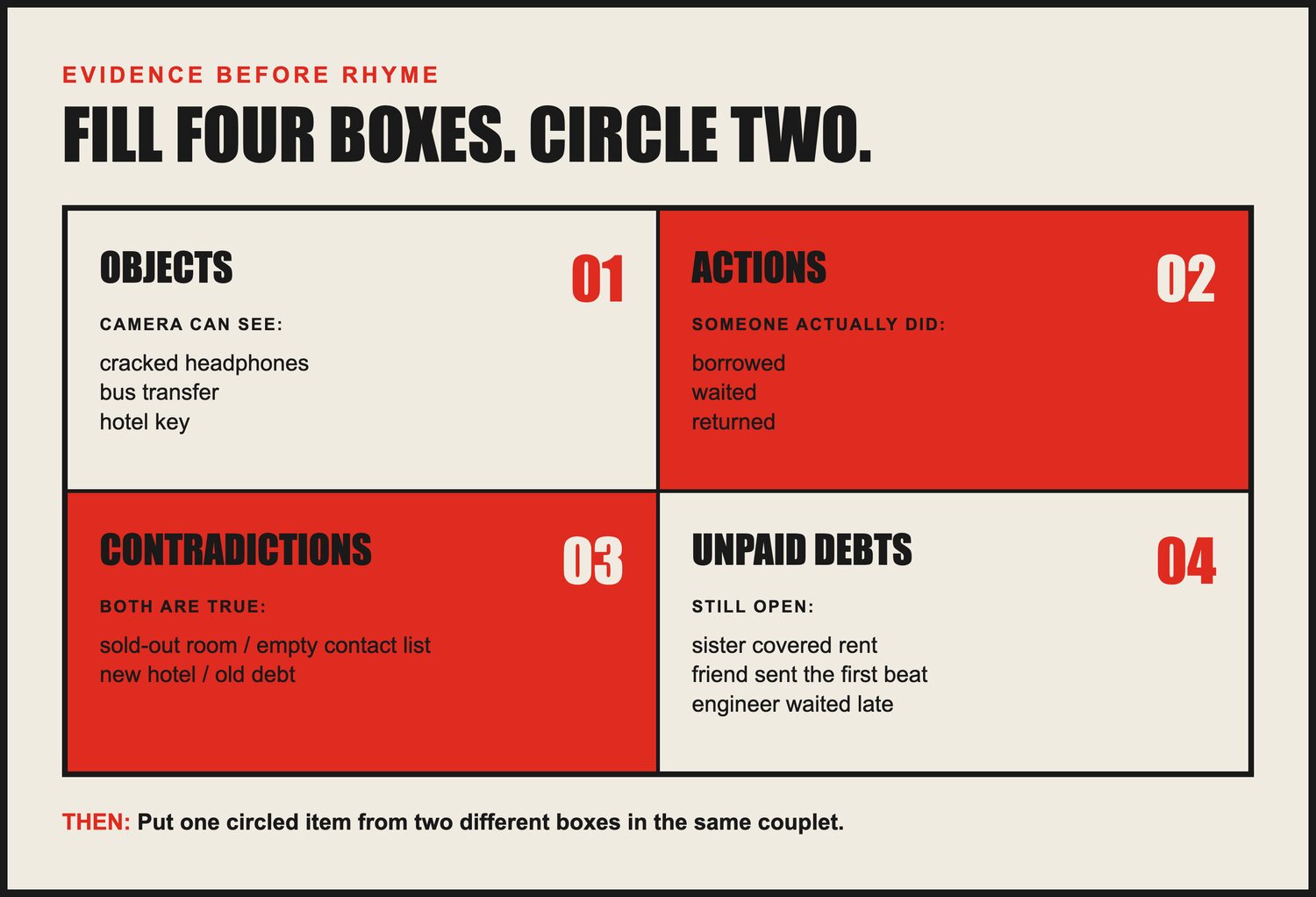
Instead, divide a page into four boxes and put two or three usable entries in each. Do not rhyme anything yet.
| Box | What goes in it | Example for a “made it” song |
|---|---|---|
| Objects | Things a camera could see | cracked headphones, bus transfer, hotel key |
| Actions | Verbs somebody actually did | borrowed, waited, returned |
| Contradictions | Two true things that do not sit easily together | sold-out room / empty contact list; new hotel / old debt |
| Unpaid debts | Help, harm or promises still open | sister covered rent; friend sent the first beat; engineer waited late |
Circle one item from two different boxes. Put them in the same couplet:
Hotel key shining, old bus pass in the case
Whole room knows the hook, I still owe you the tape
The rhyme is plain. The relationship between the objects does the work.
Once you have four useful couplet ideas, then gather rhymes. Build sound around evidence instead of using sound to manufacture evidence.
6. Draft the turn in prose, then break it into bars
The pressure to sound like rap can make an unfinished thought hide behind filler. Write the central turn as two ugly prose sentences first:
I kept saying I left because the town was too small. The truth is I left before anyone could decide I was not good enough.
That is not a lyric. Good. It tells you what the lyric has to preserve: the public reason, the private reason and the gap between them.
Now underline the load-bearing words: town too small, left first, decide, not good enough. Try a four-bar version without protecting the original grammar:
Said the town had no room, so I ran for the map
Truth is, I left while the verdict was blank
I feared they'd say no, so I chose not to ask
Called that fear courage and filled up the tank
The prose kept the logic honest. The bars added compression, rhythm and a final image.
If the bar draft loses the turn, return to the prose. Do not polish the rhyme scheme of a verse whose central sentence you can no longer state.
7. Make the last four bars earn the hook
The final quarter of verse two has a specific responsibility: it must point the ear back toward words the listener already knows. That does not mean quoting the hook early. It means finishing the change that lets the hook return.
For a sixteen-bar draft, label the last four positions:
- Result: what is true now?
- Choice: what does the narrator do about it?
- Image: what can the listener see at the moment of change?
- Hinge: which word, sound or idea opens the door to the hook?
Imagine the hook begins, “Still got miles to go.” The verse might close:
So I folded that letter and left it unread
Put the key in the dash where the old coins roll
Dawn caught the glass and it painted it red
I watched one town vanish — still got miles to go
The fourth line touches the hook, but the important work happens before it. The choice and image make the repeated words arrive with a consequence.
Do not save all four bars for a slogan. A closer without a completed turn feels like a trailer for a scene the verse forgot to include.
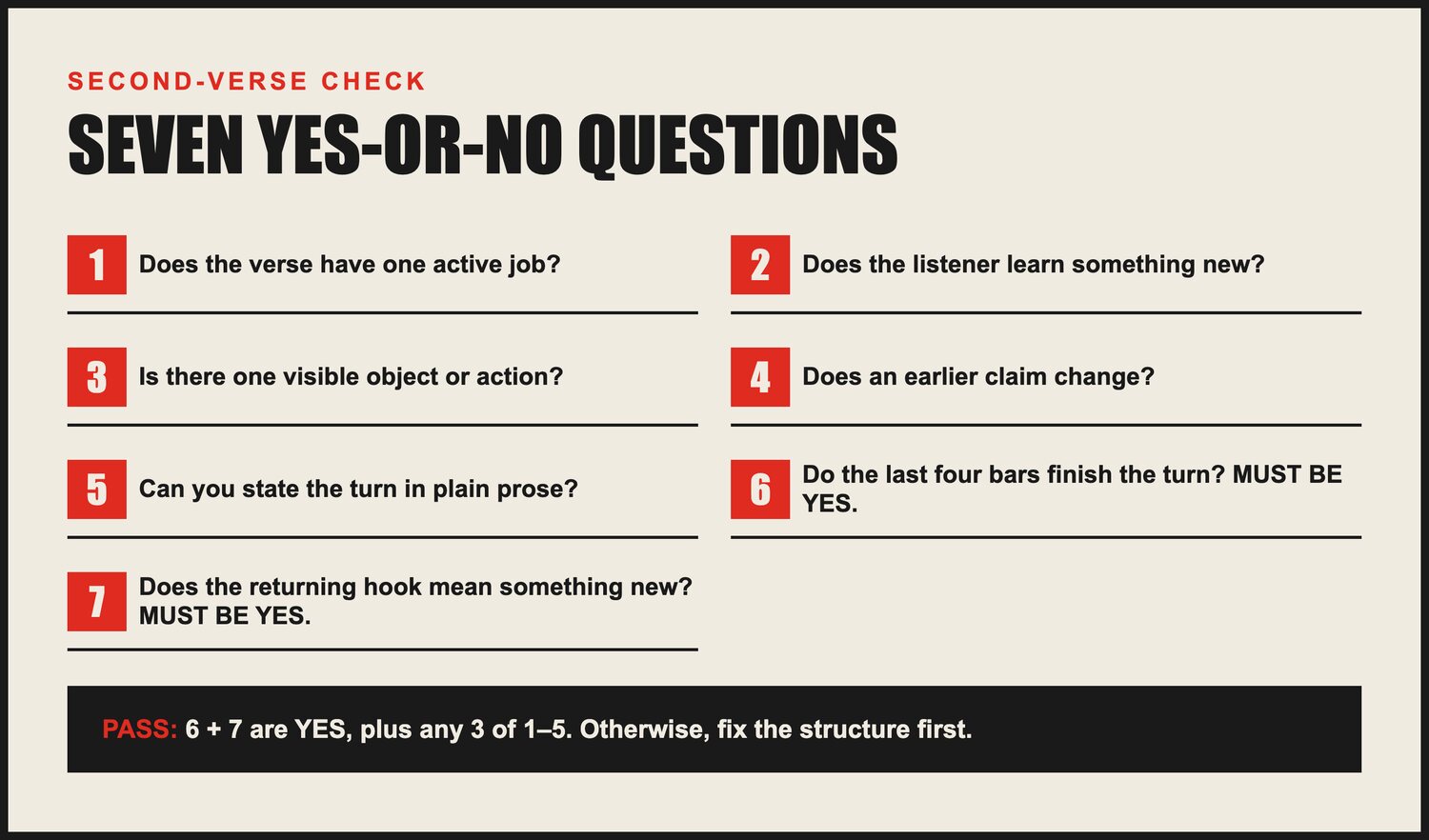
A seven-question second-verse check
Read the draft once without editing and answer yes or no:
- Can I state the verse's job with an active verb?
- Does the listener learn something unavailable in verse one?
- Is there one object or action a camera could capture?
- Does one earlier claim gain proof, cost, exception or reversal?
- Can I explain the central turn in plain prose?
- Do the final four bars complete that turn? This must be yes.
- Does the returning hook mean something new? This must be yes.
Questions six and seven are gates, not bonus points. Both must be yes, because an unfinished turn cannot deliver a changed hook. After that, look for at least three yes answers among questions one through five. That gives you five yes answers overall, including the two that prove the verse has actually arrived somewhere. If either gate is no, return to the turn map. If both gates pass but fewer than three supporting answers do, add visible evidence before polishing rhyme.
Three things you can stop worrying about
Making verse two better than verse one. Better is too vague to direct a draft. Ask it to reveal, test, answer or reverse one thing. A clear new job is enough.
Using a completely new flow. A changed rhythm can signal movement, but it cannot create movement by itself. Keep the cadence if it suits the beat. Change the evidence underneath it.
Saving an equal number of ideas for both verses. Songs are not storage boxes. Verse one may need six facts to establish the world; verse two may need one scene to overturn it.
When a draft needs a second set of ears
For a draft whose turn is hard to see, rate my rap can quote the strongest and weakest lines. If the verse is incomplete, it can also finish it to eight or sixteen lines. Use that output as an argument to inspect, not a verdict. A strong couplet can still belong to the wrong song, and a generated continuation cannot decide which earlier claim your second verse should change.
The short version
The useful answer to why do rappers not write second verses is that verse one consumes the obvious subject, while verse two must change the listener's understanding of it. Give the verse a job, map the meaning between two hooks, move the camera, test one earlier claim, collect evidence before rhymes, write the turn in prose and make the last four bars earn the return.
Before you close the draft, write its job in one sentence and read the hook on both sides of the verse. If you cannot describe the change between those two readings, return to the evidence inventory and choose one contradiction to resolve.