Rap Cypher: 7 Rules for a Session That Keeps Moving
Rap cypher sessions work when the format, cues and recording permission are clear. Plan a live round, rehearse the handoff and build a useful recovery rule.

The beat is running. One person is waiting for a nod, another thinks they are next and the person holding the phone has started streaming without asking. Before the first complete turn, the group is solving three different versions of the session.
A rap cypher is a shared space for successive rap performances, often organized as a circle or rotating set of turns. Its energy depends on people hearing and responding to the same moment. Written and improvised formats both exist; state which one you are running instead of expecting everyone to infer it.
Wu-Tang Clan's place on the 2026 Rock & Roll Hall of Fame Performer inductee list offers a timely reason to think about collective identity. The official ceremony is scheduled to tape on November 14, 2026 and debut on ABC and Disney+ in December. That announcement is not confirmation of a specific performance lineup. The facts come from the Hall's external release. Our exercise is a small practice session, not an event reenactment.
1. State the format before the backing starts
Tell the group whether the round permits prepared material, requires improvisation or mixes the two. A person who brought a written verse should not discover halfway through that somebody expects every word to be invented on the spot.
Agree on turn length in musical bars or an explicit time limit. If you choose bars, practice counting the actual loop together. Sixteen written lines are not reliable evidence that a turn occupies sixteen measures; the delivery may use more or less space.
Keep the first session modest. A clear short turn gives beginners a chance to enter, finish and hear someone else. You can expand the length once the handoff works. Long turns before the group understands the format make mistakes harder to recover from.
Choose one shared constraint
Use a common word, object or situation as a light frame. Our example word is “light.” One person can describe a shop sign, another a bike lamp and another an open doorway. These are different contributions with something recognizable in common.
Make the constraint simple enough to recall without reading a sheet. The point is to give participants an available starting place. If the rules require several unrelated words, a rhyme scheme and an exact narrative ending, the session may become a memory test instead.
2. Separate participation from permission to record
Joining a round does not automatically mean agreeing to a public recording. Ask whether people accept private practice recording, edited clips, public posting or a live stream. Those are different uses and deserve a clear answer.
Give someone an easy way to participate without appearing in a clip. You might record audio only where everyone approves, stop the camera for one turn or run the first round entirely unrecorded. A person declining publication should not have to leave the musical activity to maintain that boundary.
| Session use | What to ask | What to save | What to avoid |
|---|---|---|---|
| Unrecorded practice | Is everyone comfortable with the format? | A written run-of-show | Starting a camera unnoticed |
| Private review | May we record and share only with this group? | Agreed recipients and purpose | Treating a private file as a public demo |
| Edited public clip | May this specific approved clip be posted? | The approved export and caption | Uploading a different cut afterward |
| Live stream | Is everyone explicitly comfortable going live? | Clear agreement before starting | Assuming later editing can undo live exposure |
If participants are minors or the venue has rules, resolve the appropriate permissions before recording. This worksheet does not replace legal advice or an organizer's requirements. The practical principle is to make the intended use clear while people can still choose.
3. Practice a cue everyone can see or hear
Choose a host or a clear rotation. The next person should know when their turn is approaching and what marks the handoff. A nod, a counted final bar or an agreed spoken cue can work if everybody knows which one matters.
Practice the transition without lyrics. Run the loop, count one short turn and pass the cue. This isolates the coordination problem. If the group cannot rotate while counting, more elaborate verses will not make the handoff clearer.
Leave the backing running if that is the agreed format. Stopping the loop after every uncertain entrance can make the group depend on a reset instead of learning how to rejoin a continuous pulse. You can pause between rounds to adjust rules or level; distinguish that pause from an accidental interruption.
Give the incoming person room
The outgoing MC can finish at the agreed place and leave a clear opening. They do not need to add an extra last-minute couplet because the audience responded. If the format allows extra bars, establish how the host signals that extension.
The next voice can enter with something simple that acknowledges the scene. “Still on the same light” is enough to establish continuity before taking the word somewhere new. A complicated opening that requires immediate silence may be harder to land in a noisy circle.
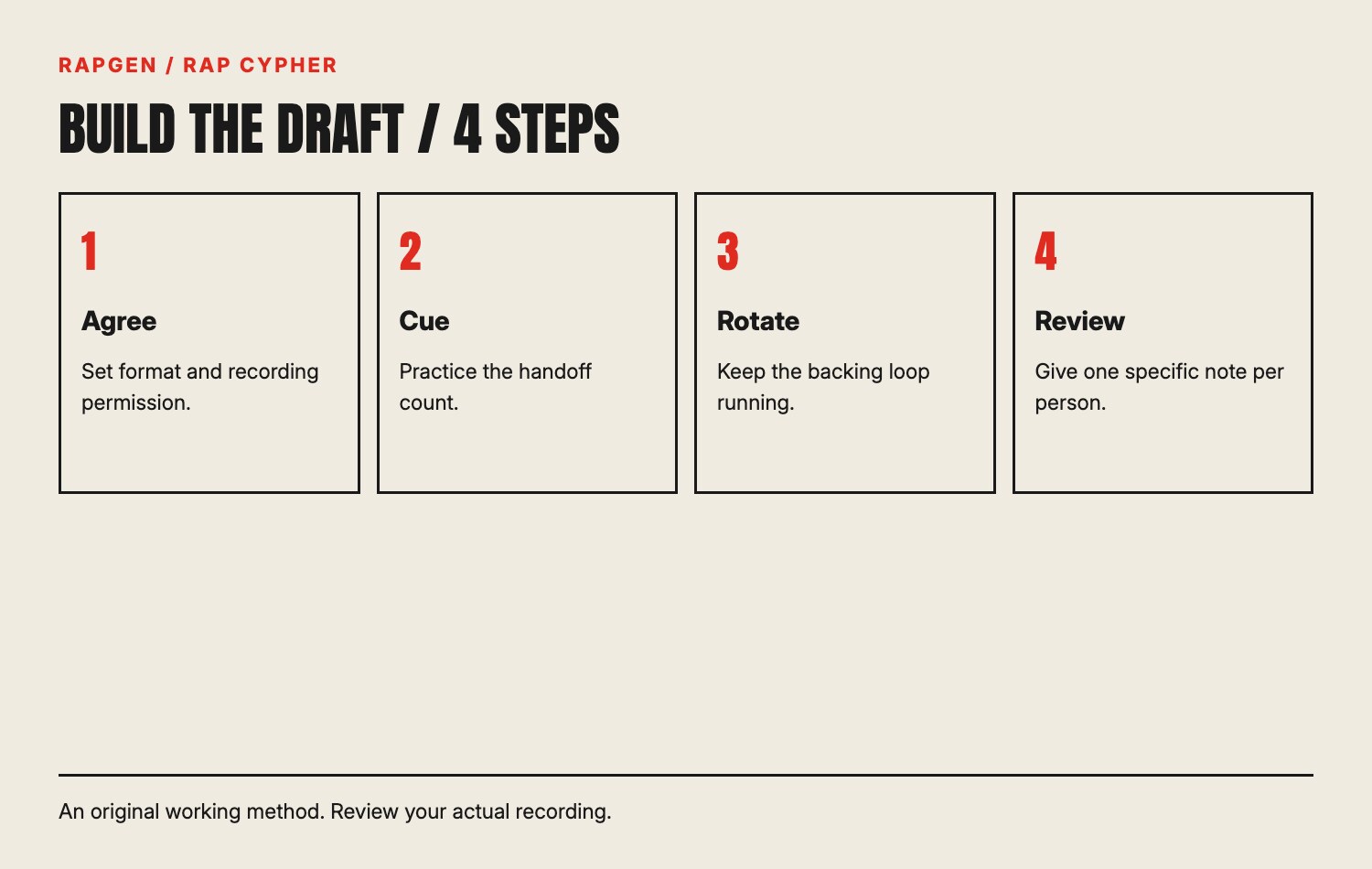
4. Prepare an entrance without pretending it is improvisation
For a mixed practice round, write an opening phrase, a middle route and an ending you can reach. Leave some space for a detail from the room or a previous turn. State that the session permits preparation so participants understand what they are hearing.
Our original entrance might be:
Bike light blinking by the door where we stand,
One small circle, one beat, pass it hand to hand.
The first line points to the setting; the second points to the activity. You can replace the bike with an actual object present in the room, but avoid making a person an unwanted target just because they happen to be nearby.
A prepared ending helps you relinquish the turn. It gives you a place to arrive if the middle becomes uncertain. The ending should fit the agreed length and cue, not rely on the host guessing that you have finished.
Listen for a usable detail
During someone else's turn, notice one word or image you can acknowledge. If they mention a window, you might begin with a doorway. If they name a broken lamp, you can describe someone carrying a phone light. Acknowledgment does not require repeating their complete line.
Keep listening instead of silently rehearsing your whole next verse. A shared session becomes more connected when participants respond to what actually happened. Our collaboration verse guide explores related handoff writing for planned performances.
5. Agree on recovery before somebody blanks
A recovery rule reduces the uncertainty of a mistake. The group might allow a repeated phrase, a short pause while counting or a direct pass to the next person. Decide this before the first participant needs it.
Keep the response supportive. If someone forgets their words, the host can maintain the cue and offer the agreed pass. Mocking the person for using a rule the group approved makes the next participant less likely to take a risk.
Try a deliberately interrupted practice turn. The performer loses a phrase on purpose and rejoins on the next agreed entrance. You are rehearsing timing, not proving that nobody will ever hesitate. A useful recovery is one the participant can actually recognize and repeat.
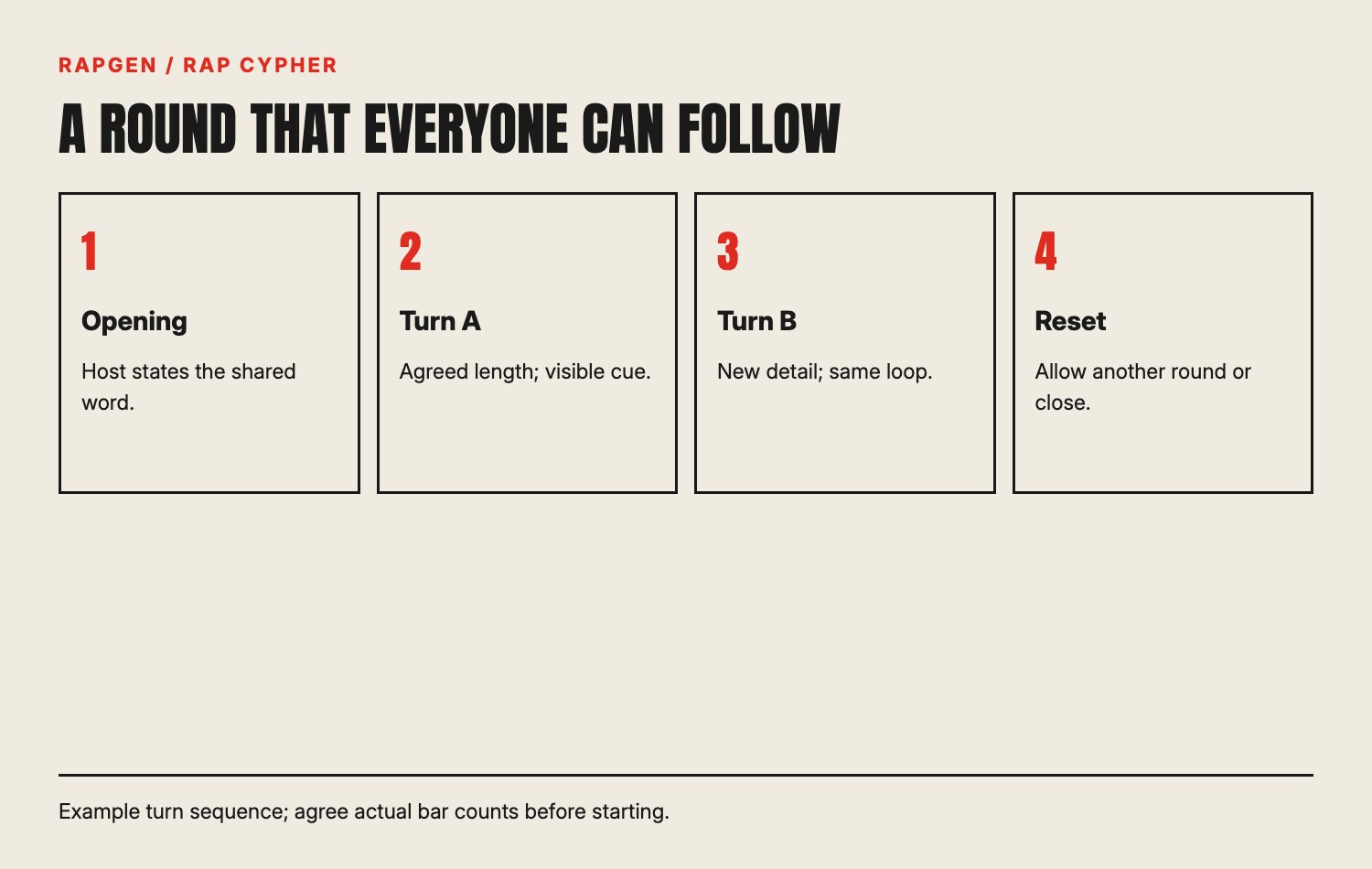
If the format is explicitly competitive, state those terms separately. A friendly rotating session does not become a battle simply because somebody delivers a punchline. The battle preparation guide addresses a different audience relationship and set of expectations.
6. Make the backing usable in the actual room
Check whether everyone can hear the pulse from where they will stand. A speaker aimed away from part of the circle can leave one participant guessing the beat while another hears it clearly. Fix placement before interpreting the difference as a skill problem.
Set the backing low enough for the unamplified voice if you are not using microphones. If microphones are available, test comfortable speaking volume and the intended positions. Avoid turning up the system endlessly to compensate for unclear words or a poorly placed speaker.
Use a backing track you have permission to use for the intended recording or public event. Private practice, public streaming and a commercially released recording can involve different terms. Keep the source and permission record with any clip you plan to publish.
Test the recording, not only the room
A phone may capture a balance different from what participants hear. Record a short approved test, replay it and check whether both voice and backing are identifiable. If the voice is buried, change placement or level before recording a full session.
Make sure the device has enough storage and power, and check what framing includes. These are simple practical checks, but losing the only approved recording because the device stopped halfway through is harder to repair than a weak first take.
7. Review one useful detail per person
After the round, ask each participant for one moment that worked and one specific thing to try next. “Your doorway line made the shared word feel local” is useful. “Be better at freestyle” gives nobody a next action.
Focus feedback on the agreed format. If prepared verses were allowed, do not criticize someone for bringing one. If the goal was a clean handoff, notice the participant who entered reliably even if their wording was simple. The session should teach the skill it actually set out to practice.
An original closing phrase could be:
Leave the small light where the next voice can see,
I've had my turn; pass the circle from me.
The phrase says the turn is ending. It can be adapted into a host cue, but the group should agree on that function. A poetic closing is not a reliable signal until others know to listen for it.
Before sharing an edited clip, let the people appearing hear and see that exact export and caption. They may be comfortable with the complete round but dislike a cut that isolates a hesitation or changes the apparent response. Keep the approved file and do not silently substitute another version.
End the session while people still have a clear understanding of what improved. Save the turn length, cue and any recording boundaries in a short note. Next time you can repeat the useful structure and change one constraint without rebuilding all the coordination from scratch.
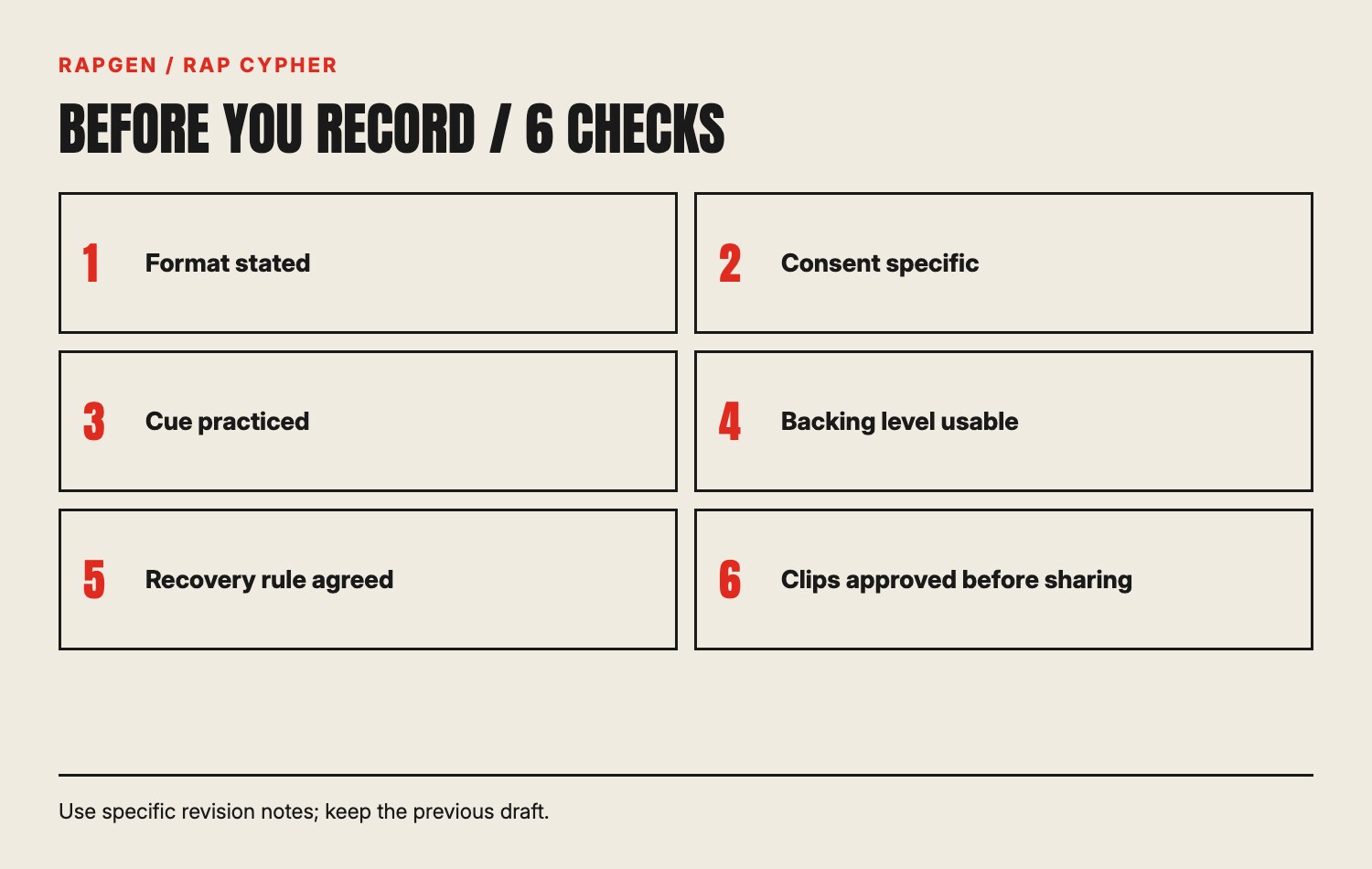
Reset a round without blaming the participant
Suppose two people repeatedly enter together. Pause between rounds and ask which cue each was following. One may be using the outgoing performer's last rhyme while the other is watching the host's hand. Agree on a single cue, then practice two rotations with counting only.
If the confusion remains, shorten the first practice turns so the host can signal their end consistently. Do not add more rules about rhyme or subject while repairing the handoff. That would change the task before the coordination problem is understood.
Once the rotation works, bring the shared word back and run another short round. Notice the reliable entrance as an improvement, even if the participant chooses simpler wording. You can work on responsive lines in the next pass. Keep any recording private until the participants approve its use; a clip of the failed rotation may misrepresent a session whose main purpose was learning that coordination. The reset should leave everybody knowing exactly what to watch or hear on the next turn.
Three things you can stop worrying about
Making every turn entirely improvised. State the format honestly. Prepared and mixed rounds can both be useful practice when participants share the same expectation.
Avoiding every hesitation. A rehearsed recovery and a supportive handoff keep the session moving when words do not arrive immediately.
Posting proof that the session happened. An unrecorded round is still a complete musical activity. Publication is a separate choice that requires permission.
Prepare a small set of lines for an agreed practice round
The rap bars generator can provide separate written candidates about the shared word. Use them only in a format that permits prepared material, and adapt them to your own entrance and ending. The live response still comes from listening to the people in the circle.
The short version
A rap cypher keeps moving when everyone knows the format, turn length, cue and recovery rule. Check the room's sound, separate participation from publication consent and review specific moments afterward. The shared beat is easier to use when the shared expectations are equally clear.