Rap Rhyme Schemes to Try: 2026 VMA Collab Lab
Rap rhyme schemes to try: use the 2026 VMA collaboration field to plan handoffs, shared sound families, contrast, callbacks, and clean boundaries.

The 2026 VMA Best Collaboration field includes Clipse with Kendrick Lamar, French Montana with Max B, and several singer-led pairings. The award is not a technical score for verse construction, but its September 27 date creates a timely workshop question: when several voices share one record, what makes the handoff feel designed rather than pasted together?
The confirmed nominees come from Paramount's official announcement. This lab does not quote or grade their lyrics. It gives you rap rhyme schemes to try in an original rehearsal-room scene, with extra attention to callbacks, contrast, and verse handoffs.
This practice uses an invented rehearsal-room scene. Two writers, Voice A and Voice B, stay late because somebody has misplaced a key. Every example assigns lines to a voice and gives the next person a word, image, or question to catch. The lines are writing exercises rather than transcriptions of any nominee, and their eventual bar lengths depend on your beat and delivery.
1. Make a sound map before choosing a pattern
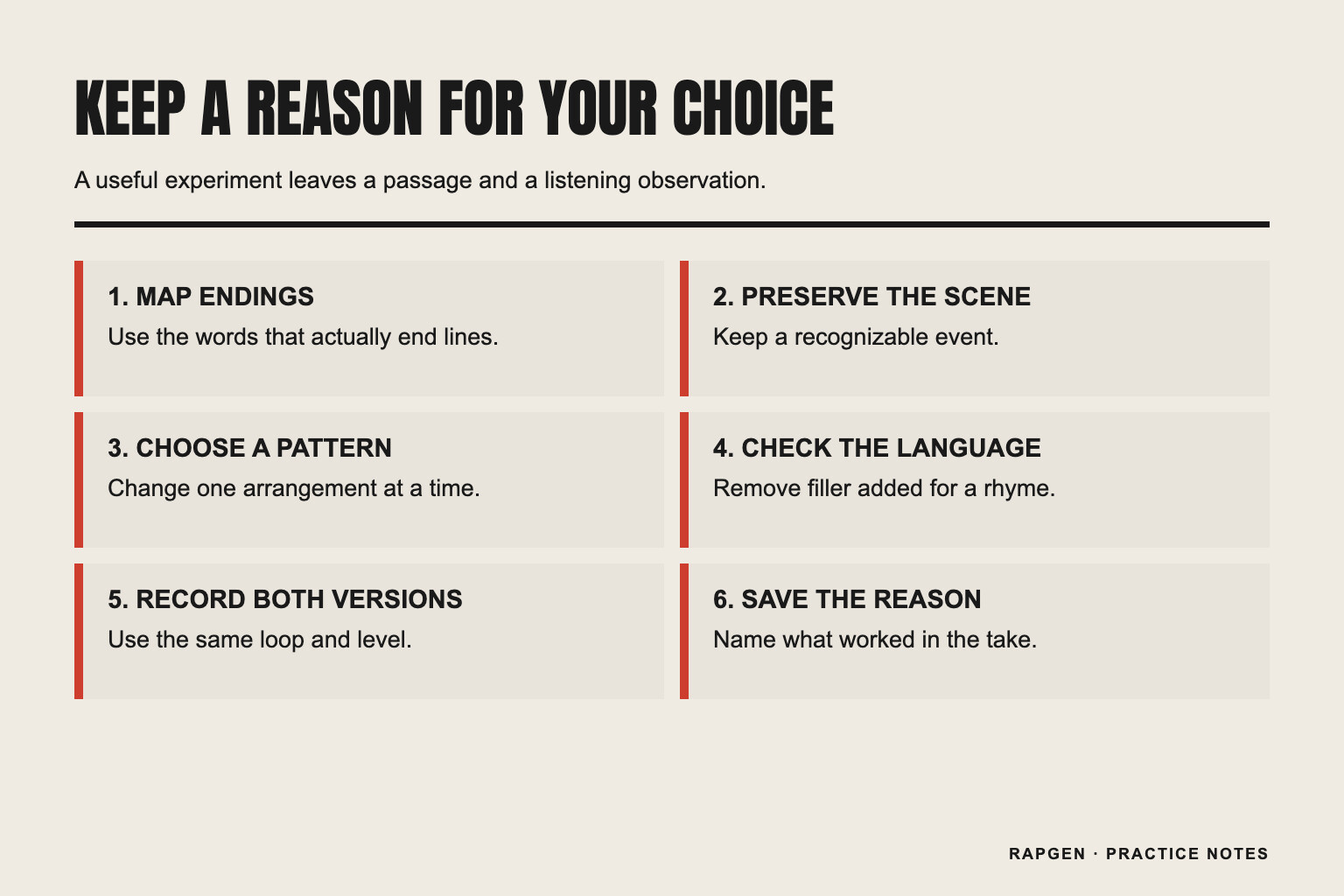
Write the last stressed word of each line in a separate column, then add a second column for the performer. Read the ending words aloud without the surrounding sentence. Give matching sound families the same letter, starting with A. A new family gets B, then C. The labels show both the sound pattern and who carries it across the handoff.
For a simple first pass, use clear pairs such as light / night and door / floor. In the examples below, light and night belong to A; door and floor belong to B. Letters reset when we start a different example. This avoids pretending that A always means a particular vowel across every song.
Decide what the map includes
Here we are tracking line endings only. A line can contain other repeated sounds that this little map leaves out. Underline those separately if you want, but do not make the first exercise so detailed that it becomes a transcription project.
Also distinguish a repeated word from a new rhyme word. Ending twice on door can create a deliberate refrain, yet it gives you different writing material from finding floor. Mark exact repetitions with an asterisk so the page reminds you which device you used. Repetition is available; it simply deserves an honest label.
2. Try AABB as a two-voice relay
Start with two adjacent pairs. Give the first pair one job and the second pair another. In our rehearsal scene, the first pair establishes why everyone is still there; the second supplies evidence of the missing key.
Voice A: The room goes quiet under borrowed light. Voice A: I missed the bus we take on Friday night. Voice B: You blame the coat that's hanging by the door. Voice B: I lift its sleeve—the key drops to the floor.
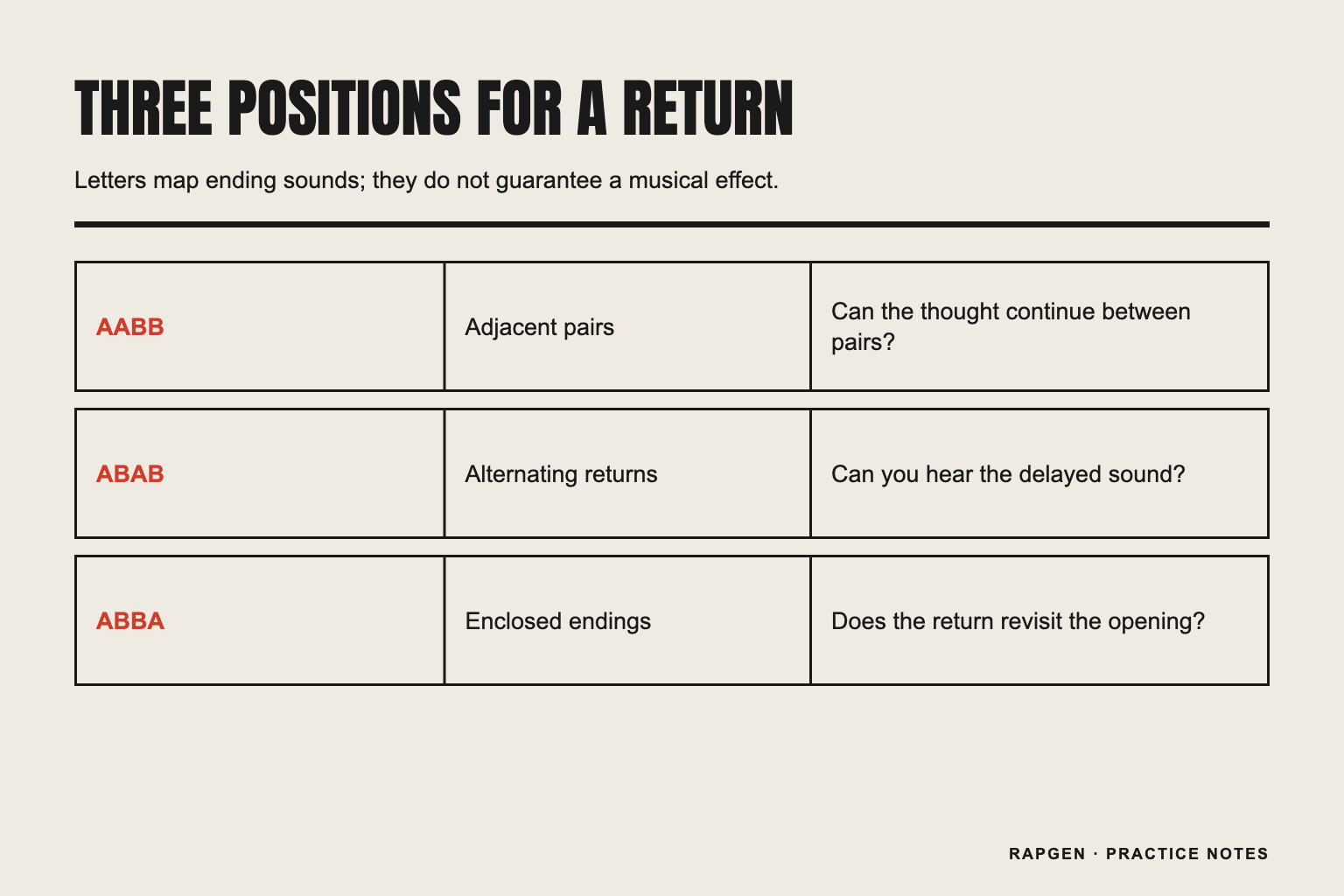
The endings produce AABB: light, night, door, floor. Voice A owns the problem; Voice B answers it with a new action. Read the passage once with a clean pause after line two, then again with Voice B entering on the last consonant of “night.” The scheme stays fixed while the handoff changes.
Check the second line of each pair
Those lines can become dumping grounds for obvious conclusions. Cover the last word and ask what new information the sentence contains. Here the second line adds a missed journey; the fourth locates the object. If either merely repeats the previous sentence, rewrite its action before searching for another ending.
This pattern is useful when a passage really contains two related observations. It can become monotonous when every pair finishes a completely separate thought. Before changing the letters, try allowing a consequence from the first pair to continue into the next one.
3. Try ABAB when both voices share a sound family
Now alternate the families. Keep the same people and missing-key problem so the experiment stays controlled.
Voice A: We kill the amplifier; I leave on the light. Voice B: Your coat is still hanging beside the door. Voice A: You said the key was here earlier tonight. Voice B: Then follow my finger and check the floor.
The map is ABAB: light, door, tonight, floor. Voice A carries the A family and Voice B carries B, so the listener can associate a sound with each speaker. Swap the assignments for a second take. If the exchange remains legible, the writing—not merely the timbre—is doing useful work.
Listen for the delayed return
Keep the same tempo as the couplet version. Do you still hear the connection between light and tonight? If the first line is mumbled and the third is stretched, the printed scheme may be much clearer than the performed one. Bring the words into a comfortable delivery before judging the pattern.
Alternation can also separate two strands of attention. In this example the A lines concern the late session, while the B lines inspect the room. You do not need to impose that division on every ABAB passage. It is one concrete way to make the arrangement serve the scene.
Once the voices are clear on the page, use the how to rap on beat session test to check whether each entrance still lands cleanly when the written handoff becomes a performed one.
4. Try ABBA to return to the opening sound
An enclosed pattern places two B endings between the A endings. Use the last line to revisit something introduced at the start, while allowing the middle lines to change what the return means.
Voice A: You ask me why I haven't killed the light. Voice B: I point toward the shadow by the door. Voice B: Your missing key is shining on the floor. Voice A: We laugh about the extra hour tonight.
That gives light, door, floor, tonight: ABBA. Voice A opens and closes the frame while Voice B supplies the discovery in the middle. The return is now also a personnel decision: the first speaker gets the last word, but only after the second speaker changes the situation.
If your fourth line only exists to reach the A word, the enclosure can feel like a detour. Draft the final thought in ordinary prose first: “We stayed late over something that was right there.” Then find a natural version that fits your chosen family. Keep the thought available even if you eventually abandon the pattern.
This is a useful option for a short passage with an opening question or image you want to revisit. It is not a rule for endings, hooks, or reflective writing. Test the particular passage rather than assigning permanent moods to letter combinations.
5. Try AAAA as a shared-chain stress test
For a longer chain, keep one family through four lines. Choose a family with enough words that belong in your scene. Our location gives us door, floor, before, and more without introducing unrelated objects just to fill slots.
Voice A: Your coat swings softly when I shut the door. Voice B: The missing key throws silver from the floor. Voice A: You swear you checked that very spot before. Voice B: I pocket it; we're searching here no more.
All four endings share the same final stressed rhyme sound in an ordinary English reading. Each voice inherits the other person's sound and must still move the action. That pressure makes AAAA a useful collaboration test: the chain belongs to the record, not to either writer's private verse.
Keep a cost column
Beside each line, note what you changed to reach its ending. Did you reverse a phrase you would normally say? Add an unnecessary qualifier? Lose a detail that made the scene yours? One awkward line can be a revision problem. Several awkward lines suggest that this sound family may be the wrong constraint for this passage.
A long chain is not a test of how many dictionary matches you can fit into a verse. Stop the chain when you have delivered its purpose, even if your list contains ten more endings. Save unused words for another scene rather than making this one carry them all.
6. Use AAXA to make the handoff audible
Use X for an ending you are not assigning to a recurring family in this passage. Here the third line opens a short interruption before the earlier sound returns.
Voice A: I slide the silver key across the floor. Voice A: You miss it when it stops beside the door. Voice B: Both our phones begin to buzz at once. Voice B: I grab the key; the calls can wait some more.
Floor, door, once, more produce AAXA for this exercise. Voice B enters on the unmatched X line, so the change of person and the break in sound reinforce each other. The last line proves the newcomer can return to Voice A's family rather than beginning an unrelated mini-song.
Do not assume listeners will hear the break as a dramatic event. Other sounds, rhythm, and emphasis may make it subtle. Record one version with an exaggerated pause before line three, then another with ordinary continuity. Keep whichever supports the scene without making the device more important than the people in it.
| Pattern | Collaboration job | Warning sign |
|---|---|---|
| AABB | One voice sets up, one voice answers | The second verse merely restates the first |
| ABAB | Each voice carries one sound family | The exchange disappears without name labels |
| ABBA | One voice frames the other's discovery | The middle voice becomes a detour |
| AAAA | Both writers inherit one shared chain | Sentences bend around spare rhyme words |
| AAXA | A new voice enters on the break | The switch has no narrative purpose |
These are listening questions, not promises about how a scheme will feel. The same pattern can sound very different over a different beat or through a different performance.
For a longer group track, a rhyme handoff is only one part of the shared brief. Our posse-cut writing worksheet gives four MCs distinct narrative jobs and carries one object between their sections so the full sequence adds information.
7. Build a handoff worksheet at the scene boundary
Write two four-line passages about one event. Let Voice A use AABB and Voice B answer with ABAB. Choose the transition because something changes: the key is found, the group leaves, or an earlier accusation needs an apology. Before drafting Voice B, complete four boxes: the last image received, the claim that needs an answer, the sound family worth carrying, and the new fact only Voice B can add.
You now have eight printed lines. They still are not guaranteed to occupy eight musical bars. Fit them to your chosen beat before adding timing claims to your notes. If you need help establishing that larger unit, use the approach in writing a first rap song.
Read the join aloud without saying the pattern letters or speaker names. Can a listener tell that the second person heard the first? A callback to the coat, bus, key, or closing time is stronger evidence than a generic “I agree.” If the second voice could be pasted before the first with no loss, the handoff still needs a dependency.
For a second take, make Voice B catch the exact final word from Voice A and change its meaning in the first response. This is a callback, not a requirement for every collaboration. Compare it with a clean gap between verses; one may suit a tense exchange while the other gives the new voice more room.
In a live circle, the handoff also needs a visible cue and an agreed recovery rule. The rap cypher session plan covers turn lengths, backing levels and recording consent before the group begins its first round.
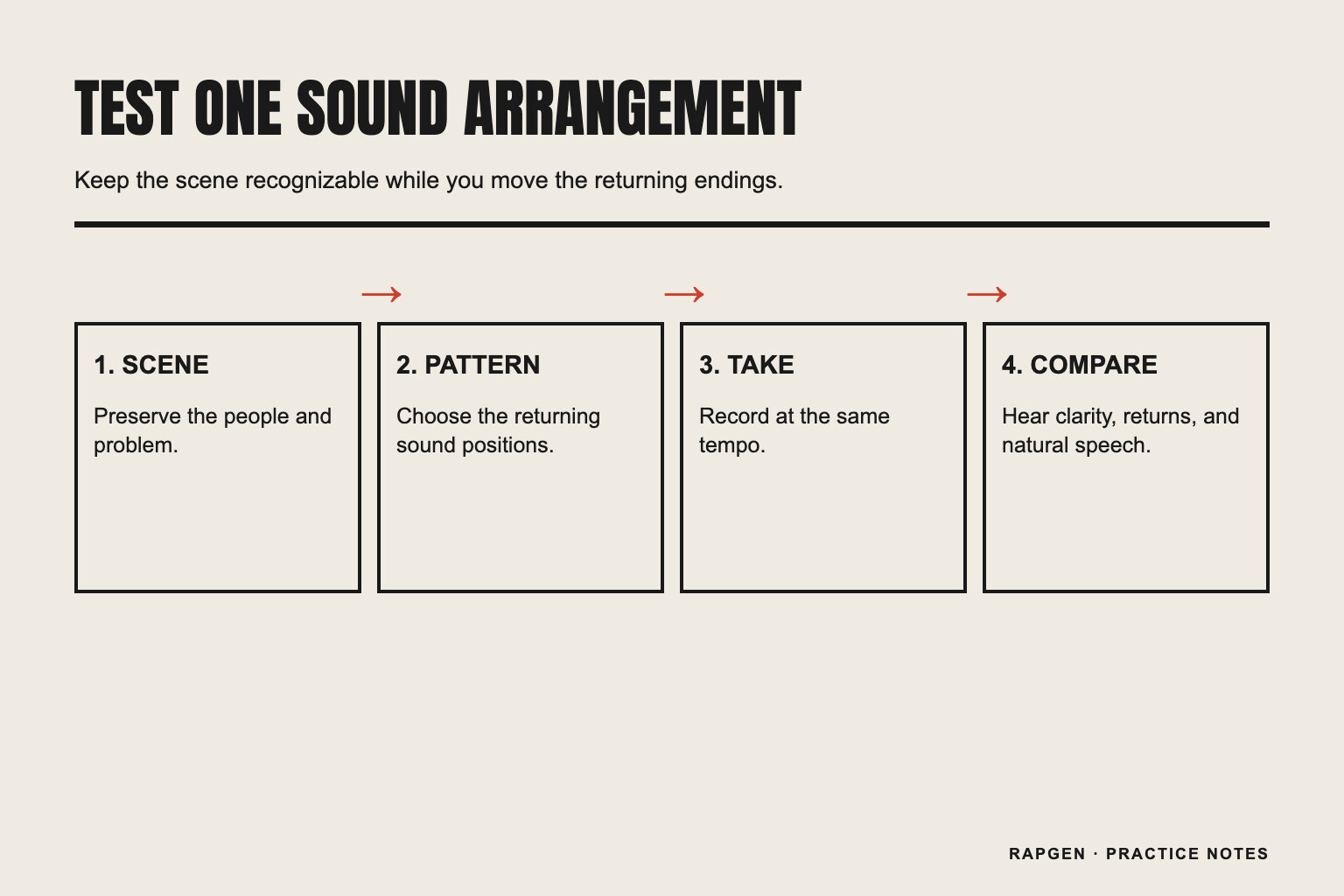
8. Try a blind comparison before adding complexity
Choose your two strongest versions. Record both voices over the same loop, even if you perform both parts yourself. In Take One, leave a full beat between writers. In Take Two, let the incoming voice overlap the outgoing word without obscuring it. Keep the lyrics and levels stable so the boundary is the variable you are judging.
Ask three specific questions
Could you follow what happened? Which returning ending did you notice? Did Voice B answer a specific image or merely arrive? Write a short answer to each question for each take. “More technical” is not an answer to any of them.
If you ask another listener, avoid telling them which scheme you want to win. Let them describe the passage first. Their inability to name the pattern does not make the writing unsuccessful; listeners do not need notation to understand a song. Their account of a confusing action is more actionable than a guess about your letter sequence.
Keep one version, save the rejected take, and note the reason. You can add internal sound links or alter cadence in another session. Changing all those variables now would make it harder to learn anything from this comparison.
Three things you can stop worrying about
Using a common scheme. AABB leaves room for a precise scene, an unexpected observation, and a distinctive performance. Familiar notation does not decide whether the writing is personal.
Keeping the same pattern throughout the song. You can retain it, interrupt it, or replace it when the passage benefits. You do not owe the worksheet perfect symmetry.
Making every rhyme visible on paper. Your end-rhyme map is a limited editing aid. It leaves out delivery and many sounds inside the line. Use it to answer one question rather than forcing it to explain the whole performance.
Give the chosen passage another reading
Once your listening comparison has produced a preferred version, you can put its text into Rate My Rap. Compare the tool's rhyme and structure comments with your own notes. It reads submitted words; it cannot establish whether a delayed return was audible in your recording.
If its advice would remove the scene's clearest detail, preserve a copy before trying the edit. Read both versions aloud and decide which serves the passage. You remain responsible for the meaning and for checking how the words sit on the beat.
The short version
The most useful rap rhyme schemes to try are the ones you can compare with a stable scene: adjacent pairs, alternating returns, enclosed endings, a sustained family, and a deliberate unmatched line. Map the sounds honestly, rewrite sentences naturally, and record before choosing.
An experiment succeeds when it leaves you with a clearer passage and a reason for keeping it. It does not need to produce the most complicated letter sequence in your notebook.