How to Rap on Beat: 2026 VMA Nominee Scorecard
How to rap on beat: use the 2026 VMA Best Hip-Hop nominees as a listening scorecard for entrances, pauses, density, handoffs, and repeatable timing.

The 2026 VMA nominees were announced on August 18, and Best Hip-Hop places six records in one category: Cardi B featuring Kehlani's “Safe,” Don Toliver's “E85,” Drake's “Janice STFU,” Megan Thee Stallion's “LOVER GIRL,” Travis Scott's “DUMBO,” and Tyler, the Creator's “SUGAR ON MY TONGUE.” The awards air September 27. That gives us a timely six-record listening set without pretending the nominees are an announced live-performance lineup.
Learning how to rap on beat is the useful scorecard here, not predicting the vote. The confirmed field and date come from Paramount's official nomination release. You will make your own observations from the official videos, then test one observation with four original lines. No nominee is graded, ranked, or treated as a template to imitate.
Open the six official nominee videos from a legitimate source and make one row per record. Use timestamps instead of copied lyrics. For each row, note the first vocal entrance, one clear pause, one density change, a section boundary, and one question you want to test. Then use four original lines and a simple instrumental for the checks below.
| Nominee record | Entrance timestamp | Pause | Density change | Section boundary |
|---|---|---|---|---|
| Safe | ||||
| E85 | ||||
| Janice STFU | ||||
| LOVER GIRL | ||||
| DUMBO | ||||
| SUGAR ON MY TONGUE |
1. Build the nominee listening sheet before you perform
Choose a 20–30 second passage from each nominee video and record the timestamp. Tap a broad pulse without speaking. Do not force every record into the same subdivision; the first job is to locate a repeating frame you can follow. Write “unclear” when the opening or edit makes the pulse hard to locate instead of inventing precision.
Do not assign every audible drum to a number. A hat pattern may contain several sounds between your taps. A kick may arrive between counts, and a snare may be delayed slightly within the groove. Your job is to find the recurring framework underneath those events.
Use visible section changes as a cross-check
A repeating bass phrase, chord change, drum turnaround, or cut in the video can help you relocate the passage. Replay the same timestamp twice. If your first count lands differently, keep the row as an observation problem; do not turn it into a claim about the artist's timing.
Some tracks make two counting levels plausible. You might feel a broad pulse while the project grid runs twice as fast. Either can work for practice if you state which one you mean and keep your bar labels consistent. A collaborator cannot follow “bar three” when your bars are twice as long as theirs.
Give yourself a starting cue
Choose one audible event before your entrance: a fill, a bass note, or the beginning of a loop. Start counting there each time. A cue turns the exercise into something you can reproduce tomorrow instead of a lucky entrance you cannot locate again.
2. Compare entrances without declaring a winner
Choose two nominee passages with noticeably different entrances. One may begin immediately after a section change; another may leave more instrumental space. Record only the timestamp and the amount of space you can count. The point is a repeatable observation, not a label such as “better” or “late.”
Now say a neutral reference phrase over your own beat. “One more / right here” is enough. Try an immediate entrance and a version with one extra beat of space. Keep the words unchanged. If you can reproduce both, you have converted the listening note into a controlled choice rather than a vague impression.
This is a coordination exercise, so keep your voice comfortable and the beat quiet enough to hear both parts. Extra volume makes the performance feel more committed without telling you whether the timing improved. Save a brief recording so your judgment has something outside the moment to work with.
3. Turn one observed entrance into an original test
Return to one row on the nominee sheet and choose only its entrance relationship: before the first obvious snare, after it, or after a larger section cue. Do not copy cadence or words. Take a single original line and mark where it begins and where its last important syllable lands.
Try this original line:
Blue cup by the window, rain against the glass.
Begin “blue” on the first count. Aim “glass” toward the fourth count, with a little space after it. Do not worry about equal spacing between every syllable. Ordinary speech already groups words unevenly, and a workable delivery can preserve some of that shape.
If you cannot reach “glass” comfortably, cut the line:
Blue cup, wet window, rain against the glass.
Keep the entrance and exit where they were. The shorter phrase gives you room to discover where the extra words were squeezing your delivery. You can restore one word later, once you know what that word costs.
Repeat before extending
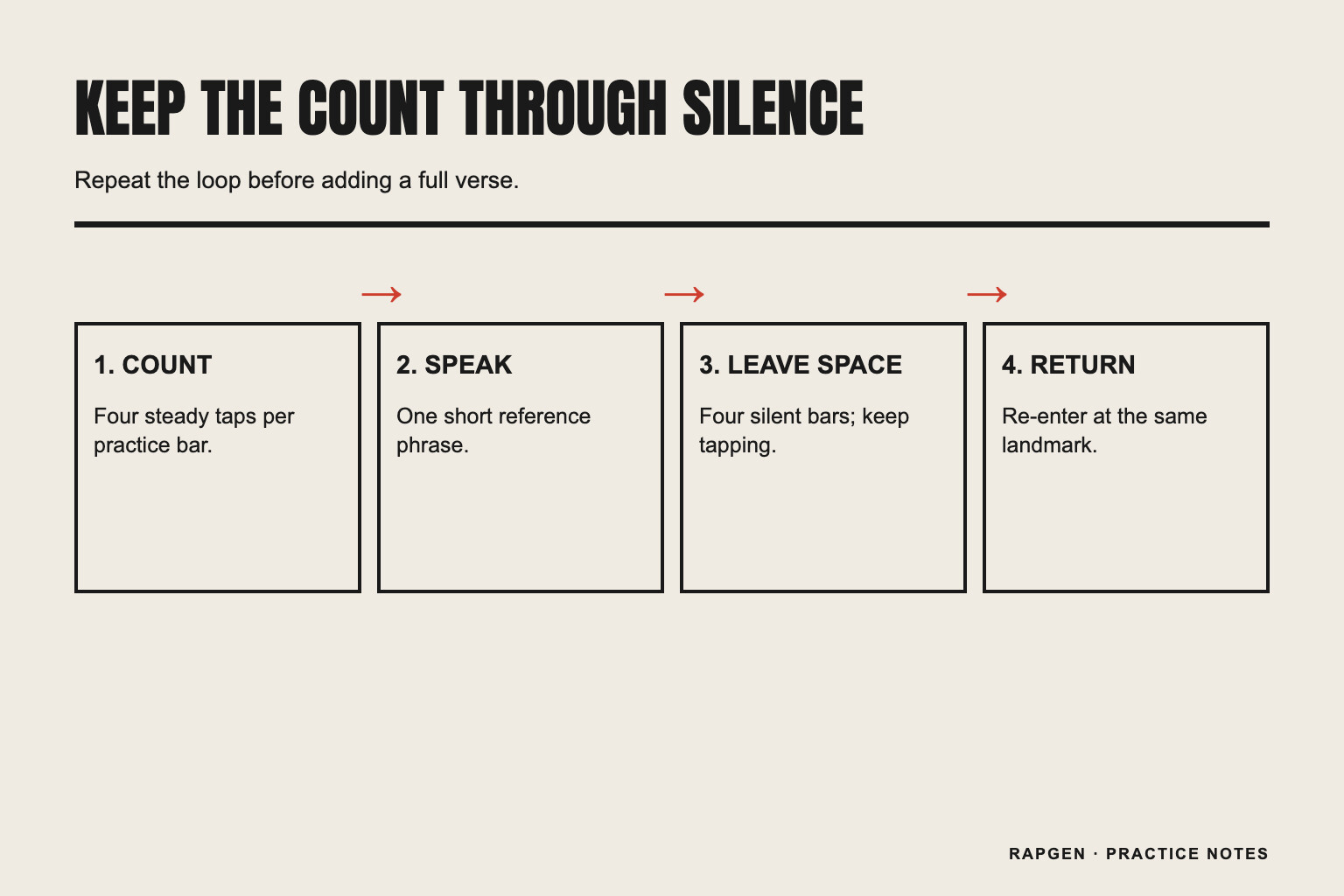
Perform the line four times with a silent bar between repetitions. You should be able to predict your entrance during the silence. When all four attempts begin and end in approximately the same places, add the next line. Extending after one good take hides inconsistency inside more material.
4. Score repeatability, not stylistic preference
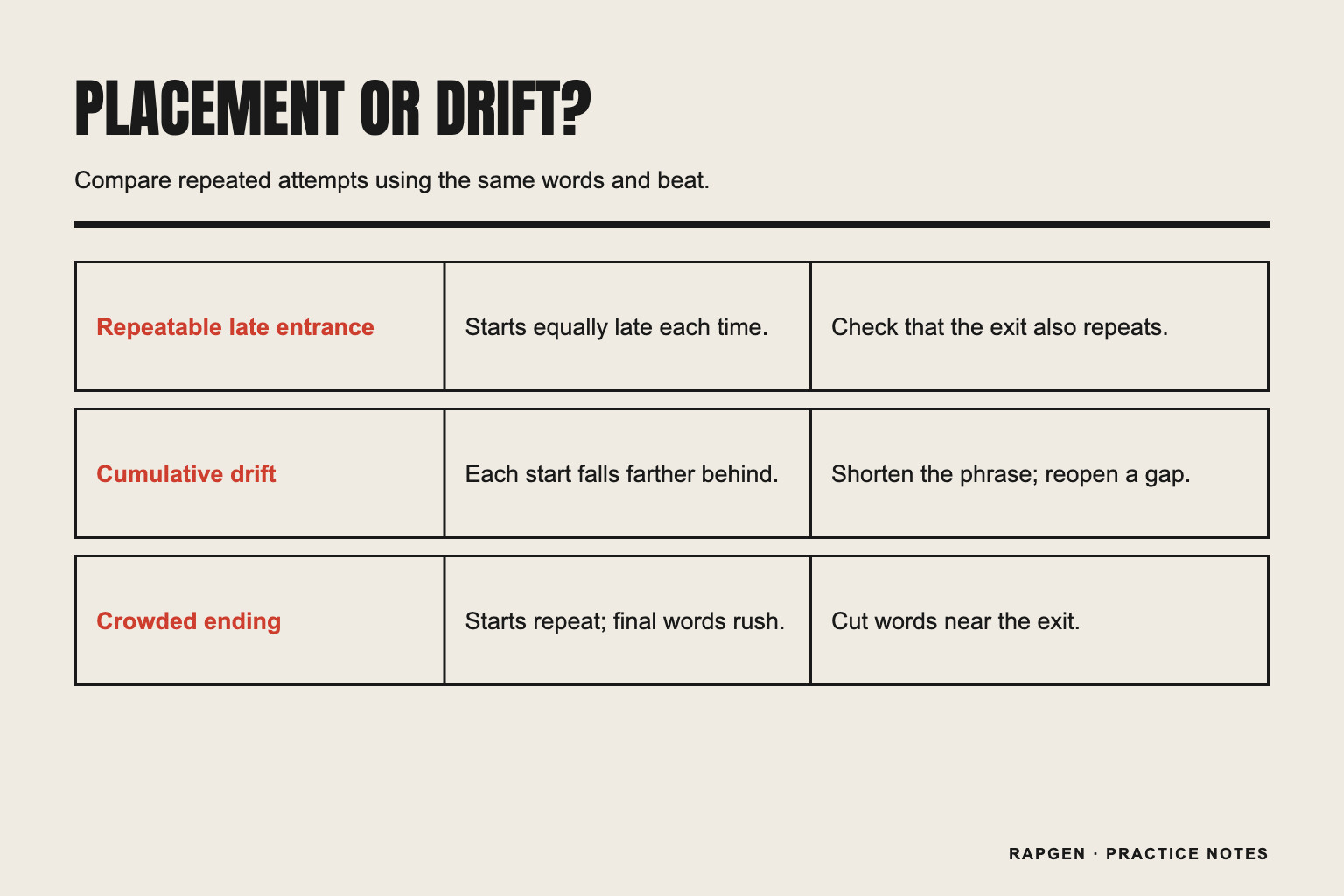
The six nominee rows will not share one ideal entrance. Your own test therefore scores repeatability: can you place the same line in the same location four times? Starting after beat one is a choice; falling progressively farther behind each bar is a different event.
| What the recording shows | What to test next |
|---|---|
| Every entrance sits equally behind the chosen tap | Keep the placement and check whether the exit repeats |
| Each line starts later than the one before | Shorten the phrase or reopen a gap before the next entrance |
| Starts repeat, but final words get crowded | Reduce words near the ending and preserve its landing point |
| One line fails while the others repeat | Practise that line separately with the same count-in |
| The tap speeds up while the lyric gets busy | Speak the rhythm on one sound before restoring words |
To make the comparison fair, use the same beat segment and the same lyric. Changing tempo, words, and entrance on every attempt leaves you with several recordings but no controlled comparison.
You do not need to align every consonant to a visual grid. The target is intentional, repeatable placement within the groove. A waveform can help locate obvious drift, but it cannot decide whether an expressive delay sounds good.
5. Compare density changes with timestamps
For each nominee, mark one passage where the number of audible syllables seems to rise or fall. You are not calculating an official syllables-per-second score; you are locating contrast you can replay. Pick the clearest two timestamps and describe the difference in plain language: “more space after phrases” or “more sounds between taps.”
Then find the word in your own four lines beside which your count disappears. Replace only that phrase with a neutral sound while preserving its intended rhythm. Keep tapping the broad pulse underneath it, then restore your words. This turns a density observation into a diagnostic test without copying the nominated recording.
If the hand continues steadily now, word production was competing with the timing task. Restore only the difficult word. Then restore the two words before it. Build outward until the line survives with the tap intact.
If the hand still accelerates or stops, simplify the rhythm itself. Put fewer sounds between taps and leave a larger gap near the end. You can make the pattern denser later; first establish a version whose timing does not depend on rushing.
Separate tongue trouble from memory trouble
Read the line while performing it once. Then look away and try again. A problem that appears only when you look away may be recall-related. Repeating the line at a higher speed will not necessarily solve that. Break it into meaningful chunks and use the lyric memorization practice before retesting the timing.
Make the difficult spot easy to find
Underline the word in your lyric file and write a short instruction above it: “leave space before,” “start earlier,” or “drop this adjective.” A concrete note survives between sessions. “Needs better flow” rarely tells you what to do when you return.
6. Test a section-boundary handoff
Use the nominee sheet to find two different section boundaries: perhaps a vocal enters after a longer instrumental gap in one video while another transition feels nearly continuous. Record the timestamps and verify them twice. Then build both boundary types with your own lines. Many timing problems happen at the seam because the silence around isolated lines was doing repair work.
Loop just the last half of the first line and the opening of the second. Use the same count as before. Leave the rest of each bar silent so the transition gets most of your attention.
For example:
…rain against the glass.
Bus lights cross the ceiling…
Try three revisions: shorten the first ending, delay the second opening, or cut a word from each side of the seam. Record all three. Choose the version that preserves the meaning and gives you a repeatable join.
A delayed second opening may create a different mood. That is fine if you can maintain it and still reach the next planned landmark. The exercise should reveal musical choices as well as mistakes. Write down the chosen version so tomorrow's attempt has the same target.
7. Use the six videos as a blind recall check
Close the videos and look only at your six rows. Can you distinguish the records by the timing notes alone? A useful row should say where the event occurred and what changed; “great flow” tells you nothing you can replay. Correct weak rows before moving to your own recovery test.
Here is a complete original passage for that test:
Blue cup, wet window, rain against the glass.
Bus lights on the ceiling, watch the colors pass.
Coat hangs by the doorway, keys beside the phone.
Last bus turns the corner, now I walk back home.
Use one practice bar per line. Begin each first word on your chosen first count and aim the final word toward the fourth. This is a temporary delivery assignment, not a claim that printed lines automatically equal musical bars. If a line feels crowded at your tempo, slow the exercise or remove a modifier before recording the complete passage. Mark the entrance and final word on the page. First perform all four lines; on the next take, keep tapping through the entire third bar without speaking. Compare the fourth entrance in both recordings. It should occupy the same place even though the previous words disappeared.
Once four lines work, deliberately leave the third one silent. Keep counting and begin line four where it belongs. This tests whether the beat is still running in your attention when the lyric disappears.
On the next attempt, omit line two instead. Then have someone point to a line for you to skip, or decide the omission before pressing record. The purpose is a predictable recovery exercise, not a surprise that makes you abandon the count.
If line four keeps arriving early, you may be treating the omitted lyric as an omitted bar. The time still has to pass. Tap through the full space and name the next entrance before you speak it.
Build a recovery phrase
A short original phrase can help when you lose your place in longer practice. Something like “hold that thought” leaves room to listen. Test it over the instrumental beforehand, so it buys time instead of adding another timing problem.
Recovery does not require filling every gap. A silent bar with a stable count is often a more useful practice result than four improvised lines that obscure where you are. Once you can return reliably, experiment with filling some of that space.
8. Run a fifteen-minute VMA scorecard session
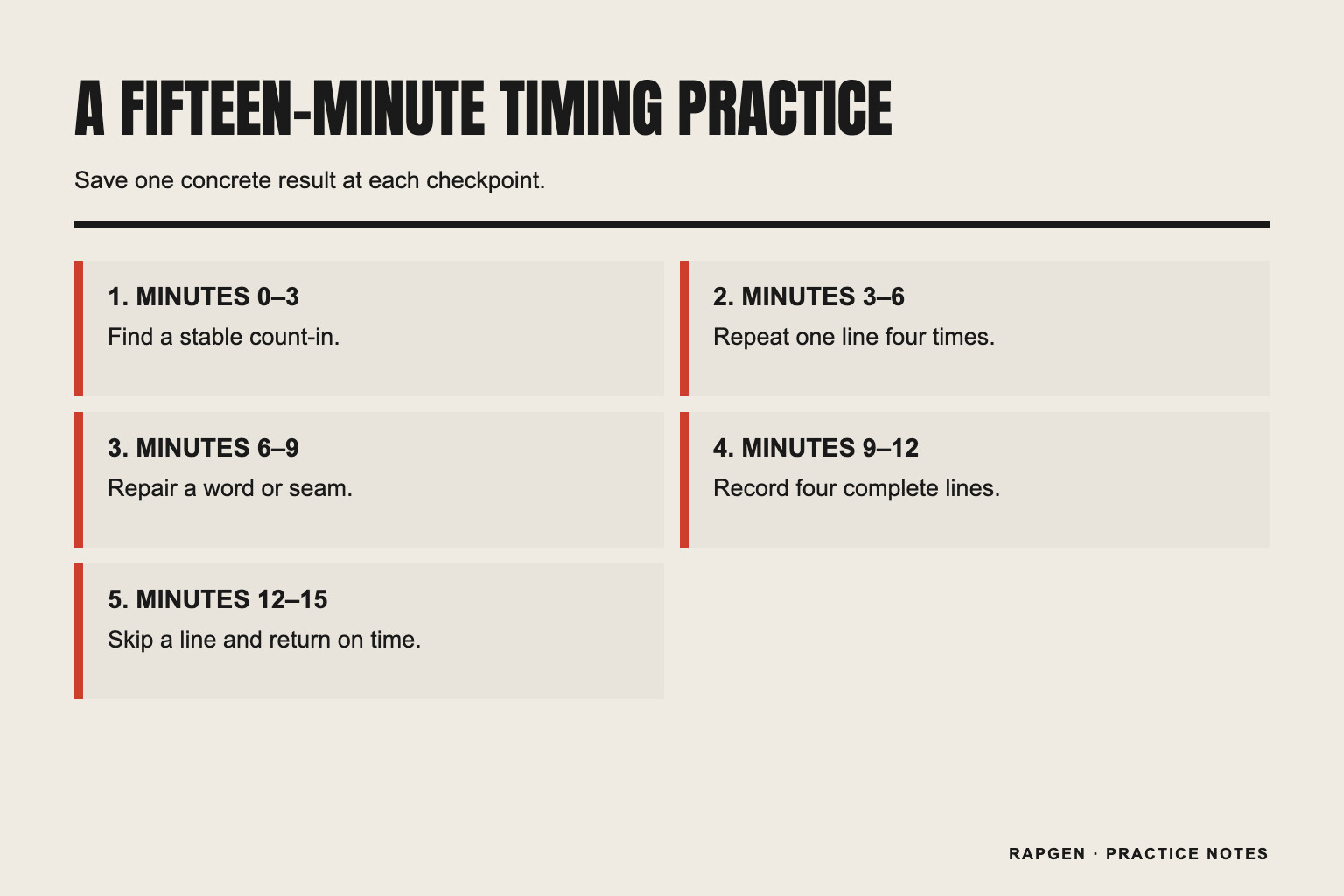
Keep one beat and one four-line passage for the entire session. Set a timer for each phase so a promising first line does not consume all the available practice.
| Minutes | Action | Evidence to save |
|---|---|---|
| 0–3 | Recheck two nominee timestamps | Two factual listening notes |
| 3–6 | Recreate one entrance with original words | Four comparable attempts |
| 6–9 | Recreate one density contrast | One sparse and one dense take |
| 9–12 | Test a section-boundary handoff | Two boundary versions |
| 12–15 | Omit a line and return on time | One successful re-entry |
Listen once at the end. Choose the next session's target from the recording: entrance, density, boundary, or recovery. Keep the six-row sheet as dated listening evidence. When a new VMA performance lineup is officially announced, it can become a new dataset; this article does not assume the nominees will perform on the show.
When the passage works on two separate days, try a second beat with a similarly clear pulse. Begin again with the counting check. Success on one familiar loop does not automatically transfer to a different groove, and the new count-in will tell you what changed.
Three things you can stop worrying about
Matching every drum hit. The drums can be syncopated while your count stays steady. You need a shared framework, not a syllable for each sound.
Writing faster lines immediately. Dense delivery adds coordination demands. Clear short phrases give you a better reference for deciding when density is helping.
A perfect-looking waveform. A grid can locate timing relationships. Your repeated recordings determine whether the relationship is stable and musically convincing.
Add unfamiliar words after the count survives
The word game on the freestyle rap generator can introduce a new constraint once your entrance and exit repeat. Use one supplied word in a short line, keep the same count, and record the result yourself.
If the new word makes you lose your place, return to the spoken reference phrase and try a simpler sentence. The page supplies material for the exercise; it does not listen to the audio. For the next stage—varying stress, density, and space while preserving timing—use the separate flow practice guide.
The short version
The reliable route through how to rap on beat is to keep a count through speech and silence, give a short phrase two landmarks, compare repeated attempts, repair the seam that fails, and practise returning after a missed line. Save a recording that demonstrates each change.
Keep reading
- How to improve rap flow for changing a delivery after its timing is stable.
- How to memorize rap lyrics for keeping recall problems out of timing practice.
- How many syllables fit at 138 BPM for testing density inside a defined bar.