Rap Syllables at 138 BPM: How Many Fit Without Rushing?
At 138 BPM, one four-beat bar lasts about 1.74 seconds. Use this test to choose a clear syllable range instead of chasing one universal number.
At 138 BPM, a four-beat bar lasts about 1.74 seconds. That fact is exact; the number of rap syllables that fit inside it is not. A spacious line may use six. A clear, active line may use ten or twelve. A trained double-time passage may use sixteen or more, but the usable number depends on stress, word shape, breath, and what the drums are doing.
The literal query how many syllables can rap fit in a 138 bpm beat assumes tempo creates one capacity. It creates a container. Your delivery decides how densely that container can be filled before meaning and groove collapse.
This guide shows how to calculate the container, test your personal range, and edit a line that is mathematically possible but physically ugly.
1. Calculate the length of one bar
BPM means beats per minute. At 138 BPM:
60 ÷ 138 = about 0.435 seconds per beat
Most rap is counted in groups of four beats, so:
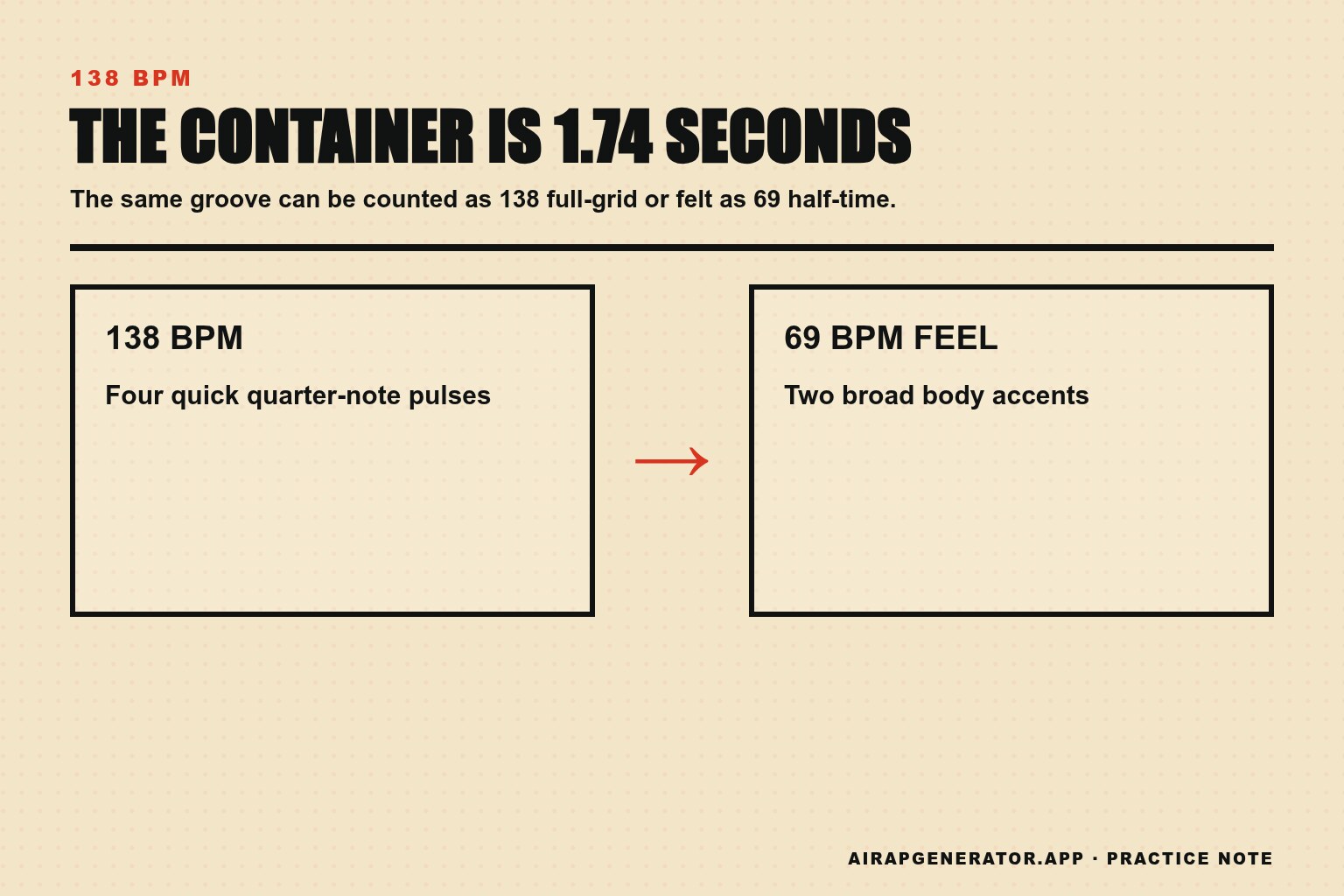
0.435 × 4 = about 1.739 seconds per bar
That is the available clock time. It does not tell you how the beat feels. Many 138 BPM trap and drill instrumentals are felt in half-time, where the snare suggests a slower 69 BPM pulse even though the project grid counts 138. The bar still lasts the same amount of clock time; your phrase may simply feel broader because the main accents are farther apart.
Full-time and half-time are counting choices
If you nod to every fast quarter-note pulse, 138 feels urgent. If you nod to the larger backbeat, it feels like 69. Producers and rappers may describe the same instrumental using either number. Confirm what one bar means in the session before comparing syllable counts.
2. Convert delivery speed into a rough range
A useful estimate starts with syllables per second, not syllables per bar. Multiply your clear speaking or rapping rate by 1.739 seconds.
| Delivery rate | Approximate syllables per 138 BPM bar | Practical feel |
|---|---|---|
| 3 syllables/second | 5 | Very open, room for held vowels |
| 4 syllables/second | 7 | Conversational and spacious |
| 5 syllables/second | 9 | Active but generally readable |
| 6 syllables/second | 10–11 | Dense, needs clean word choices |
| 7 syllables/second | 12 | Fast and articulation-sensitive |
| 8 syllables/second | 14 | Double-time territory for many beginners |
| 9 syllables/second | 15–16 | Demanding and hard to sustain clearly |
These are arithmetic estimates, not prescriptions. Two lines with eleven syllables can require very different effort. “I never let the daylight catch me waiting” moves more easily than a line packed with clusters such as “strict scripts clipped through cramped breaths.” The count is the same kind of data; the mouthfeel is not.
Start testing around eight to ten syllables per bar. That range leaves enough room to hear stress and make edits. Expand only when the words remain clear on playback.
3. Count spoken syllables, not dictionary possibilities
Rap uses performance pronunciation. “Every” may be two syllables in one delivery and three in another. “Family” may compress. A word can stretch across several notes. The count that matters is the version you actually say.
Take this original line:
Every little message in the hallway stayed.
A careful reading may produce twelve syllables. Compressing “every” to two spoken syllables produces eleven. Neither version is automatically correct.
Write the performed sounds under the line:
Ev-ry lit-tle mes-sage / in the hall-way stayed
Then tap four beats and speak it. If a syllable disappears only because you are swallowing it, the count has not solved the clarity problem.
Consonants set the real speed limit
Vowels can connect smoothly. Repeated hard consonants require the tongue and lips to reset. Count the clusters that slow the line:
- “clean lane” joins easily;
- “crisp scripts” demands several rapid closures;
- “world turned” may blur unless separated;
- “sixth street” is far harder than its written count suggests.
When a line trips, replace the cluster before deleting the image.
4. Place stresses before filling every subdivision
A bar containing ten evenly weighted syllables often sounds busier than a bar containing fourteen with a clear stress pattern. The listener follows accents, not a spreadsheet.
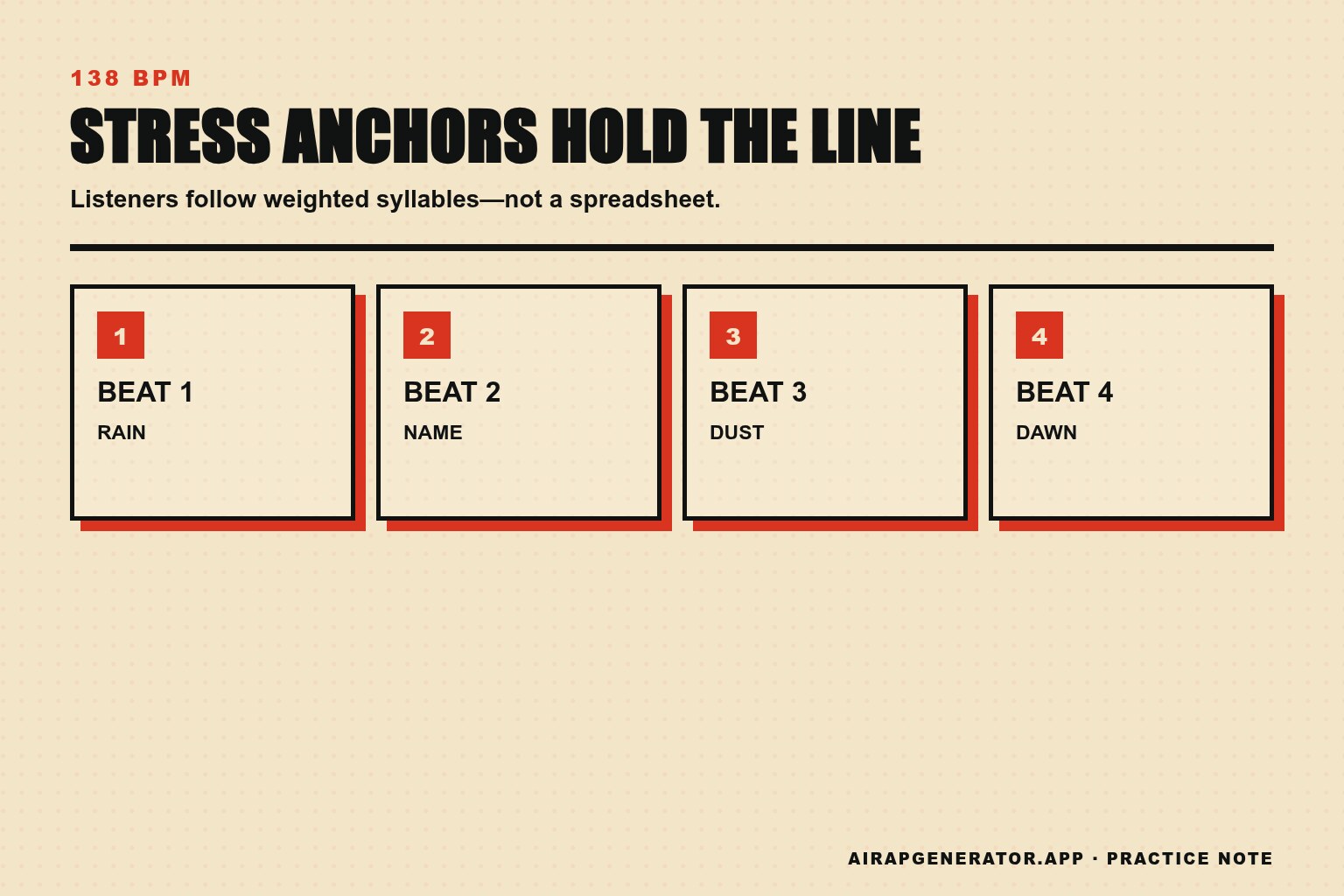
Start with four anchors, one around each beat:
Rain on the roof / left a name in the dust / by dawn
Now add unstressed syllables around them. The anchors act like fence posts. You can lean phrases forward or backward while the larger shape remains understandable.
Avoid stressing every syllable. Constant weight removes hierarchy and exhausts the voice. A dense line needs more contrast, not more force.
If the anchors look right but the recorded line still drifts, run the on-beat reference-loop test before changing the syllable count again. It separates a density problem from an entrance or pocket problem.
Try this exercise:
- Clap four steady beats.
- Say only the four stressed words.
- Add the connecting words quietly.
- Remove one connecting word without moving the anchors.
- Record both versions and compare clarity.
5. Test three density levels on the same thought
Do not compare unrelated lines. Rewrite one thought at three densities so the timing is the variable.
Open, six syllables:
Rain kept tapping my door.
Middle, nine syllables:
Rain kept tapping hard against my door.
Dense, fifteen syllables:
All night the rain kept tapping hard against my apartment door.
The fifteen-syllable version contains more information, but it also spends most of the bar. At 138 BPM it may work as a quick pickup, a double-time phrase, or a line carried across the boundary. If every bar has that density, the verse loses contrast and breathing room.
Record each version three times. A density passes when:
- every important word remains intelligible;
- the final syllable is not squeezed;
- the next bar begins on purpose;
- the take can be repeated without changing the words;
- your breath still supports the following line.
The highest passing count is your current ceiling for that word shape, not a target for every bar.
6. Use bar lines as doors, not walls
Trying to finish every sentence before beat four creates cramped endings. A phrase can cross into the next bar while the musical count continues underneath.
Consider:
Bar 1: I left the light on in the hall because I
Bar 2: knew you would be late but never said it
The sentence crosses the boundary after “I.” That small suspension can create forward pull. It also spreads the syllables more naturally than forcing the whole thought into one bar.
Three legal ways to handle an overfull line
- Cut: remove words that do not change the image.
- Carry: let the phrase continue into the next bar.
- Split: turn one sentence into a setup and answer.
Original overfull thought:
I was standing in the kitchen when I saw your name appear again.
Cut:
Kitchen light, your name appeared again.
Carry:
I was standing in the kitchen when your name / appeared again.
Split:
Kitchen light, the screen woke up / your name came back again.
All three preserve the event. They create different rhythms rather than merely shorter text.
7. Budget breaths across four bars
One bar can be performable and still sabotage the next three. Test density in a four-bar chain.
Mark breath locations before recording. A short inhale after a complete thought is easier to hide than a desperate breath between a modifier and noun. Leave one planned opening every one or two bars while learning the passage.
Use a simple grid:
| Bar | Syllables | Main stresses | Planned breath | Result |
|---|---|---|---|---|
| 1 | 9 | 4 | End | Clear |
| 2 | 12 | 4 | None | Clear but tense |
| 3 | 8 | 3 | Middle pause | Recovers |
| 4 | 14 | 5 | End | Rushed final word |
This example shows why average density matters. Bar three gives back the air bar two spent. Bar four still fails because it ends the sequence without recovery. The fix could be cutting bar four to eleven syllables or moving part of it into the next section.
Do not practise breath control by pushing until dizzy. Stop, recover normally, and reduce density. Clear rap is not an endurance stunt.
8. Find your personal 138 BPM ceiling
Use one four-bar loop and a metronome or instrumental set to 138 BPM.
- Write four original seven-syllable lines.
- Record them three times.
- Add one or two unstressed syllables per line.
- Keep the same stress anchors.
- Record again.
- Repeat until clarity or repeatability drops.
- Step back one level and perform four clean takes.
Score the takes without watching the lyric sheet:
| Score | Description |
|---|---|
| 5 | Every word clear; pocket repeatable; breath controlled |
| 4 | One soft consonant; timing still intentional |
| 3 | Meaning clear, but at least one rushed phrase |
| 2 | Several words blur or bar ending collapses |
| 1 | Cannot repeat the take at the same density |
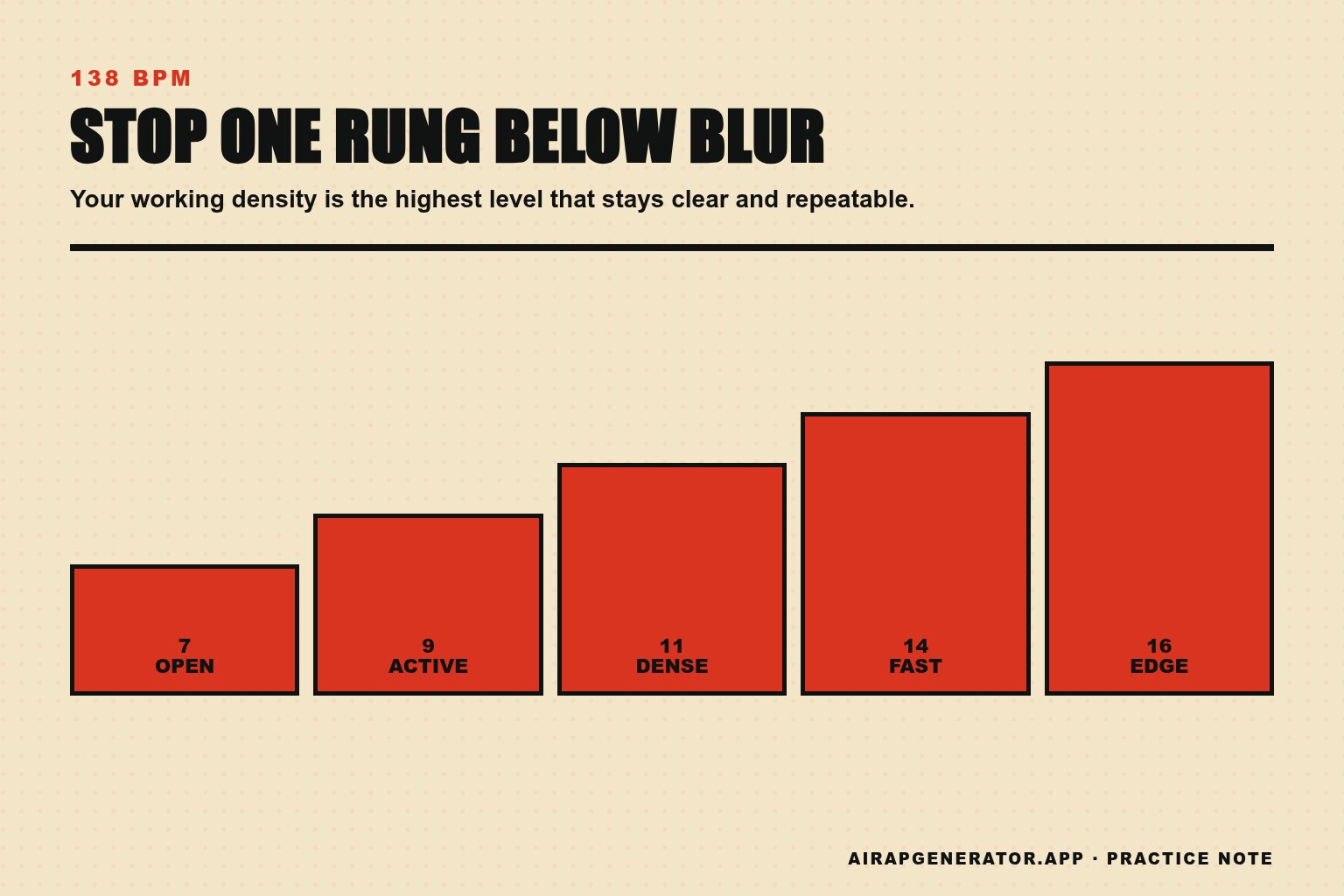
Your working density is the highest level that earns four or five three times. The first level that earns two is useful too: it identifies a training edge.
For most new rappers, the answer should not be the maximum. Start with the highest repeatable, intelligible number, then vary below it. A verse with bars of seven, ten, eight, and twelve syllables can move more than four consecutive bars of fourteen.
Edit density across a whole eight-bar passage
Once the personal ceiling is known, map the eight bars as a contour instead of solving each independently. A useful first pattern is medium, medium, open, dense, then repeat with a different ending. The open bar prepares the ear and the breath for the dense one.
For example, a performer whose repeatable ceiling is twelve might draft this contour:
| Bar | Planned count | Job |
|---|---|---|
| 1 | 9 | Establish the pocket |
| 2 | 10 | Add detail |
| 3 | 7 | Leave space after the image |
| 4 | 12 | Push into the section turn |
| 5 | 8 | Reset the voice |
| 6 | 10 | Rebuild movement |
| 7 | 6 | Create suspense |
| 8 | 11 | Land the final rhyme |
The numbers do not need to be exact before performance. Their purpose is to prevent four dense bars from arriving by accident. After recording, replace the planned counts with performed counts and note where pronunciation compressed a word.
If every bar remains clear but the passage still feels flat, change the contour before adding speed. Put the open bar somewhere unexpected, carry a phrase across a boundary, or move the densest line away from the obvious ending. Density becomes musical when it creates contrast over time.
A practical starting chart
Use this only to choose the first test:
| Goal | Starting syllables per bar | What to listen for |
|---|---|---|
| Spacious melodic phrase | 5–8 | Held vowels and clean breath |
| Conversational verse | 7–10 | Natural stress without rushing |
| Active drill or trap pocket | 9–12 | Crisp consonants and deliberate gaps |
| Short double-time burst | 12–16 | Every word surviving playback |
| Sustained fast passage | Test individually | Breath, jaw tension, and repeatability |
Genre labels do not override the test. An “active drill” line full of hard clusters may need fewer syllables than a smooth conversational line. Use your recording, not the row name, as the decision.
Frequently asked questions
Is 138 BPM fast for rap?
It is a fast quarter-note grid, but many rap instrumentals at that tempo use a half-time feel. That makes the main groove feel broader. The numerical tempo and perceived pace describe different parts of the experience.
Do contractions count as one syllable?
Count the sound you perform. “I'm” is one, while a stretched “I am” is two. Write the spoken version under the lyric when the count is ambiguous.
Should every bar have the same number of syllables?
No. Similar counts can make a section stable, but identical density across a verse often sounds flat. Keep a repeatable underlying pulse and vary how much space each thought uses.
Can software count rap syllables accurately?
It can estimate written syllables, but performance pronunciation, contractions, stretched vowels, and swallowed sounds create differences. Use automated counts as a draft check and a spoken recording as the final evidence.
Three things you can stop worrying about
Finding one universal number. Tempo defines the time available; pronunciation, consonants, stress, and breath determine usable density.
Giving every bar the same count. A changing contour creates contrast and can make the dense line easier to hear.
Matching a dictionary perfectly. Count the performed version, then reject any compression that makes the word unclear.
The short version
The useful answer to how many syllables can rap fit in a 138 bpm beat is the highest count you can deliver clearly and repeatably. Start around eight to ten, test upward, and keep one level below the first breakdown.
Keep reading
- How to write rap lyrics for building the full verse around a usable bar length.
- How to improve rap flow for changing pocket after the density works.
- How to write your first rap song for placing dense and open sections across an arrangement.