Alternative Hip Hop: 7 Decisions for a Coherent Track
Alternative hip hop writing can cross textures without losing its center. Make seven concrete decisions about voice, arrangement, contrast and the final edit.

You add guitar to the loop, replace the drums with a strange pattern and speak the second half of the verse. Each change sounds interesting alone. Together, they feel like three unfinished songs switching tabs.
Alternative hip hop is a broad label rather than a recipe. For a writer building an experimental track, the practical challenge is giving the listener something stable while changing enough around it to create surprise. That stable thing might be a speaker, an image, a rhythmic anchor or a recurring phrase.
Vince Staples' “Tulsa, OK” is listed as a one-song single released on October 9, 2026, under an Alternative classification on the external Apple Music release page. A store category is not a full genre analysis. The verified release is a current prompt for thinking about crossed categories; this guide does not claim to have measured its arrangement or attribute the following techniques to that recording.
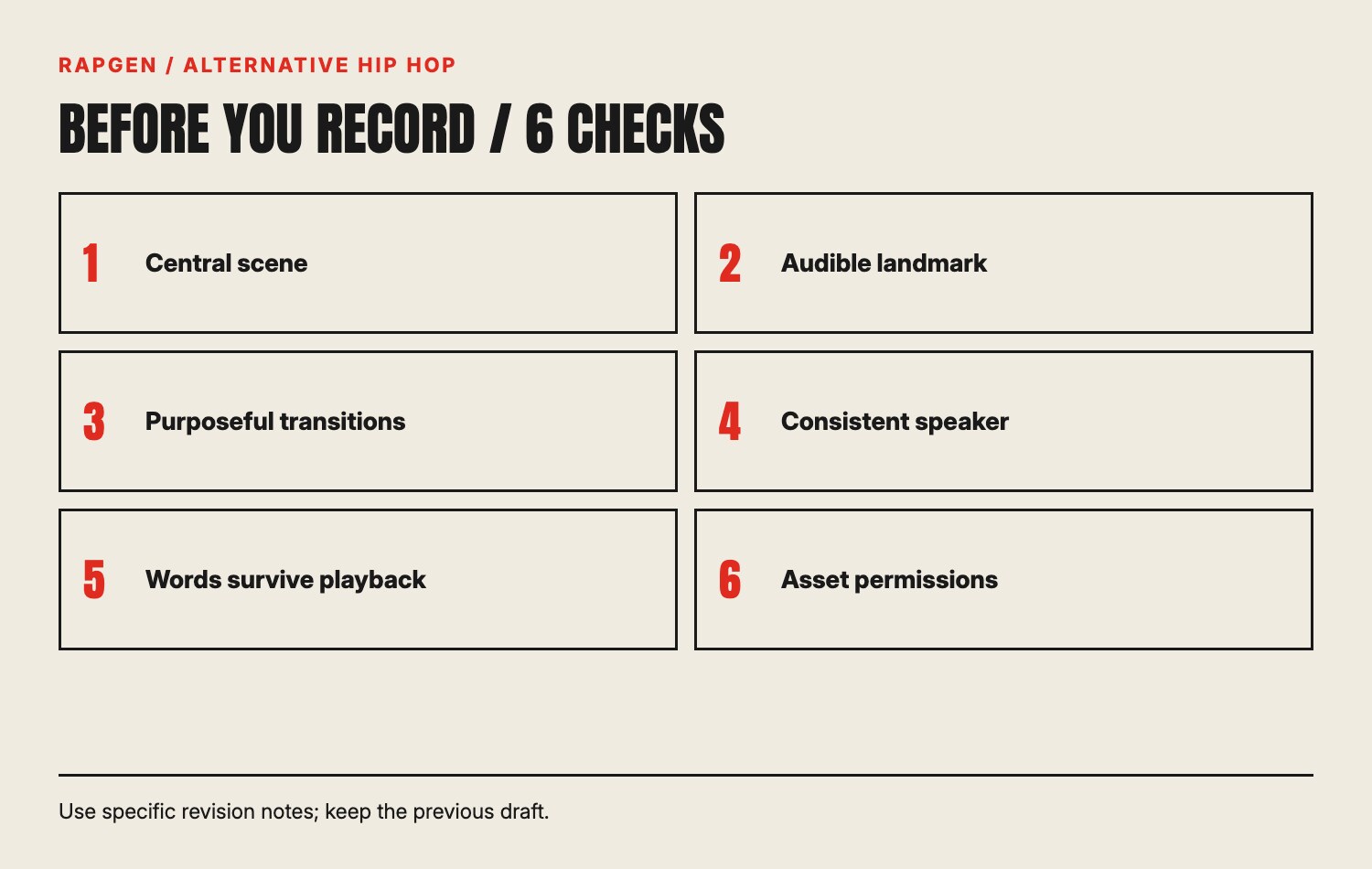
We will make decisions for an original fictional track about a night-shift repair shop. Its central object is a radio that catches a station only when the shop lights go out. You can borrow the decision process, then replace the entire setting with your own.
1. Write the sentence that holds the experiments together
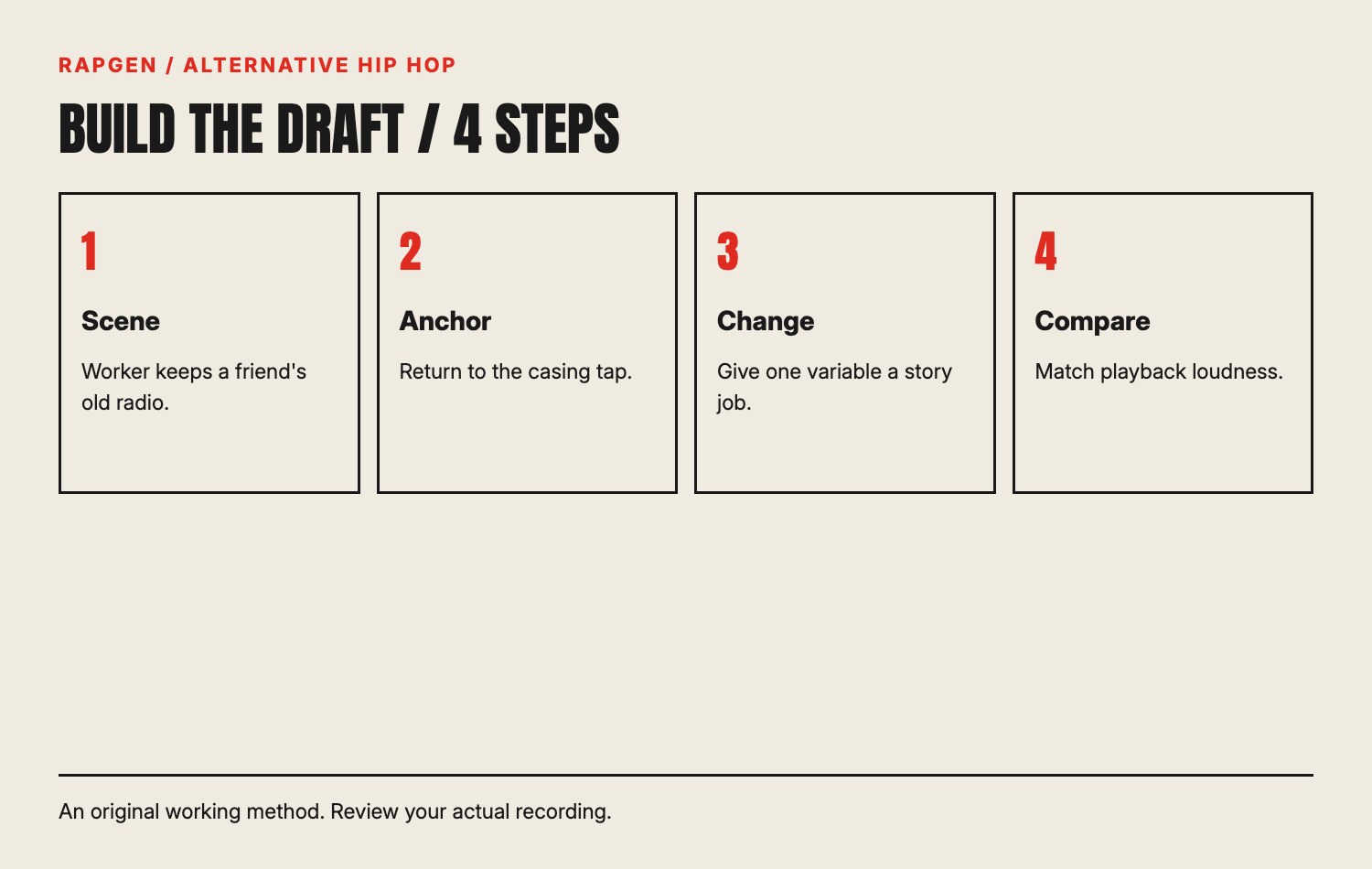
Before choosing unusual sounds, describe what happens. “A repair worker keeps a broken radio because it is the last thing a friend left behind.” That sentence supplies a relationship, an object and a reason the speaker refuses to discard it.
An arrangement can then change while the listener remains inside the same situation. A dry spoken section might describe the workbench. A melodic return might carry the memory attached to the radio. Both are different views of the same object rather than separate themes fighting for attention.
Keep the sentence beside the session. When you add a new section, write how it relates to that central situation. If you cannot explain the connection, save the idea in a separate file. You do not have to delete an interesting experiment to recognize that it belongs elsewhere.
Choose an anchor you can hear
A theme in your notes may be invisible in the recording. Give it a recurring word, sound or action. Our speaker taps the radio casing whenever reception fails. The tap can appear in the lyric and, if you record it yourself, in the arrangement.
Use the anchor sparingly enough that its return remains noticeable. Put it at a transition or emotional turn, then listen without watching the timeline. If it feels like a random sound effect, establish its connection to the narrator earlier.
2. Change one major variable per section
You can change tempo, meter, instrumentation, delivery and perspective. Changing all of them at once makes it harder for a listener to know what continued across the cut. Choose the variable with the clearest narrative purpose first.
Our verse keeps the same pulse while moving from drums to a sparse guitar texture. The speaker remains the worker at the bench. Later, the return phrase becomes more melodic while the radio image remains intact. Each transition offers a new surface and a recognizable link.
This is a drafting constraint, not a law for the genre. Once a listener can follow the basic form, you can test a more abrupt change. The constrained version gives you something meaningful to compare against; it prevents novelty from becoming the only reason a section exists.
| Variable | Example change | What stays recognizable | Review question |
|---|---|---|---|
| Texture | Drums give way to a guitar figure | Speaker and pulse | Does the lyric gain room? |
| Delivery | Rapped passage becomes spoken | Central object and scene | Is the change connected to a thought? |
| Density | Several layers reduce to one | Recurring phrase | Does the reduction reveal something? |
| Perspective | A memory enters the present account | Clear speaker cue | Can the listener identify who is talking? |
Write the reason for the change in a few words: “memory interrupts work,” “speaker stops explaining,” “radio becomes audible.” That reason is more useful in revision than a genre adjective that does not tell you what to remove.
3. Give each texture a job in the lyric
If you already have an instrumental, mark the moments where it changes. Beside each, write what the speaker is doing or understanding. A transition can underline a turn, create breathing room or deliberately oppose the lyric's mood.
Avoid describing a borrowed beat as if you can freely remove its parts. If you only have a stereo file, your control is limited. You may need a different beat, permission for an edit or access to stems. Keep the writing exercise within the material you can actually use.
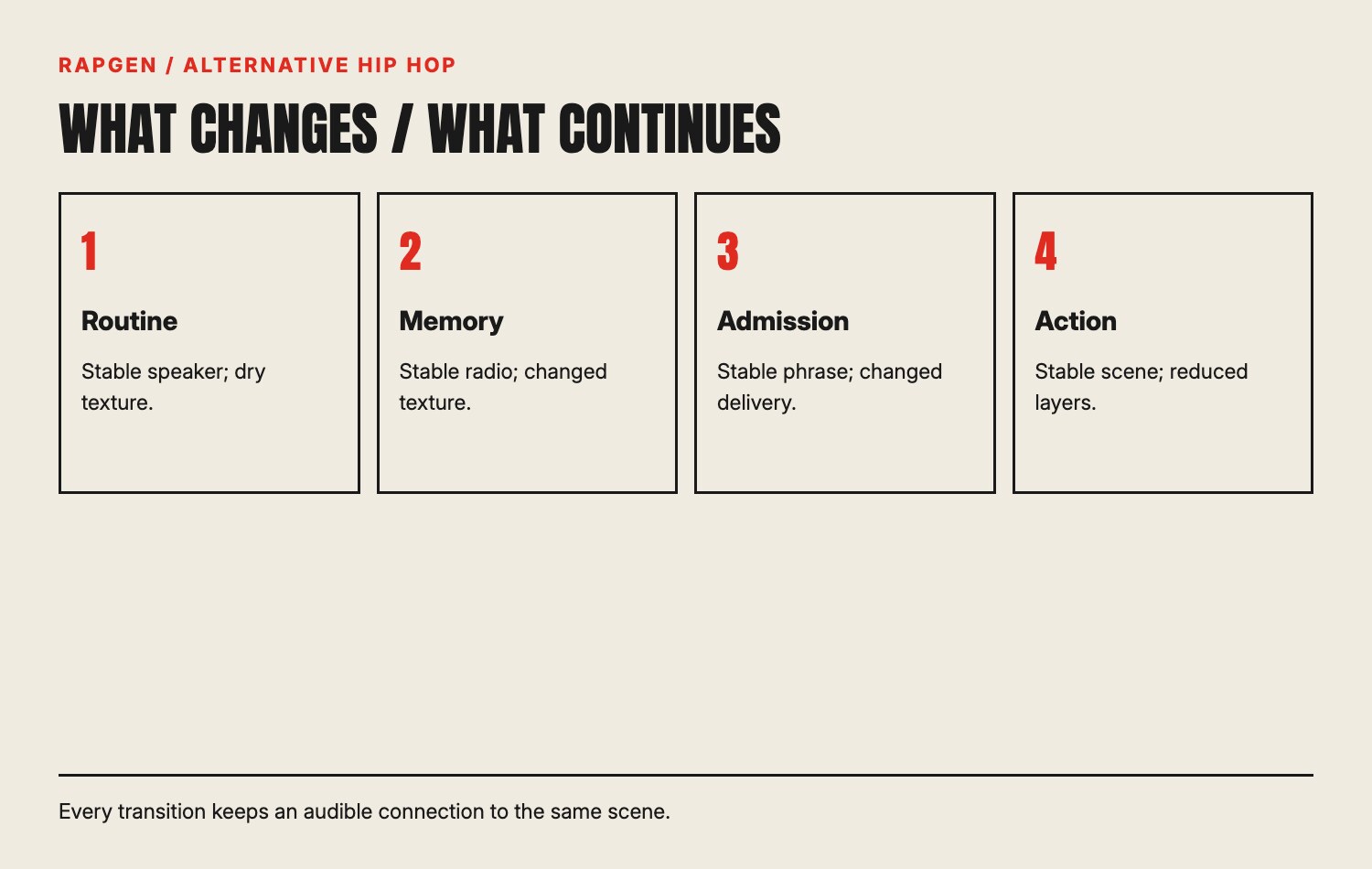
For our original session, the dry opening carries tools and routine. A softer texture enters when the speaker mentions the friend. The stripped ending leaves the radio tap exposed. This mapping gives every arrangement idea a reason to survive the edit.
Write across the seam
Create one sentence that begins before a texture change and completes after it. The continuing thought can connect the surfaces. Try the phrase spoken first so you know the change is musical, not an accidental loss of meaning.
I kept the radio because the dial was bent —
Or that's the story that I tell about the dent.
The second line revises the speaker's explanation. A transition between the lines can support that revision. These original lines are a writing model, not a prescribed melody or an analysis of a released song.
4. Keep the speaker consistent across delivery styles
A person can rap, speak and sing within the same track. They should still seem to inhabit the same scene unless you explicitly introduce a different character. Vocabulary, point of view and what the speaker knows are useful continuity checks.
Our worker would call the object a radio, a dial or an old set. If the melodic section suddenly refers to it as a “transcendent vessel of frequencies,” ask whether that phrase belongs to the person you established. It may be intentionally theatrical, but it should be a decision rather than an artifact of chasing a rhyme.
Use a plain sentence to reset the listener after a dense section. “The shop closes at eleven” can orient the next passage before it becomes associative. The specific time is a fictional scene detail here, not a universal fact about repair shops.
Mark a deliberate character change
If you want the radio to speak, distinguish that voice with a cue. A separate address, a repeated introduction or a changed recording treatment can help. Test the audio without the lyric sheet; a label in your notes cannot explain the switch to someone who never sees it.
You do not need to imitate a recognizable singer to create contrast. Change the sentence length, spacing or relationship to the beat. A quieter, shorter response can sound like a different perspective while remaining performable in your own voice.
5. Use a repeated phrase as a movable landmark
Write a phrase that has a clear literal meaning at the opening and room to acquire another meaning later. “Keep the dial where it was” can refer to a radio setting, then to the worker's reluctance to move on.
Try the phrase in two positions: after the first account of the broken radio and after the admission about the friend. Listen for whether the second appearance earns its place through new information. If both sections say the same thing, revise the section rather than decorating the repeated phrase.
Your landmark can be spoken or melodic. It does not have to become a conventional chorus. It does need an identifiable shape if you expect a listener to recognize its return. Keep a key word, stress pattern or recording cue consistent while testing variations.
Do not ask an unusual instrumental to compensate for a vague repeated line. Read the phrase without the music. Can you explain who is saying it and what they want? If the answer depends entirely on the production's atmosphere, supply one clearer connection in the lyric.
6. Compare experiments at similar playback loudness
Save a straightforward version before adding new layers. Then compare a version with one major change. Similar playback loudness matters because a louder arrangement can feel more exciting even when it hides the words you meant to emphasize.
Make your comparison specific. “The guitar version leaves the word ‘friend’ clearer” is useful. “This version feels more alternative” does not identify what improved. A genre label cannot tell you whether the transition clarified the scene.
Listen in three contexts: headphones, a phone speaker and a low-volume room playback. You are not mastering the track with this test. You are checking whether the vocal and anchor survive different ordinary listening conditions. Log a timestamp if a key sentence disappears.
Keep the reversible decision
Store alternate takes and instrument versions separately. Name them for the change, such as “spoken bridge” or “radio tap exposed,” rather than “final final.” If a later vocal makes the old arrangement work, you can recover it without reconstructing a session.
Check licenses for loops, samples and sound effects. Experimental framing does not remove those obligations. If the radio in your scene uses broadcast audio, an original recorded texture is a different rights situation from sampling an actual program. Use material you can establish permission to release.
7. Cut the experiment that repeats another section's job
Walk through the arrangement and write what each section contributes. One establishes routine, another changes the explanation, another supplies the admission and the last shows an action. If two sections both supply the same admission, combine them or make one do different work.
A favorite sound may have no remaining job after the lyric changes. Keep it in the project archive rather than forcing a section around it. The edit is easier when you have already saved the idea; removing it from this track is not losing it forever.
Our ending returns to a physical action:
I leave the little radio beside the open door,
Let the morning find the dial where I kept it before.
You might revise this into a more decisive action, such as handing the radio to another worker. Choose the ending that matches the speaker's actual change. An unresolved ending can be coherent if the track has clearly established what remains unresolved.
Ask an unfamiliar listener to describe the track in one sentence. They do not need to identify every production influence. If they understand the worker's relationship to the radio and notice the explanation changing, your central thread has survived the experiments.
A transition repair in practice
Suppose a listener says the spoken bridge feels like a different narrator. First compare its vocabulary with the opening verse. If the bridge abandons the repair worker's radio and tools for general language about destiny, replace one abstract sentence with the worker touching the bent dial. Keep the unusual instrumental in place for that test.
If the speaker now feels continuous but the entrance still jars, move the radio tap to the seam and let the bridge begin after it. You have addressed identity first and musical connection second. Changing both together would make it harder to tell what restored the thread.
Save an export containing the verse, seam and bridge. You need to hear the repair in context, not judge the spoken sentence alone. Ask the listener whether they still picture the worker in the shop. If they do, the contrasting texture can remain surprising without requiring another explanation of who is speaking. Keep the earlier version as a reference rather than overwriting the evidence of what failed.
Three things you can stop worrying about
Crossing enough genres. One well-motivated contrast can reshape a song. More categories do not automatically produce a more coherent recording.
Explaining every unusual sound. The arrangement can remain suggestive. The speaker's situation needs enough clarity for that suggestion to connect to something.
Choosing a permanent label while drafting. Describe the actual decisions you made. You can consider release metadata once you have a recording that communicates those decisions.
Draft words before choosing another texture
Use the rap lyrics generator once the repair-shop situation has a clear point of view. Its output is a structured lyric draft, not a controllable multitrack arrangement. Compare any returned section with your anchor sentence and write the production decisions yourself.
The short version
For alternative hip hop writing, choose a central scene, make an audible anchor and change major variables for identifiable reasons. Keep the speaker consistent, compare experiments fairly and remove sections that repeat another section's job. The listener can follow a surprising surface when something underneath continues.