Rap Song Structure: 8 Decisions Beyond Verse and Hook
Rap song structure made practical: map section lengths, compare two arrangements, place the contrast, and decide what each return adds to your track.
You have a verse you like, a hook that returns easily, and an instrumental that keeps looping. Put them together and the song still seems to stand in one place. The individual sections have enough material. Their sequence has not yet created a reason to keep listening.
That is where rap song structure becomes a set of practical decisions. Which section introduces the central phrase? How long does a listener wait for its return? What changes after that return? You can test those questions with rough vocals before polishing a single transition.
The examples here use four-beat bars and simple section lengths so the arithmetic stays visible. They are working arrangements, not a rule for every genre or a prescription for streaming performance. Use them to find the shortest version that delivers your particular song.
1. Name the job before you name the section
Write a short description of what each piece currently does. A verse may introduce the situation, a hook may state the central phrase, and another passage may change the speaker's view. Those descriptions are more informative than naming three files “verse,” “hook,” and “bridge.”
A section can also have a primarily musical job. Eight bars might clear the vocal so the bass becomes the foreground. Another four might create a ramp into the last refrain. You do not have to explain everything in lyrics, but you should know what changes while the section plays.
Label an arrangement with verbs
Try “introduce,” “insist,” “complicate,” “release,” and “leave.” A sequence that reads “introduce, repeat, introduce, repeat” may work as a deliberate circular song. If you intended development, however, the labels reveal that you have not yet assigned a place for it.
Keep this map separate from your lyric document. You should be able to move a section without getting distracted by whether its third line needs a better rhyme. First make a decision about its job; afterward decide whether the current writing performs that job.
2. Measure the song you actually built
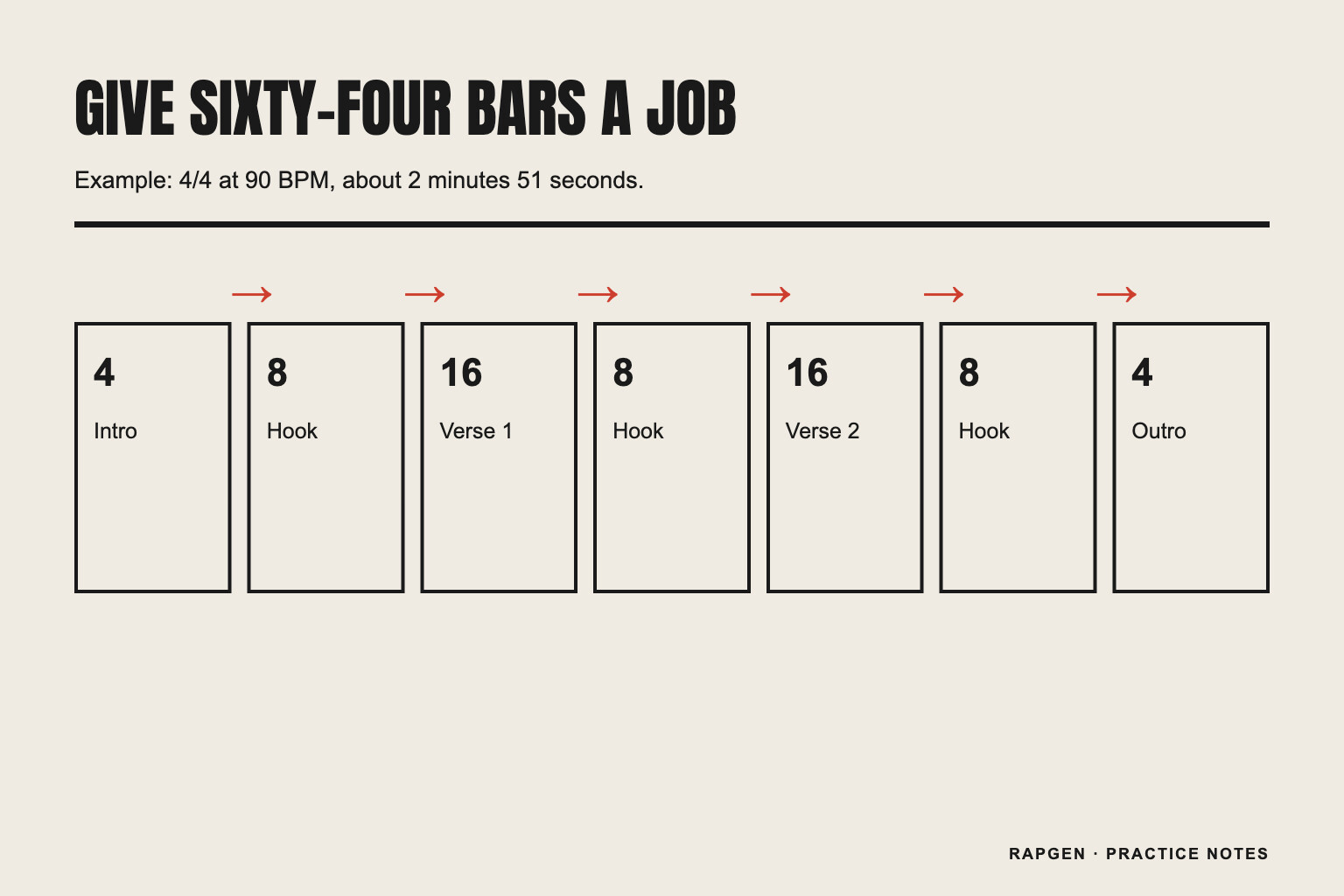
A bar count is useful only when you know what a bar means in the session. In the examples below, one bar contains four quarter-note beats. At 90 BPM, its duration is four multiplied by sixty divided by ninety: about 2.67 seconds.
Here is a compact, fully specified arrangement:
| Section | Bars | Job |
|---|---|---|
| Intro | 4 | Establish the sound and entrance cue |
| Hook | 8 | Introduce the central phrase |
| Verse 1 | 16 | Show the situation |
| Hook | 8 | Return with the situation in mind |
| Verse 2 | 16 | Add a consequence or different angle |
| Hook | 8 | Make the final return |
| Outro | 4 | Finish the musical thought |
| Total | 64 | About 2 minutes 51 seconds at 90 BPM |
The precise total is 64 × 4 × 60 ÷ 90, or about 170.67 seconds. This excludes extra silence, pickup time outside the counted sections, and any tempo changes. At another tempo the same bar map has a different duration.
Check the count against the audio
Place markers at the actual starts in your audio session. A file labeled “eight-bar hook” may include a two-bar lead-in. If you count the file name instead of listening, every later marker will appear to be misplaced.
3. Compare a hook-first and a verse-first opening
Make two rough versions with the same material. Version A is the map above: intro 4, hook 8, verse one 16, hook 8, verse two 16, hook 8, outro 4. For version B, swap only the opening hook and verse one: intro 4, verse one 16, hook 8, hook 8, verse two 16, hook 8, outro 4. Both versions contain sixty-four bars and three eight-bar hook units. The swap leaves two consecutive hook units in B, so listen to that extended return as part of the comparison rather than overlooking it.
This controlled swap answers a narrow question about the opening; B is not a finished recommendation. If its sixteen-bar refrain feels too long, save a third version with one of those adjacent hook units removed. That edit produces fifty-six bars, about 2 minutes 29 seconds at 90 BPM in 4/4. Now you are testing a shorter structure as well as a different opening. Keep those two decisions separate in your notes so you know which improvement you heard.
The hook-first version establishes the phrase early, which can help a listener recognize later returns. The verse-first version can give that phrase a context before it appears. Neither choice repairs a weak opening section; it changes what information reaches the listener first.
Use a concrete example. Suppose your refrain is “leave a light in the hall.” The first verse describes someone returning late and hesitating outside the door. Hook first makes the phrase sound like an invitation that the verse explains. Verse first lets the same phrase arrive as an answer to the scene.
Ask one question after each version
“What am I waiting to hear next?” is a useful test. If both openings make you wait only for the current section to end, examine the material itself. If one creates a specific expectation, note what established it: a withheld detail, a musical pickup, or a recognizable phrase.
Do the comparison at similar playback levels and without announcing which arrangement you prefer. A dramatic volume difference or your introduction to the test can steer the result before the structure has a chance to speak.
For example, record “A: phrase arrives early but the scene feels delayed; B: scene is clearer, double hook drags; C: clearer scene without the extended return.” Those are useful observations tied to specific versions. “B is more professional” supplies no next edit and no evidence another listener can check.
4. Give the second verse information the first lacks
Before adding sixteen more bars, write the new information in plain language. “The speaker discovers who left the light on” is a change. “The speaker repeats how tired they are” is more of the same material, even if the rhymes improve.
A second verse might change the time, location, consequence, or point of view. Choose one main change for the first draft. Several simultaneous shifts can be exciting, but they are harder to diagnose when the arrangement already feels confused.
Try this pair of original section summaries:
Verse one: I wait outside the door because I expect an argument.
Verse two: I go inside and find the table set for two.
The refrain now has something new to carry. “Leave a light in the hall” means one thing before the door opens and another afterward. You have created a reason for repetition without rewriting the refrain.
If no new section is needed, test a shorter song. A second verse is a structural option, not a fee every track must pay. The second-verse guide provides more ways to locate new material when the song does need that space.
5. Change one layer at a returning hook
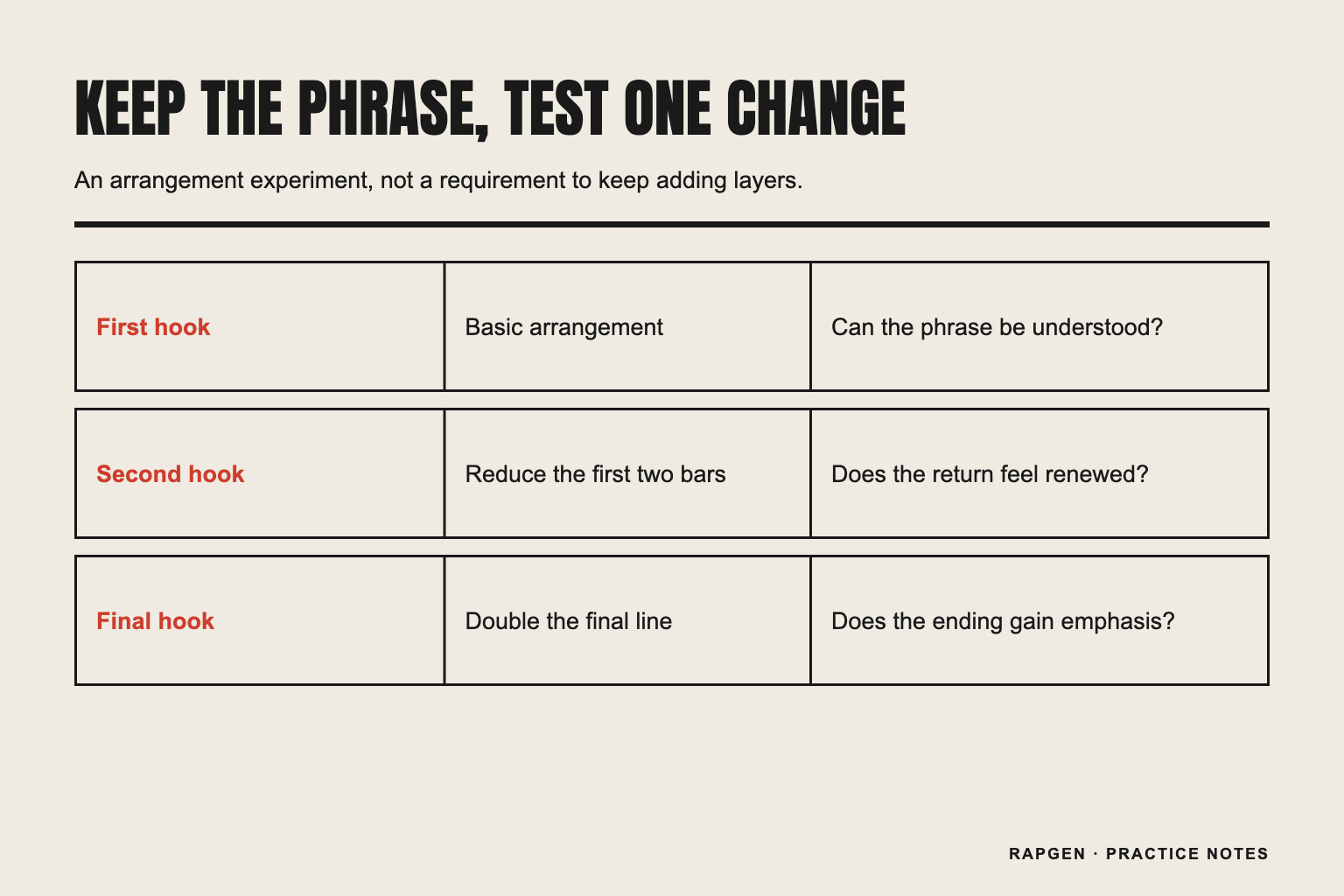
A return can remain recognizable while sounding different. Keep the main phrase and test one change: remove the first kick, add a vocal double on the final line, thin the opening two bars, or let an earlier instrumental part return.
The change should have a job you can hear. Removing a busy layer may bring attention back to the words. A brief drop can create room before the strongest entrance. More layers may support a final expansion, but they can also make the same performance harder to understand.
Use a small contrast matrix
| Return | Stable element | One trial change | Listen for |
|---|---|---|---|
| First hook | Main phrase | Basic arrangement | Can the phrase be understood? |
| Second hook | Same words and melody | Reduce first two bars | Does the return feel renewed? |
| Final hook | Recognizable opening | Add a final-line double | Does the ending gain emphasis? |
Save the original version before trying the changes. If you keep adding to each return without a comparison, complexity becomes the only direction available. Sometimes the strongest last hook is the one with the fewest competing parts.
6. Add a bridge only when it supplies missing contrast
A bridge can introduce a contrasting melody, delivery, harmony, or lyrical angle before the final return. Naming a section “bridge” does not ensure that it creates contrast. Eight more bars with the same loop and sentence rhythm may function like an additional verse.
Mute the proposed bridge and listen across the gap. If the song now moves more clearly, identify what the bridge was meant to accomplish. Perhaps a two-bar break can do that job. Perhaps the existing verse needs a stronger ending instead.
For the light-in-the-hall example, a bridge could briefly switch from describing the room to addressing the other person directly. Keep it short enough to preserve the impact of that change. The final hook then returns from the altered perspective.
Check the duration cost
Adding an eight-bar bridge to the sixty-four-bar example produces seventy-two bars. At 90 BPM in 4/4, that is 192 seconds, or 3 minutes 12 seconds. The bridge adds about 21.33 seconds. Listen to those seconds as part of the full track, not only as an isolated section you enjoyed making.
7. Design the last audible event
Listen to the final thirty seconds with your eyes away from the session. Decide what the listener should retain: a phrase, a bass figure, a stop, or a quieter fragment. Then make the ending support that choice.
A final hook can end cleanly. A short instrumental tail can let its sound settle. A spoken line can add a last detail. A fade can suggest continuation beyond the recording. Each choice changes the feeling of closure, so audition two before committing.
Avoid adding a long outro simply because the instrumental file contains one. Your song may need fewer bars than the beat maker's original arrangement. Equally, an abrupt cut is not automatically concise: if it interrupts the final word or musical resolution you wanted, adjust the cut.
Test the handoff to silence
Export a rough version and let it finish without touching playback. You are testing the last sound and the silence after it as one event. If you instinctively reach to stop an extra loop, note where you reached. That point is a useful candidate for a shorter edit.
8. Make a rough arrangement before polishing transitions
Use guide vocals, repeated hooks, and simple cuts to assemble the whole track. The first complete pass should answer the structural questions even if it contains imperfect takes. A detailed riser cannot tell you whether verse two belongs where you placed it.
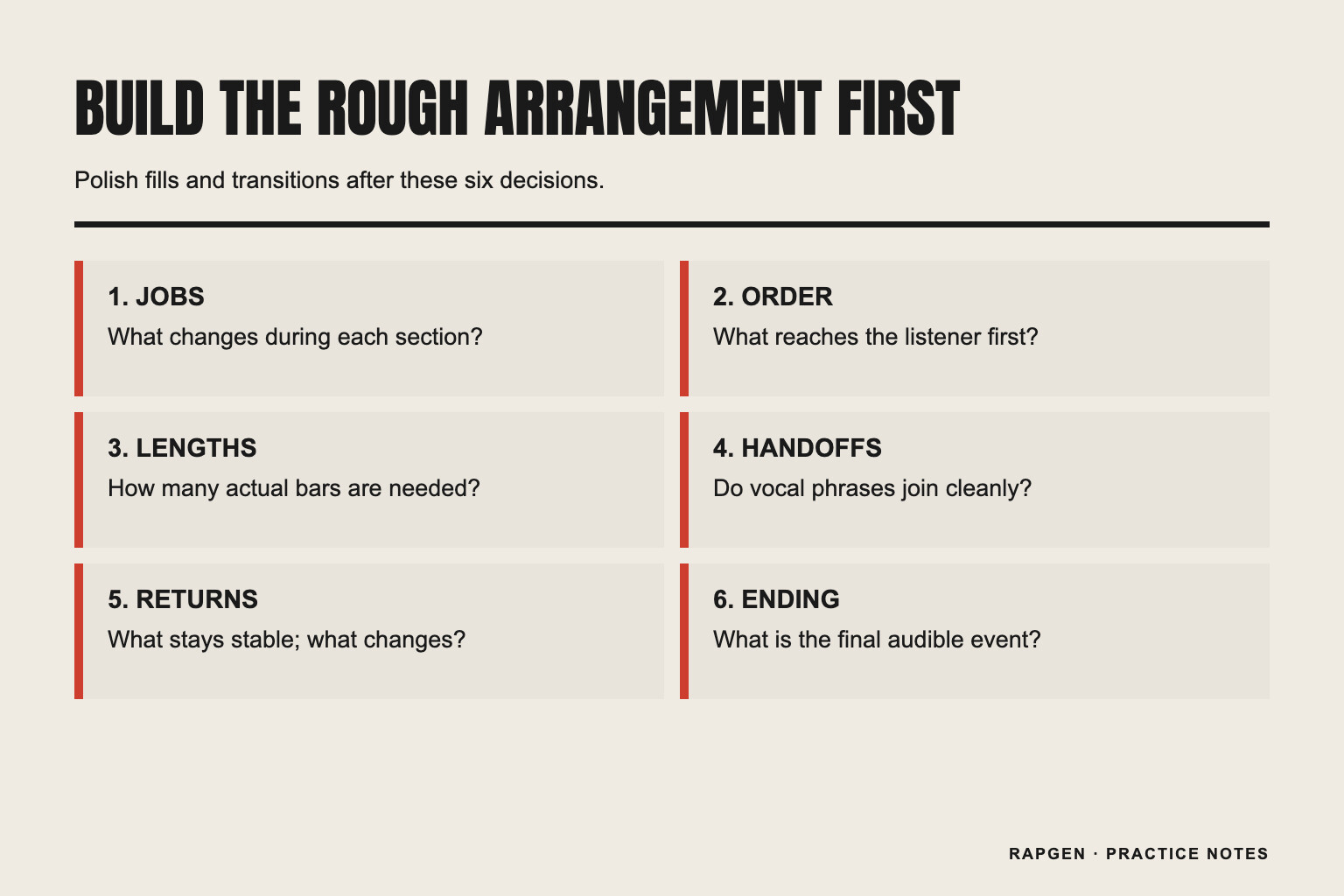
Work through this order: section jobs, section order, section lengths, vocal handoffs, returning contrast, ending. Only then spend time on fills and other transitions. You may discover that the passage you were about to decorate should be half as long.
Save decisions with the version
Name exports by the change, such as “hook-first-short-outro” and “verse-first-short-outro.” Keep your playback level comparable. In a note beside each file, write what improved and what became weaker. That record is more useful than trying to remember which of six files called “final” had the better opening.
Ask a listener to mark the first moment their attention wandered and what they expected next. One response is not a universal audience verdict. It is a concrete listening observation you can compare with your own. If several people point to the same section, test a specific change there.
Three things you can stop worrying about
A single correct template. Familiar maps are useful starting points. The song's material decides whether an intro, bridge, second verse, or outro earns its duration.
Making every return bigger. A reduction can renew attention as effectively as another layer. Compare the actual versions before deciding.
Finishing each section in isolation. A guide take can reveal a weak join before you spend an evening polishing the wrong ending.
Use generated sections as material for the map
The rap lyrics generator supplies labeled verses and a hook. You can use that output to test a section order or compare a repeated phrase against two different passages. It does not establish your instrumental's actual bar markers.
If you use generated lyrics, read and revise the words before recording. A labeled second verse can still repeat the first verse's information. Apply the section-job test to it just as you would to your own draft, then check the result against the beat.
The short version
A useful rap song structure gives each section a job, measures the actual bars, establishes an opening expectation, changes what a hook's return means, and chooses an ending deliberately. Compare complete rough arrangements before polishing their transitions.
Keep reading
- How to write your first rap song for building the initial verse and hook.
- Why rappers leave second verses unfinished for finding material that changes the song.
- How long a rap beat takes to make for organizing an instrumental session around a defined deliverable.