Can Rapping Build Confidence? A Practice Ladder That Helps
Rapping can build performance-specific confidence when practice creates evidence. Use this low-pressure ladder to move from a private take to a live verse.
Confidence is often described as a feeling you need before performing. That order keeps beginners waiting. Performance confidence is more useful when treated as evidence: you have finished a verse, recovered from a blank, shared a take, and survived the result. The feeling usually follows those events.
If your question is will making music and rapping over it increase my confidence, the honest answer is “it can, in specific situations, if the practice is designed well.” Writing or rapping alone does not guarantee broad self-esteem, and it is not a treatment for anxiety. It can give you repeated experiences of choosing words, using your voice, tolerating mistakes, and being heard.
The ladder below keeps those experiences small enough to repeat. You do not jump from a bedroom draft to an open mic. You build evidence one rung at a time.
1. Define the confidence you want
“I want to be confident” is too large to practise. Name a visible action instead:
- finish sixteen bars without deleting the first draft;
- record while standing and looking away from the lyric sheet;
- play one take for a trusted friend;
- rap one verse in front of three people;
- recover without apologizing when a line disappears.
Each action uses a different skill. Someone may write boldly and freeze when the red recording light appears. Another may perform easily and avoid sharing lyrics because the subject feels exposed. A single confidence score hides the useful distinction.
Write one sentence: “I want enough confidence to ___.” That blank becomes the top of your ladder.
Separate courage from quality
A take can be brave and technically weak. A polished take can be cautious. Score the act of doing it separately from rhyme, timing, or vocal control. Otherwise every craft note becomes evidence about your worth, which makes honest revision harder.
2. Start with a private completion rule
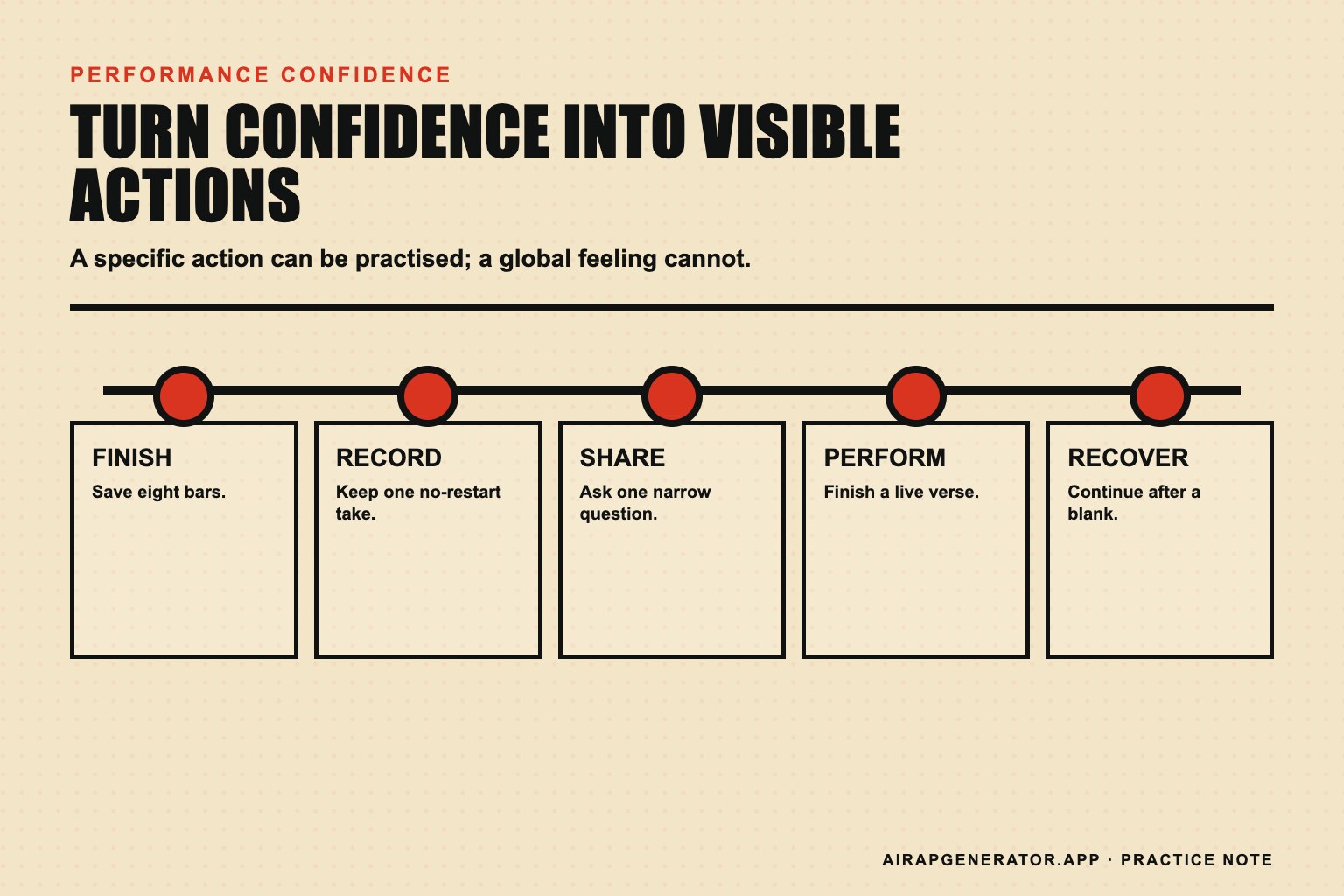
The first rung is not “make something great.” It is “finish something small without restarting.” Use eight original bars over one beat and a fifteen-minute clock.
During the clock:
- choose one concrete moment;
- write eight lines;
- perform the full set once;
- save the recording;
- do not post it.
The no-post rule matters. Early practice needs room where completion is not immediately converted into public judgment. You are proving that a rough attempt can exist without becoming a verdict.
Name the file with the date. A folder of dated completions becomes stronger evidence than memory, which tends to keep the embarrassing moments and discard quiet progress.
3. Make imperfection predictable
Fear grows when mistakes feel undefined. List the three mistakes you expect:
- rushing the last words of a bar;
- losing eye contact to check the page;
- blanking at the start of verse two.
Now assign one response to each. Cut two syllables. Put the page at eye level. Repeat the previous line and jump to the next section. The mistake has not disappeared; it has acquired a next move.
Use a controlled-error drill. On one take, deliberately pause after bar four and continue. On another, replace one forgotten line with a neutral phrase. Listen back. The performance probably sounds less catastrophic than the moment felt.
Confidence is not believing nothing will go wrong. It is knowing what you will do when something does.
4. Build a six-rung exposure ladder
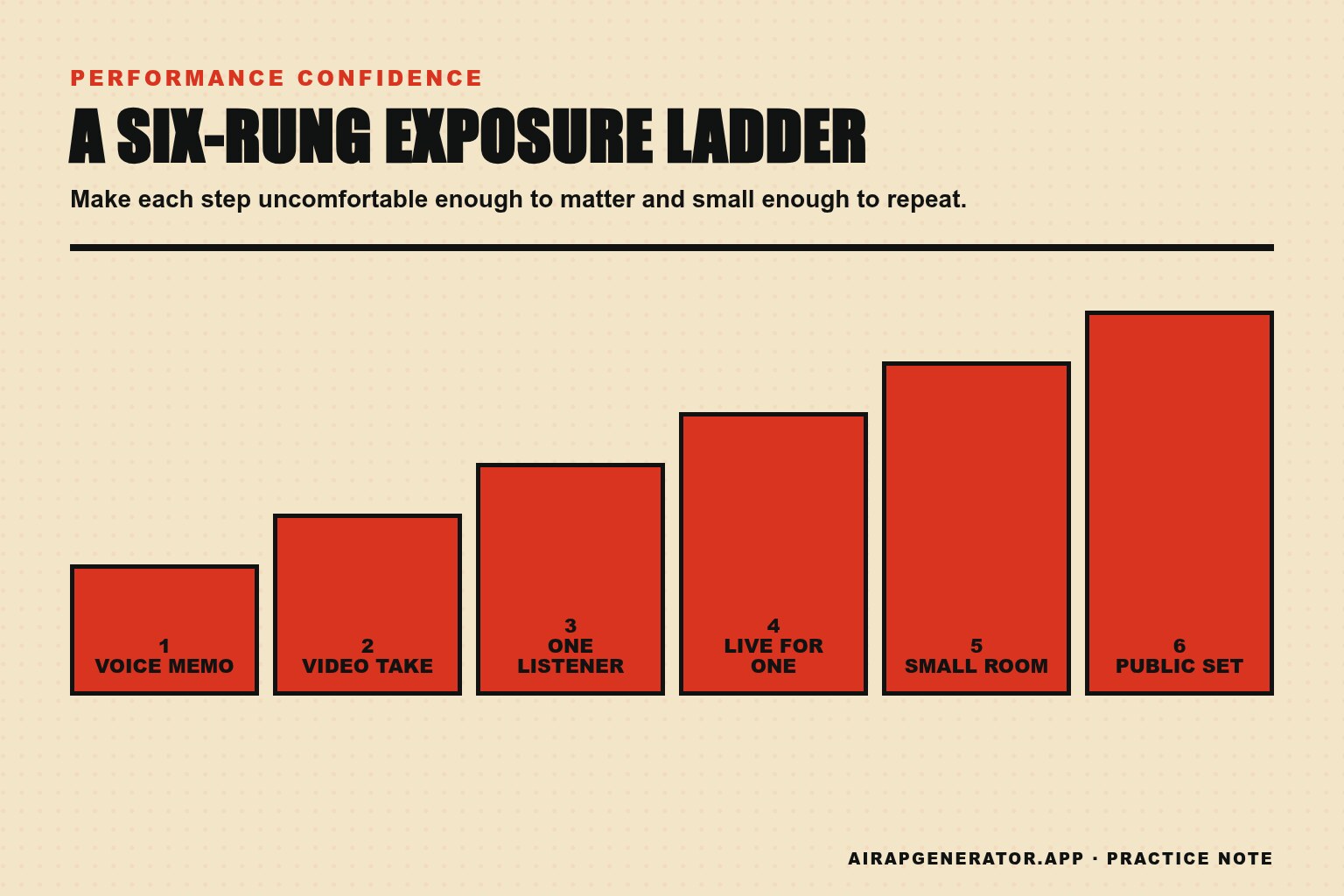
Exposure here means gradually making the performance more visible. Every rung should be uncomfortable enough to matter and small enough to repeat.
| Rung | Action | Pass condition |
|---|---|---|
| 1 | One no-restart voice memo | File saved |
| 2 | One standing video take | Watch it once without deleting |
| 3 | Send audio to one trusted person | Ask one narrow question |
| 4 | Perform live for that person | Finish despite mistakes |
| 5 | Perform for three to five people | Use one planned recovery |
| 6 | Open mic, class, or small public post | Complete the agreed verse |
Stay on a rung until you can do it twice without inventing a new escape condition. “I will share it when the mix is perfect” is an escape condition if the current task is simply sending a verse.
You can move down a rung after a difficult experience. That is not failure; it is load management. The ladder remains available.
5. Ask for feedback that cannot swallow you
“What do you think?” invites a global judgment and gives the listener no useful job. Ask one question tied to the current rung:
- Which line was easiest to remember?
- Did I rush anywhere?
- Could you understand every word in bar six?
- Did the hook feel different from the verse?
- Where did my energy drop?
Choose a person who can answer the question without turning the exchange into a performance of their own taste. Early feedback should produce one next action, not a ranking of your identity as an artist.
Use a two-column response
After receiving feedback, write:
| What they observed | What I will test |
|---|---|
| “The last line blurred” | Cut two syllables and record it again |
| “The hook felt quiet” | Stand farther from the screen and project |
| “I remembered the station image” | Keep that concrete detail in the rewrite |
You do not have to obey every opinion. Turning the comment into a test keeps agency with you.
6. Practise voice before persona
Trying to sound “like a rapper” often creates a mask: lower pitch, constant aggression, copied accent, and tension in the throat. The mask can briefly reduce embarrassment because it is not quite you. It also makes performance harder to control.
Speak the verse as if telling one person what happened. Keep the natural pitch and timing. Then add only ten percent more projection. Record that version before experimenting with character.
Use three takes:
- Conversation: ordinary speaking voice, on beat.
- Projection: same voice, clearer consonants and more breath support.
- Character: one deliberate stylistic change.
Compare which take sounds most believable. Believability is a better foundation for confidence than loudness. A style choice should enlarge something already present, not conceal the person performing it.
7. Track evidence, not mood
Mood changes before practice, during the first take, and after playback. If it is the only measurement, progress looks random.
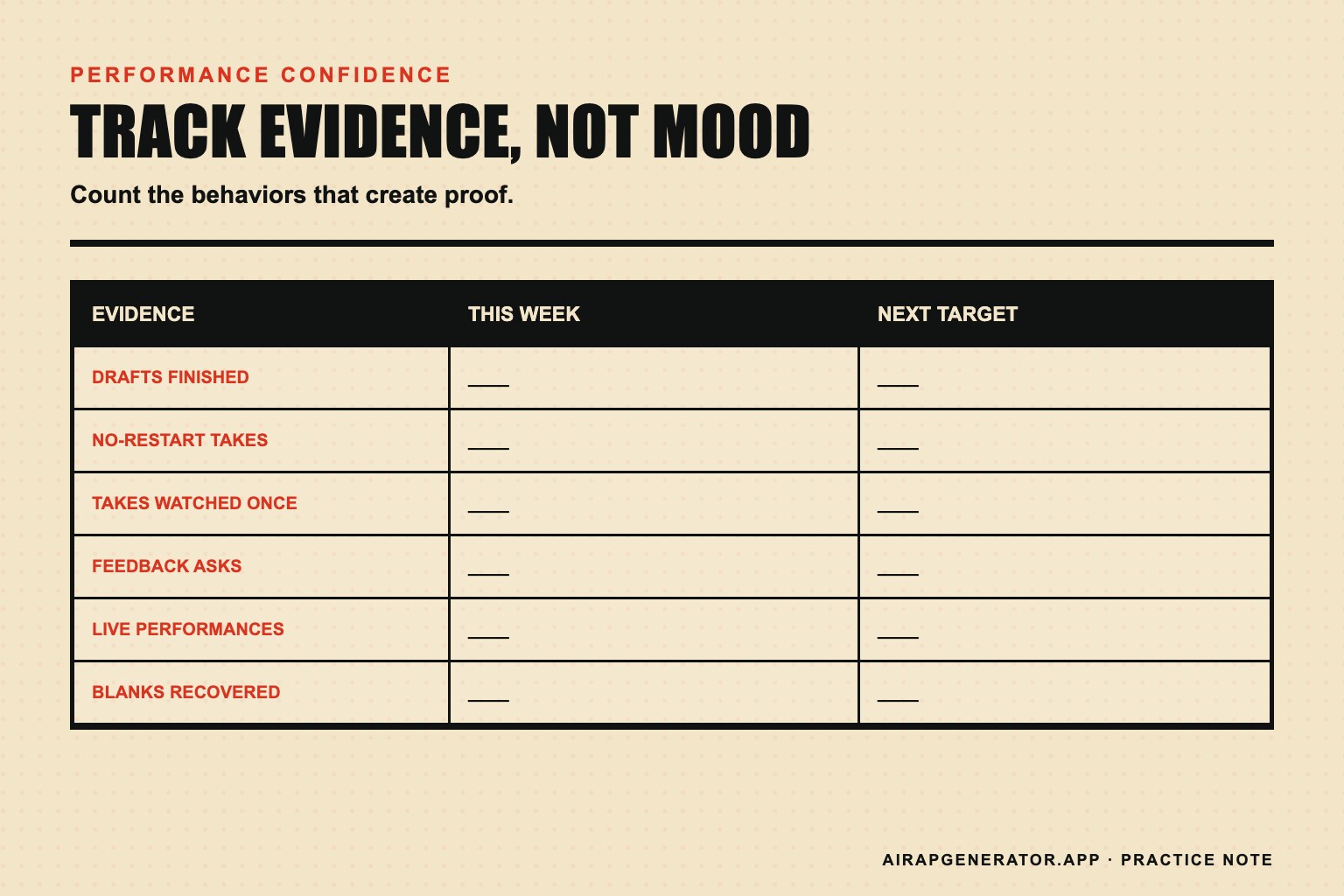
Use a weekly evidence scorecard:
| Evidence | This week |
|---|---|
| Eight-bar drafts completed | |
| No-restart takes saved | |
| Takes watched once | |
| Narrow feedback questions asked | |
| Live performances finished | |
| Blanks recovered without stopping |
Add one sentence: “The thing I can do now that I avoided last week is ___.” This is not forced positivity. If the blank stays empty, the ladder may be too steep or the practice may not be happening often enough.
Avoid tracking likes or view counts as confidence evidence. Those numbers measure distribution, audience fit, timing, and platform behavior along with the performance. They can change without your skill changing.
8. Use a four-week confidence practice
Keep the material stable enough that exposure, not memorization, is the main challenge.
Week 1 — Completion: write two eight-bar verses. Save four no-restart voice memos. Do not share them.
Week 2 — Visibility: record video while standing. Watch every take once. Note posture, eye line, and one timing issue without commenting on appearance.
Week 3 — One listener: choose the stronger verse. Send it to one trusted person with one specific question. Make one revision and perform it live for that person.
Week 4 — Small room: perform for three to five people, join a supportive class, or use another small setting that feels real but manageable. Your success condition is finishing the verse and using the recovery plan if needed.
Do not increase every difficulty at once. New lyrics, a new beat, a larger audience, and a camera create four loads. Keep three familiar while changing one.
At the end of four weeks, choose the next visible action. It may be an open mic. It may be sharing a full track with two collaborators. The correct top rung belongs to your goal, not somebody else's idea of bravery.
What rapping can and cannot change
Rapping can provide practice in several concrete behaviors:
- making a decision and finishing it;
- hearing your recorded voice without deleting it;
- speaking with volume and deliberate timing;
- recovering from a public error;
- sharing personal language with another person;
- receiving specific feedback and testing it.
Those experiences may carry into other settings. They may also remain performance-specific. Someone can become comfortable on a mic and still feel shy in a meeting. That does not make the practice fake; it makes confidence contextual.
Rapping cannot guarantee general self-esteem, remove an anxiety disorder, or make every audience safe. If fear is severe, persistent, or disrupting daily life, a qualified mental-health professional is the right source of help. Music practice can sit beside support; it should not be sold as a substitute.
It can increase the kind of confidence supported by completed attempts, recoveries, and gradually larger audiences. Build the ladder around actions you control, then let the feeling catch up.
Keep the practice alive on low-confidence days
A ladder fails if every session requires the mood it is supposed to build. Create a minimum version for days when recording or sharing feels too large.
The minimum can be five minutes:
- play the same familiar beat;
- speak four bars at conversation volume;
- record one no-restart take;
- save it without listening;
- mark the session complete.
This is not a trick for avoiding the harder rung forever. It preserves continuity while keeping the demand honest. Set a rule that the minimum version counts for practice but does not replace the next planned exposure more than twice in a row.
Also distinguish nerves from a real boundary. A little discomfort around a trusted listener may be the training load. Pressure to reveal private material, perform in an unsafe place, or share a file beyond the agreed audience is not a confidence exercise. Change the lyric, person, or setting.
Use a pre-performance card with three lines: my first entrance, my recovery phrase, and my success condition. Read it once, then put it away. The card narrows attention to controllable behavior when the mind starts inventing every possible audience reaction.
Afterward, wait until the body settles before reviewing. Write one fact that worked and one exact adjustment. “I finished after the blank” and “I need a stronger entrance for verse two” are evidence. Replaying embarrassment in general terms is not analysis.
Frequently asked questions
Should I post my first rap to become more confident?
You do not need to. A public post combines performance practice with an unpredictable audience and permanent-feeling visibility. Start with a saved take, then one trusted listener. Post when it is the next manageable rung, not because private progress seems invalid.
What if I hate hearing my recorded voice?
Keep the first listening task narrow. Check only whether the words are clear or whether the verse stays in time. Repeated neutral listening usually makes the recording less novel. You do not need to force yourself to like it immediately.
Can freestyle practice help confidence?
It can train continuation and recovery because there is no perfect script to protect. Keep rounds short, use easy prompts, and score whether you continued for the full time rather than whether every line was clever.
How do I choose a trusted first listener?
Choose someone who respects the size of the experiment, answers the question asked, and does not share the file. Expertise is less important than reliability at the first rung.
Tell them exactly what kind of response would help before you press send.
What if one bad performance erases my progress?
Return to the evidence log and a lower rung. Describe the failure precisely: forgot one entrance, rushed after a laugh, or chose a room that was too large. A specific failure can change the next practice. “I am not confident” cannot.
Three things you can stop worrying about
Feeling ready before acting. Readiness can follow a completed, manageable attempt instead of preceding it.
Posting publicly at the beginning. A saved take and one trusted listener are legitimate exposure steps.
Eliminating every nerve. The goal is to finish and recover while some discomfort is present, not to manufacture a fearless mood.
The short version
So, will making music and rapping over it increase my confidence? It can build performance-specific evidence when you finish, record, recover, ask for focused feedback, and increase the audience one rung at a time.
Keep reading
- How to memorize rap lyrics for reducing the memory load before a visible performance.
- How to improve rap flow for making practice notes specific instead of personal.
- How to write your first rap song for turning a small completion rule into a full track.