8 Ways to Stop Rhyming Every Line: EST Gee Lab
How to get over wanting to rhyme everything rapping: use EST Gee's release-day title board to test forced rhyme, concrete detail, and scene logic.
EST Gee's Bigger Than the Devil is scheduled for September 11. Before release day, Apple Music's public page labels it a prerelease and shows five available video titles: “Call Spitta,” “Thug Club,” “You Know It,” “Ya Digg,” and “Sometimes.” The page may update when the album goes live, so this workshop uses only the date and those visible titles—no claim about unheard songs, lyrics, or a disputed track count.
If you are searching how to get over wanting to rhyme everything rapping, release day offers a clean pressure test. Put the five public titles on a board, choose one as a neutral prompt, and see whether its convenient final sound makes you bend an original scene. The source is the Apple Music release listing; the exercise does not imitate EST Gee, reuse lyrics, or assign themes to songs you have not heard.
The exercises below use one invented laundromat scene. Run them with “Sometimes” as the first title card, then repeat with another card while keeping the event unchanged. The problem is narrow and observable: did the chosen sound make you change what actually happened?
If the title card produces no scene at all, start with one of the creative rap writing exercises, save the concrete details it produces, and then return to this constraint test.
1. Turn the public titles into a neutral constraint board
Write the five public titles on separate cards. Do not guess their lyrical meaning. Pick “Sometimes” and write an original four-line scene in which that exact word may appear once. Read the draft as ordinary speech and name what each sentence adds: a detail, action, answer, tonal change, or deliberate repeat.
Then circle any line whose only job is “matches the title card.” The circle identifies where a topical prompt has become your only reason for keeping a sentence. A timely reference still has to serve the invented scene.
Use a removal test
Read the passage without the circled line. If the scene becomes clearer and nothing important disappears, you have found a candidate for replacement. If the passage loses a necessary pause or a setup for a joke, keep that function and search for more specific wording.
Separate this diagnosis from whether the rhyme is impressive. A clever match can still send the listener away from your subject. Conversely, a plain repeated word can work when its return changes meaning. Ask what the sentence does before rating how hard it was to find its ending.
2. Write the scene once without the title card
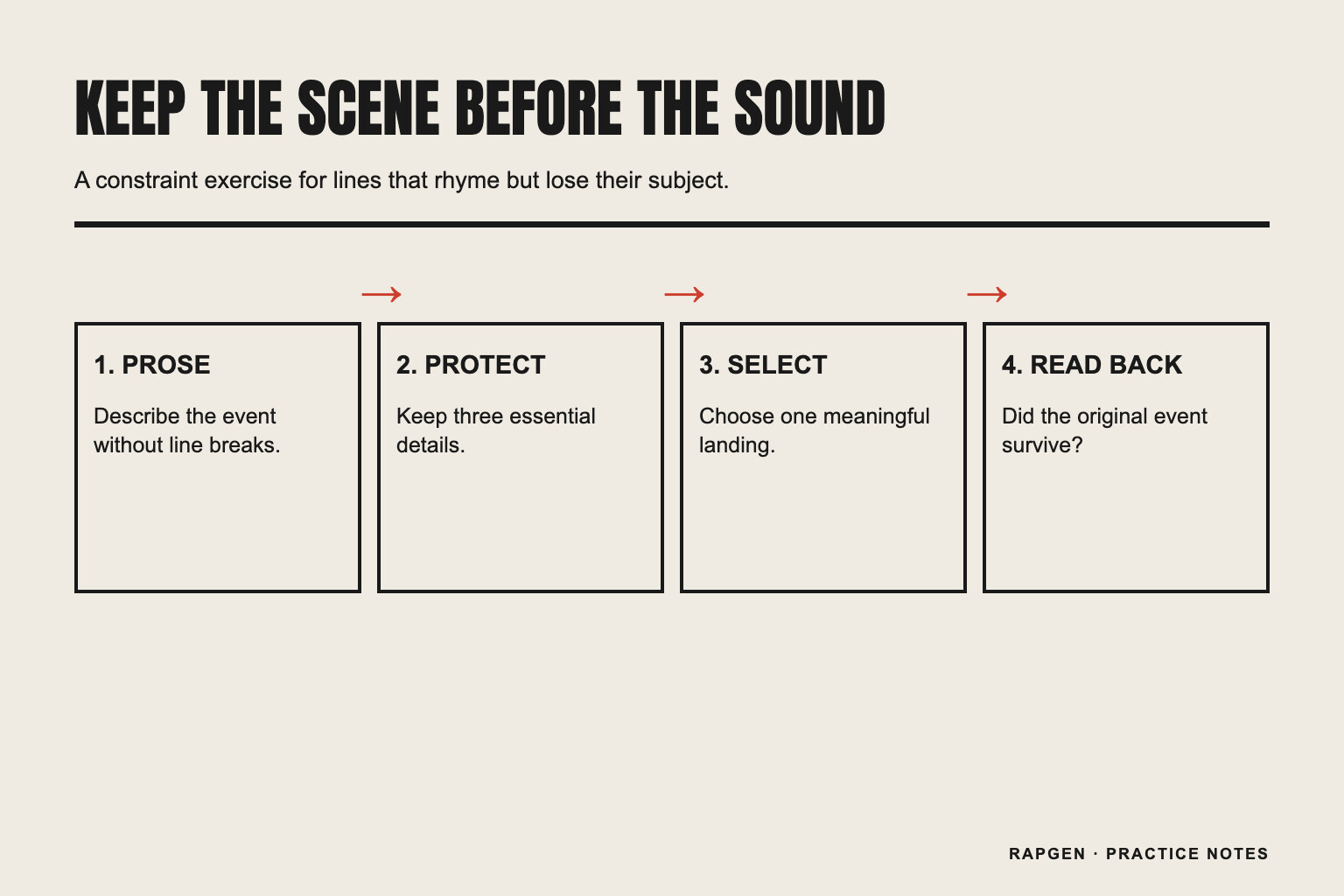
Turn the card face down and describe the scene in one short paragraph. Do not arrange it into bars or look for matching endings. Include an object, an action, and something the speaker wants. This is the control: later versions must preserve its important facts when a public title is introduced.
Here is an original example:
I wait beside the laundromat after closing. My sister said she would collect me, but her phone is off. I have enough coins for another wash, not enough money for the bus. When headlights stop outside, I hide the coins because I do not want her to notice I was worried.
That paragraph supplies a place, a practical problem, an arrival, and a small defensive action. It gives you material beyond an abstract statement such as “I had a difficult night.” You can later choose which detail deserves the strongest landing.
Protect three details
Underline three pieces you do not want rhyme hunting to erase: the closed laundromat, the coins, and hiding them when the car arrives. Other wording can move. Those three anchors keep the rewrite attached to its original scene while you experiment with delivery and sound.
3. Decide whether the title belongs at the landing
Take four practice lines and choose just one ending that deserves emphasis. In this scene, “hide the coins” carries the final action. Test “Sometimes” at the end of a different line, then in the middle, then remove it. The strongest landing should win; the release-day card does not automatically deserve the last word.
Try an intentionally loose first pass:
The laundromat is closed; I wait beside the door.
Your phone goes straight to silence.
Headlights find the window.
I close my hand and hide the coins.
This is a writing sketch, not a claim that each printed line fills a musical bar. Speak it over your chosen loop and decide its actual timing. The uneven lengths may need adjustment. First notice that the scene remains understandable without a complete end-rhyme chain.
Add one connection, then stop
You could revise the third line to “Your headlights interrupt the noise.” That makes a loose sound relationship with “coins,” depending on your pronunciation. It also introduces “noise,” which must fit the scene. If the place was deliberately quiet, reject the edit despite its convenient sound.
The exercise is successful when you can reject an available rhyme for a clear reason. That is a more useful sign of control than producing a large list of matches. You are learning to keep an option available without becoming obligated to use it.
4. Let the sentence cross a printed line
When every line ends with a complete statement, each ending can start to feel like a slot demanding a rhyme. Test a sentence that continues into the next practice line. This changes the expectation of closure while leaving you free to place a sound connection elsewhere.
For example:
I keep the coins inside my palm until your car
has passed the broken sign and stopped beside the door.
Read the sentence naturally first. Then try a short pause after “car” and another version that moves directly across the break. The printed division is an experiment, not a requirement to stop speaking. Your beat and intended emphasis determine whether either version works.
Avoid making the continuation so tangled that the listener must remember half a paragraph to understand the verb. You are loosening a repetitive ending pattern, not proving that your syntax can survive an obstacle course. A simple sentence with one clear continuation is enough for the first trial.
Keep the action audible
Ask someone what happened after hearing the passage once. If they remember a string of striking nouns but not the action, simplify the sentence. That observation does not mean every listener needs identical wording; it tells you whether your particular story survived this delivery.
5. Compare each release-day card against the same scene
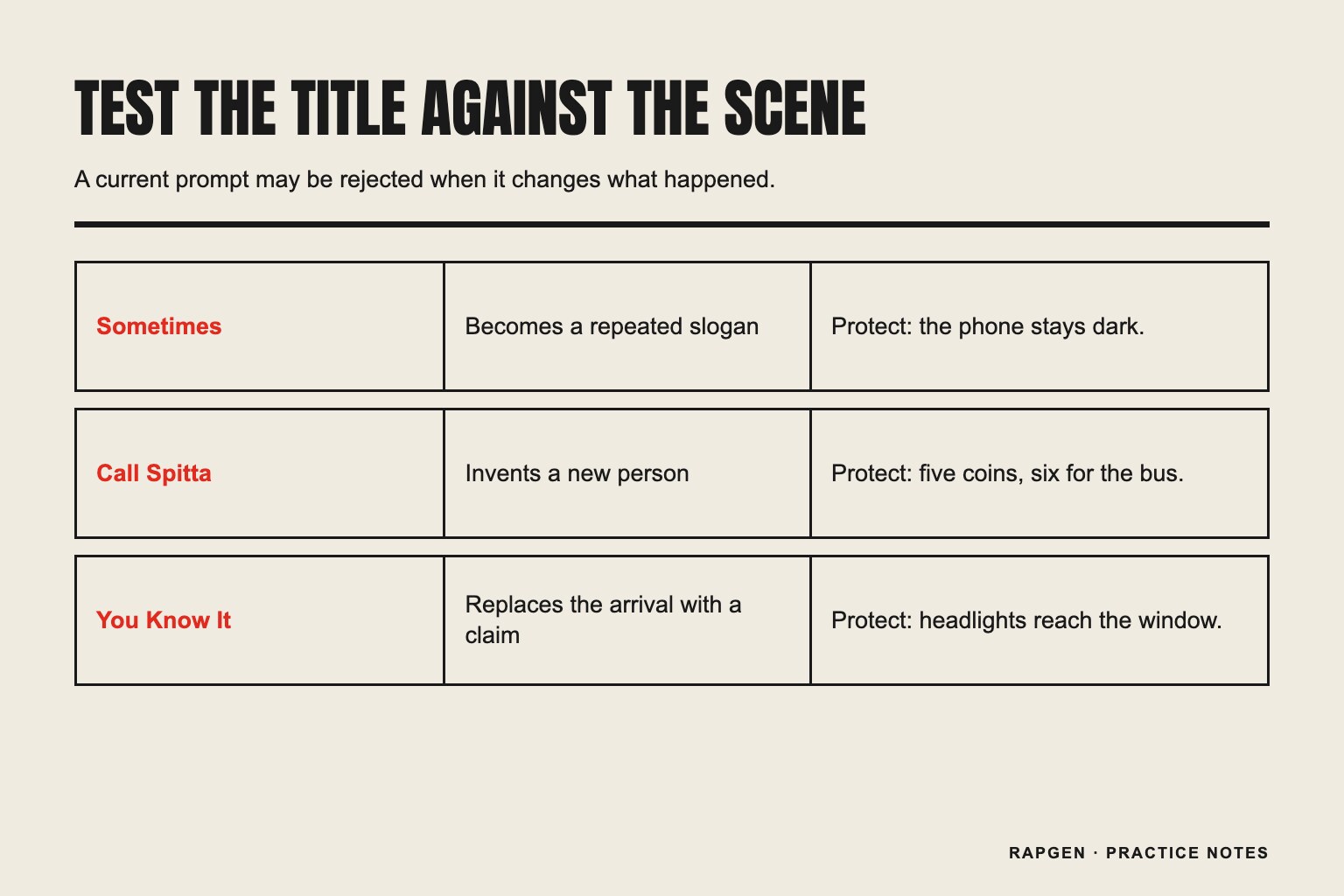
Make five copies of the same four-line scene and assign one public title to each copy. Put the title-board test in the first column, the change it tempted you to make in the second, and the detail that must survive in the third. Rejecting a card is a valid result.
| Title-board test | What the forced version changes | Detail to protect |
|---|---|---|
| Sometimes at every ending | Turns one uncertain moment into a slogan | The phone stays dark |
| Call Spitta forced into the scene | Invents a person who was never part of the event | Five coins, six needed for the bus |
| You Know It used as filler | Claims shared knowledge instead of showing arrival | Headlights reach the window before I stand |
These tests are prose-like material to shape over a beat. They are not finished replacements with guaranteed timing. Their purpose is to keep the topical card from displacing the observable action.
Notice how each forced version changes the subject: repetition becomes a slogan, a new person appears, or a shared claim replaces the arrival. The title words are not forbidden. The problem is that the topical constraint has displaced the event you started writing about.
6. Move a connection away from the last word
An end rhyme is only one place to create a sonic link. You can try a repeated vowel, an internal rhyme, a repeated phrase, or a related consonant pattern earlier in the sentence. Keep the experiment small enough that you can hear what changed.
Consider this original pair:
Cold coins, closed fist; I watch the doorway.
Your coat swings open when you step outside.
“Cold” and “closed” share a close sound relationship in many pronunciations; “coins” and “coat” add an opening consonant connection. The final words do not form the organizing pair. Read it in your own voice rather than treating the printed spelling as proof that the sounds work.
Change one sound relationship
Record a plain version and one with the internal connection. Keep the same beat and approximate delivery. Listen for whether the connection adds emphasis or merely makes the phrase harder to say. If you stumble repeatedly, simplify before adding another layer.
Do not replace compulsory end rhyme with compulsory internal rhyme. The goal is a wider set of choices. Some lines can carry the action plainly while another receives a denser pattern. The rap lyric writing guide covers broader drafting choices when you want a more systematic next step.
7. Run a five-card blind constraint experiment
Write five versions of the same four-line scene, one per public title card. Randomize the order and give each version five minutes. The title may appear once, appear internally, or be rejected with a written reason. Preserve the three details you protected earlier in every version.
Allow roughly five minutes for each version. The time limit is a practical boundary for this exercise, not a claim about how quickly good writing should happen. Stop when you have enough material to compare. A polished first version and an unfinished third one will not give you a fair test.
Score information before sound
Use three questions: can a listener identify the place, follow the action, and notice the final gesture? Then reveal the cards and ask which prompt changed the scene least. You may keep none. The timely board is a constraint generator, not a requirement to mention the release in the finished verse.
Save the losing versions too. A line that does not fit this arrangement may contain a better detail for another passage. Label why you rejected it: “unclear action,” “too many words,” or “rhyme changes the scene.” Specific notes prevent the next draft from repeating the same decision without noticing.
8. Save the release-day result without freezing the trend
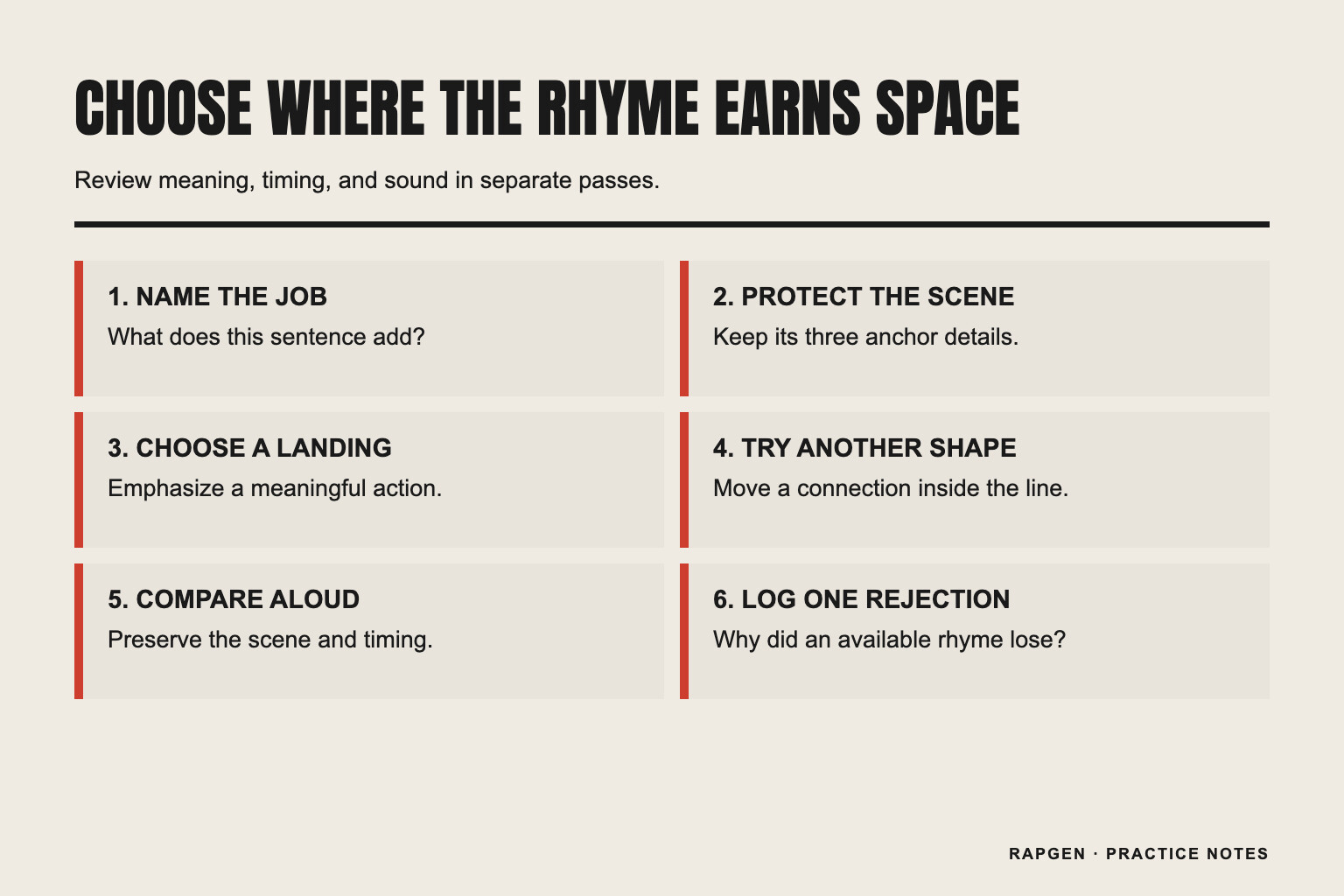
On the next draft, review meaning, timing, and sound in separate passes. First check whether each sentence belongs after its title card is removed. Then speak the passage over the beat and mark crowded joins. Finally choose which sound connections deserve a stronger relationship.
Save the source URL, access date, chosen card, rejected card, and reason. If Apple updates the page after release, your note still truthfully records the public listing that launched the exercise. A convenient topical phrase no longer automatically wins against a needed action or truthful detail.
Keep a short rejection log
Write down one rhyme you declined and why. For example: “night / flight: introduced travel that never happened.” Beside it, note the replacement: “last dryer stops.” This turns an invisible act of restraint into something you can observe across sessions.
After several drafts, check whether the same problem returns. If you repeatedly add generic boasting when a rhyme runs out, prepare a list of actions from the scene before your next session. If timing is the actual obstacle, shorten the line instead of blaming rhyme itself.
Three things you can stop worrying about
That unrhymed writing is more mature. It is one available choice. The listener hears the finished passage, not the restraint exercise that produced it.
That every rhyme must be unusual. A familiar match can be effective when the wording is exact and the delivery supports it. Novelty does not excuse a sentence that abandons your subject.
That your first sound idea was a mistake. Keep it as an option. You can build a different passage around it later without forcing the current scene to accommodate it.
Compare an edit against your protected details
Try the Tighten mode on Rate My Rap with your own four-line passage. Read the side-by-side text as a proposed edit, then compare each changed line with the scene you meant to describe. If a stronger rhyme introduces an unrelated action, leave that suggestion unused.
Compare the new passage with your protected prose details. The useful outcome is not a higher rhyme count; it is a version whose sound pattern strengthens the scene. The tool works from text, not a recording of your voice. Keep the choice about what happens, and the final timing test, in your own hands.
The short version
The practical answer to how to get over wanting to rhyme everything rapping is to write the event in prose, protect its important details, select a few meaningful landings, and compare revisions aloud. Keep rhymes that help the passage. Let the others remain unused options.
Keep reading
- How to write rap lyrics for organizing a deliberate first draft.
- How to improve rap flow for shaping the delivery around your words.
- How to write your first rap song for turning a small scene into a complete draft.