Halloween Rap Lyrics: 7 Ways to Build an Original Verse
Halloween rap lyrics start with a scene, a voice and a turn. Write an original spooky verse with a practical worksheet, example bars and a rehearsal checklist.
You have the costume, a beat saved on your phone and a blank note titled “October verse.” Your first line names a ghost. Your next line names a witch. By the fourth line, you have a shopping list of decorations and nobody moving through it.
Useful Halloween rap lyrics give somebody a problem inside a place. The seasonal vocabulary can come afterward. Start with a person trying to get home, collect a delivery or finish a night shift, then let one familiar detail behave incorrectly. A door knows their name. An elevator stops at a floor the building does not have. Their own footsteps keep going after they stop.
This is a worksheet for making an original verse, not a collection of lyrics from released songs. Every example below was written for this guide. You can adapt the method without copying another artist's recording or borrowing a recognizable movie character. With October 31 approaching, there is still time to write, rehearse and share something that sounds like your own neighborhood after dark.
1. Put a normal task inside the strange setting
A haunted building is scenery. A courier needing a signature inside a haunted building has a reason to stay. That reason keeps the verse moving when the narrator encounters a warning. Without a task, the sensible response to every creepy detail is simply leaving, and your second half has nothing to do.
Write one plain sentence before finding rhymes: “I need to return a borrowed jacket before the last bus.” Give the narrator a practical deadline and an object they must carry. Both will provide material later. The bus creates urgency; the jacket can turn up in the wrong place or contain something unexpected.
Keep the task small enough to explain in one breath. Saving the world requires rules, villains and history. Returning a jacket requires a doorbell. A short verse benefits from that economy because the listener can understand the stakes while the rhythm is still establishing itself.
A premise you can actually finish
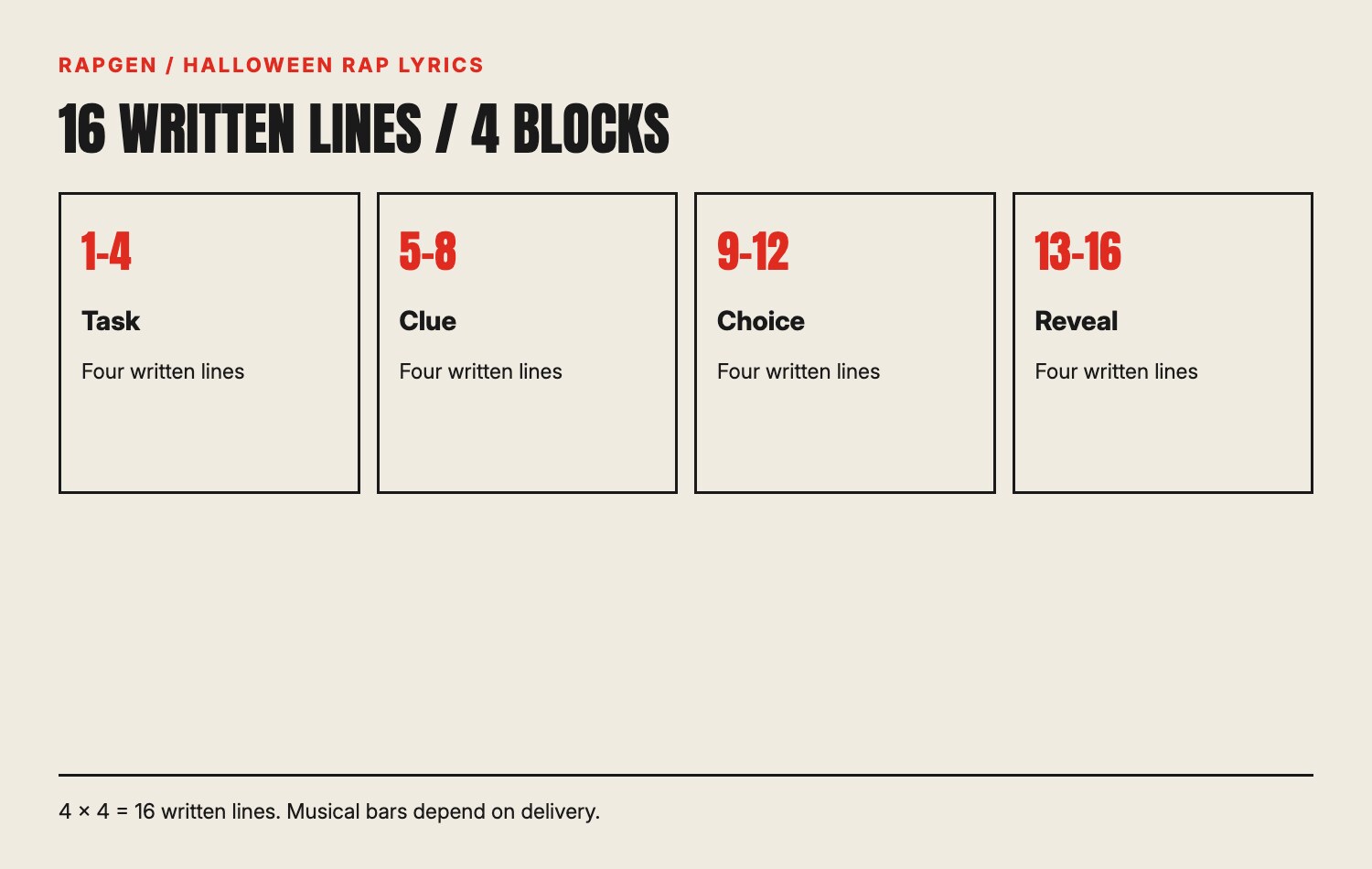
Our example narrator works a late delivery route. They must obtain one final signature. The address is ordinary except for a lift that opens on an impossible floor. The delivery bag stays in their hand throughout. That continuity matters: if the bag disappears from the scene and then becomes the reveal, the listener may miss the connection.
Draft the ordinary part first:
Last stop, cold chips, receipt on my sleeve,
One more signature, then I get to leave.
The chips and receipt are props with jobs. One establishes the shift's length; the other establishes why the narrator cannot simply drop the parcel and walk away. You have already supplied more story than a string of supernatural nouns would provide.
2. Choose the audience before choosing the scare
A classroom performance, a party freestyle and an adult horror track need different boundaries. Decide which one you are making before drafting the reveal. Changing the audience afterward can require rebuilding the whole verse rather than swapping a couple of words.
For a family event, uncertainty, funny reactions and a harmless surprise often give you enough tension. For an adult audience, you can leave the outcome unresolved. Graphic description is optional in either case. A listener imagining a sound behind a door can be more involved than a listener being told every detail of what is behind it.
If your verse mentions a real friend, neighbor or business, check that the joke will land as fiction. Do not turn a recognizable person into the subject of a supposed crime or frightening accusation. A made-up address also avoids sending an audience to somebody's actual home.
| Setting | Useful tension | Ending that fits | Check before sharing |
|---|---|---|---|
| Classroom or family party | A strange sound, missing object or costume mix-up | A comic explanation | Age suitability and understandable words |
| Friends' performance | A narrator refusing an obvious warning | A reversal everyone can follow | Whether anyone becomes the unwanted target |
| Adult fictional track | Conflicting clues and an unreliable narrator | A disturbing unresolved detail | Clear fictional framing and content expectations |
| Short social clip | One wrong detail in a recognizable place | A reveal visible or audible in the clip | Whether the opening makes sense without a caption |
This table is an editorial planning aid, not a rule about what every audience enjoys. Ask the organizer or the people in the room if you are unsure. That conversation costs less than rebuilding a performance after someone objects to its premise.
3. Let one wrong detail repeat with a change
Choose one sensory clue and return to it. Our delivery narrator hears keys jingling in the lift. The second time, the keys sound inside the sealed delivery bag. On the last return, the narrator recognizes their own key ring. Each occurrence changes the meaning of the previous one.
Write the three appearances as prose before rhyming them. If the third version merely gets louder, you have escalation in volume but no new information. A useful return supplies something the narrator did not know: a location, an identity or a consequence.
Avoid introducing five separate monsters to manufacture variety. Every new creature asks the listener to start imagining again. One clue can become richer as its location changes, and the rest of the verse remains available for the narrator's choices.
Keep the object visible
Make a tiny continuity list: bag, receipt, keys. Beside each one, write where it is at the opening, middle and ending. If the keys are in the narrator's pocket at the start, the ending should either explain how they reached the bag or deliberately make that impossibility the scare.
An original pair might read:
Keys in my pocket, but the parcel starts to chime,
Same three notes I hear when I unlock mine.
The second line gives the sound a recognizable pattern. You do not need to claim an exact syllable count or squeeze every word into an identical shape. Record a spoken draft over your chosen beat and decide which words remain clear.
4. Plan four blocks before writing sixteen lines
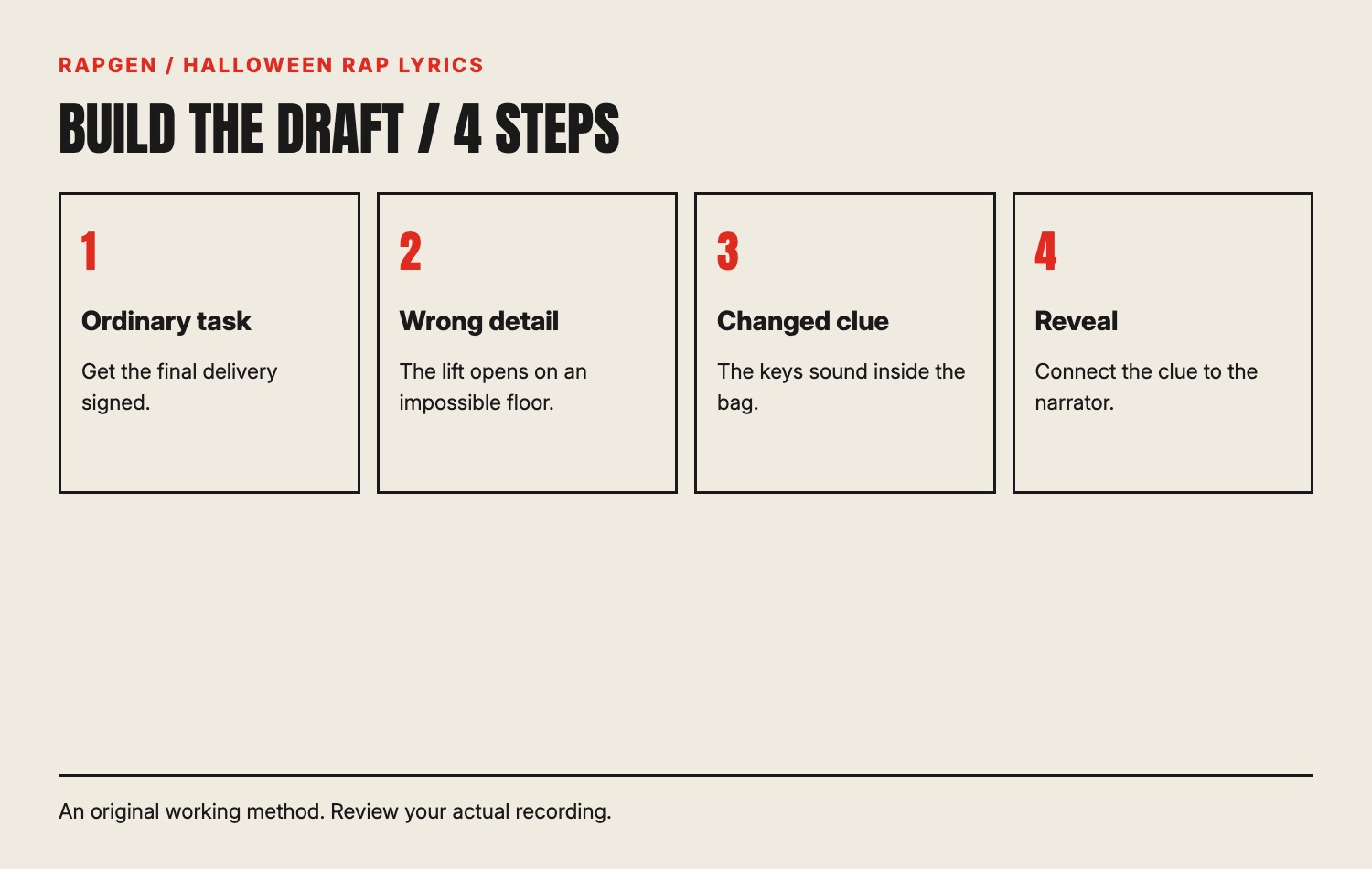
Use four short blocks as a drafting container. The first establishes the task. The second introduces the wrong detail. The third shows the narrator making a choice. The fourth delivers the consequence. Four written lines in each block make sixteen lines total; whether those lines occupy sixteen musical bars depends on your delivery.
That distinction saves a common rewrite. A long sentence may spill across two bars. A short phrase may leave half a bar empty. Count the musical measures while rehearsing rather than treating line breaks in your notes as proof of timing. Our guide to rap song structure explains how sections fit together once the verse has a shape.
For the delivery story, the blocks might be: accepting the final stop, entering the lift, opening the bag when nobody answers, discovering your own key ring inside the supposedly sealed parcel. The choice in block three is important. It gives the ending a cause instead of making the narrator a passive camera. The returning sound leads to the object you reveal; keep the receipt as the ordinary reason for making the stop.
You can change the length after the story works. A short clip might use two lines per block. A longer performance might need a hook between the middle and ending. Keep the sequence of information intact when cutting; preserve the task, clue, decision and payoff before preserving a clever standalone rhyme.
5. Use sound to support the scene
Look for words your narrator would naturally use, then build a small sound family around them. “Lift,” “shift” and “slipped” belong near the delivery premise. “Receipt,” “street” and “feet” belong there too. You are gathering possibilities, not promising to use all of them.
Say the scene without rhyme first. If you would normally say “the lift opened,” keep that action in the draft. Changing it to “the elevator did oscillate” just to match a rhyme makes the narrator sound like somebody reading a dictionary during an emergency.
Vary where the rhyme lands. A sound inside a sentence can carry a detail while the end of the line carries a new piece of information. For example:
Lift clicked, shift slipped out of the screen,
The button marked twelve opened floor thirteen.
This is fictional architecture, not a claim that a particular building has those floors. Its usefulness comes from the mismatch between what the narrator selected and what they received. “Clicked” and “slipped” add texture without forcing every meaningful word into the same end rhyme.
Rehearse the quiet line too
Your warning may need less force than the payoff. Try delivering the ordinary opening conversationally, leaving a small space before the impossible detail. If every line has the same shout and pace, the listener has no change to notice.
Do not strain your voice to sound monstrous. You can suggest a different character through phrasing, distance from the microphone or a pause. Record at a comfortable level and review what the microphone actually captured. Stop if a vocal effect hurts or leaves your voice feeling irritated.
6. Make the hook point toward the problem
A hook can carry the instruction the narrator keeps ignoring. “Don't sign your name” is short, connected to the receipt and useful before the listener knows why it matters. It can return with a different meaning after the reveal.
Draft a spoken hook, then try a rhythmic version. Our original example is:
Don't sign your name when the hallway knows it,
Keep that door shut; let the cold wind close it.
You may find the second line too crowded at your chosen tempo. That is a rehearsal result worth using. Try “Keep the door shut; let the cold wind close it,” or simplify further. The best wording for your recording is the wording you can deliver clearly, not the longest version you can fit on the page.
A funny version could answer its own warning: “Don't sign your name — unless they brought the cake.” That ending changes the track's promise. Decide whether the listener is supposed to laugh, feel uneasy or do both, and make the final hook consistent with that decision.
Keep the hook's main image separate from a famous seasonal song or film catchphrase. Familiar quotations can dominate the listener's attention and raise rights questions if you use the recording or a substantial recognizable lyric. An original instruction tied to your own prop gives you a distinctive center without needing that shortcut.
7. Check the reveal with someone who has not read the draft
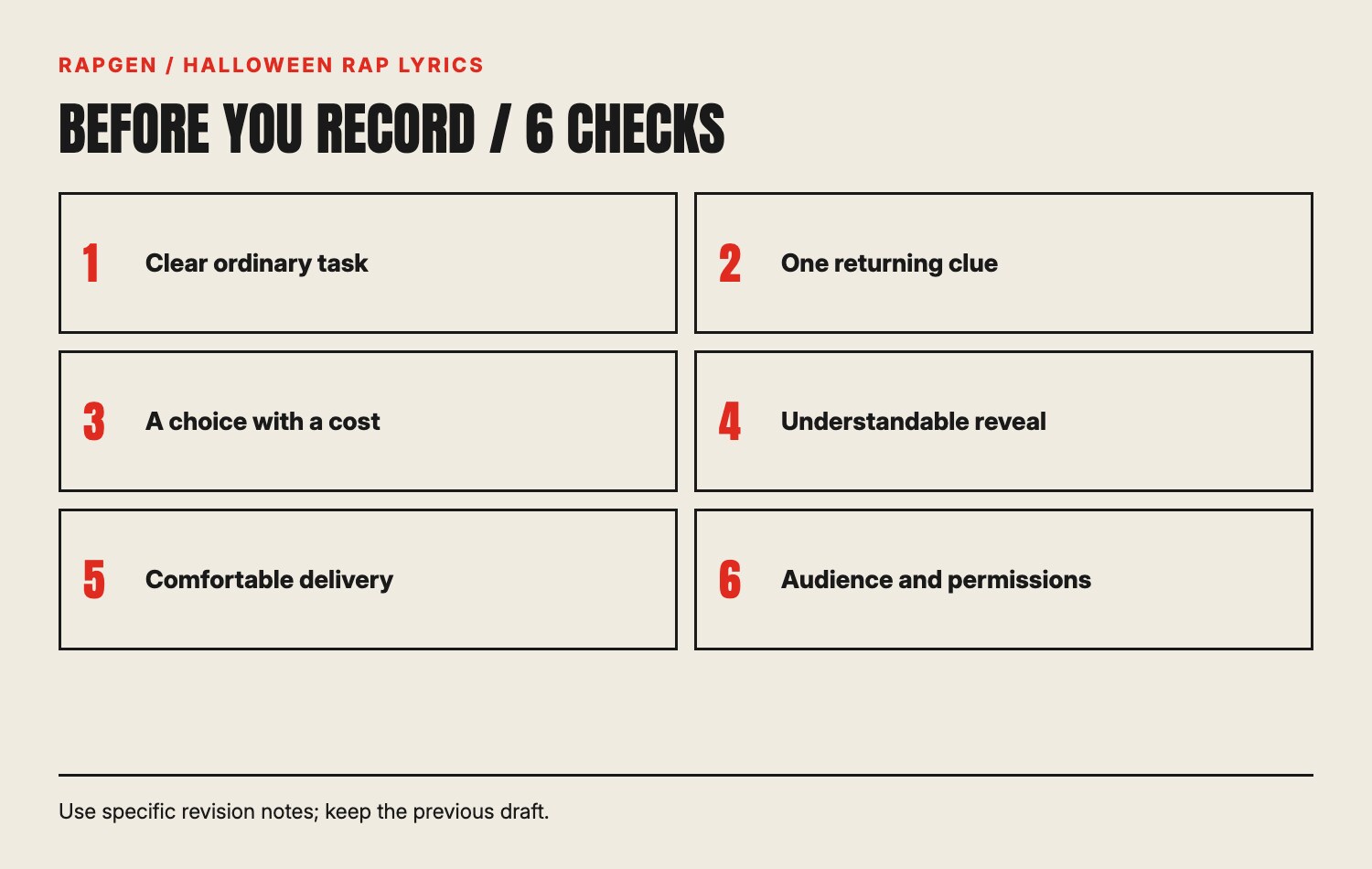
Play the verse once without explaining it. Ask the listener what the narrator wanted, which detail first felt wrong and what changed at the end. These questions test understanding. “Was it scary?” is too broad to tell you where a rewrite belongs.
If they cannot name the task, shorten the opening and make the goal explicit. If they miss the clue, repeat its object more clearly. If they cannot explain the reveal, inspect the order in which you supplied information. Do not add a paragraph of backstory until you have tested whether one clearer noun solves the problem.
Listen once with the phone screen off. Your costume and caption cannot repair a confusing recording for someone who only hears it. Then listen with the beat quieter. If a critical word becomes understandable only when the backing disappears, leave room around it or adjust the mix before sharing.
A compact revision session
Use the first pass for story, the second for delivery and the third for boundaries. On the story pass, change only missing information. On the delivery pass, remove words that repeatedly trip you. On the boundary pass, check audience suitability, fictional names and permission for anyone appearing in a clip.
Save the previous draft before each pass. Occasionally the clearer version loses a useful rhythm; keeping the original lets you recover it without reconstructing the whole verse. Your final note should include the beat version and hook wording so rehearsal and recording refer to the same material.
Three things you can stop worrying about
Naming every Halloween object. One delivery bag behaving strangely is enough for a complete scene. Extra pumpkins and cobwebs should earn their place by affecting the action or sound.
Having a terrifying voice. A believable person noticing something impossible can carry the whole piece. Use a speaking register you can sustain through rehearsal.
Making every ending rhyme perfectly. You can keep the story's clearest word and solve the surrounding phrase. A near rhyme that preserves the reveal often serves this draft better than a perfect rhyme that changes it.
Turn the premise into a small set of alternatives
Write the reveal yourself before opening the rap bars generator. Give it the delivery task and the strange clue, then compare a small set of returned lines against your continuity list. Keep only lines that preserve the narrator's perspective and leave the final discovery for the correct place. The page supplies individual lines; your story outline supplies their order.
The short version
Write Halloween rap lyrics around an ordinary task, one wrong detail and a choice that creates the ending. Draft the information in four blocks, rehearse against your actual beat and test the reveal on an unfamiliar listener. The costume can make the clip memorable; the story should still work when nobody can see it.