Half Rhymes for Rap: 8 Ways to Test Your Phrases
Half rhymes rap phrases: build original examples with sound comparisons, stress checks, and recording exercises that protect the meaning of your lines.

The sentence says exactly what happened, but its final word has sent you into a familiar trap. Every obvious rhyme changes the subject. You have a wet coat, a delayed train, and a phone call you do not want to return; the rhyme list keeps offering words that belong in somebody else's verse.
A search for half rhymes rap phrases can produce a long list of possibilities without explaining which ones will work in your voice. The useful skill is choosing a partial sound match, putting it inside a meaningful sentence, and hearing whether the connection survives an ordinary delivery.
We will build a small phrase bank around an invented late journey home. The examples are original writing material. Printed lines are not automatically bars, and the capital letters below indicate a proposed emphasis for practice, not a universal rule about English speech.
1. Name the sound relationship you are actually using
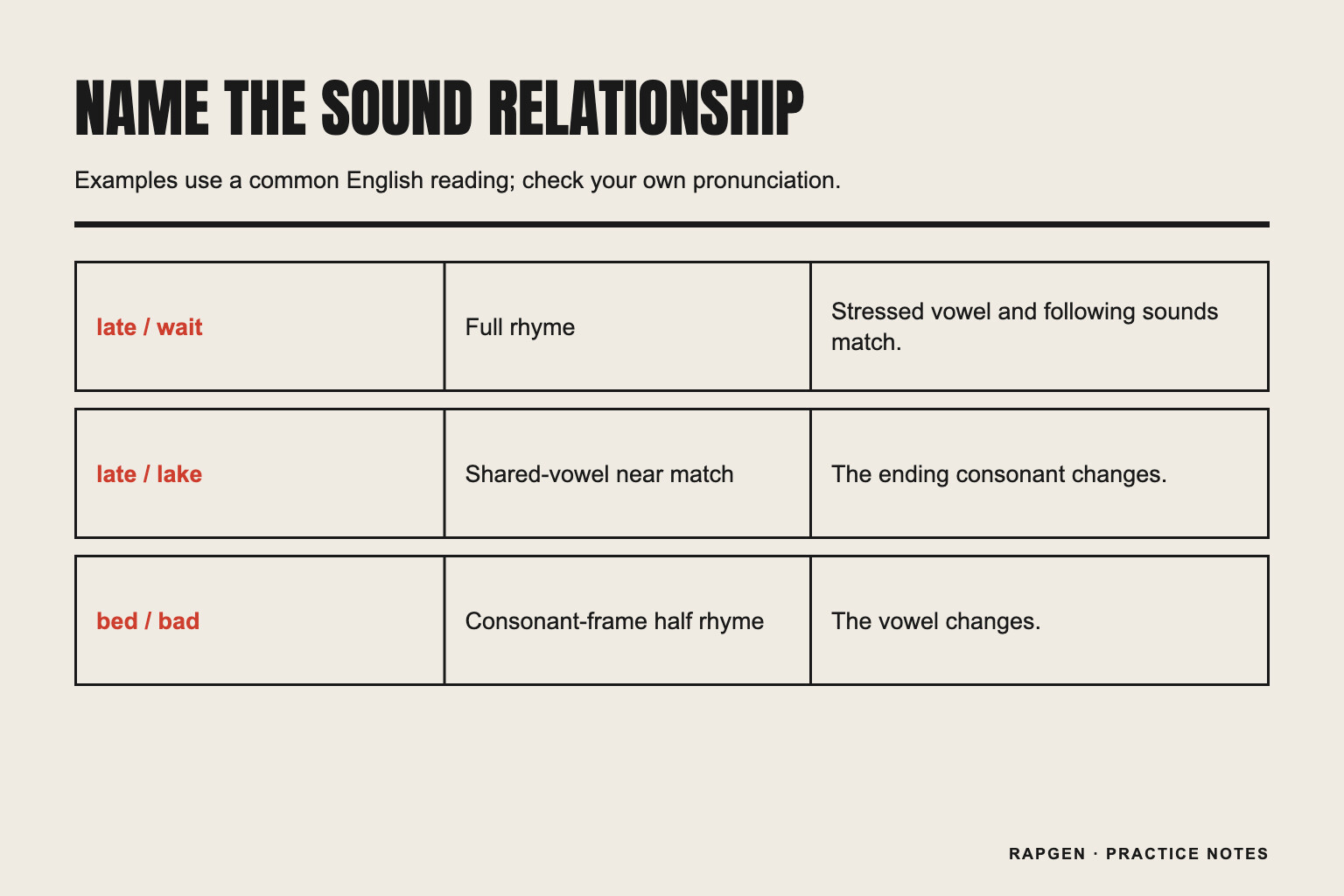
Start with a clear reference pair: late / wait. In a common English pronunciation, the stressed vowel and the sounds after it match. The beginning consonant changes. Compare that with late / lake: the vowel is shared, but the final consonant changes. You can hear a connection without calling the second pair a perfect rhyme.
Terminology varies across writing discussions. The Merriam-Webster entry for half rhyme focuses on matching terminal consonant sounds outside full rhyme. This workshop also considers broader near-rhyme candidates, including shared vowels with different endings. Keeping those relationships separate is more useful here than treating every partial match as the same device.
Write what matches and what changes
For bed / bad, the surrounding consonants match while the vowel changes in an ordinary reading. For late / lake, the vowel matches while the ending changes. Neither note says whether the pair belongs in your song. It simply identifies the material you are testing.
Use your normal speaking voice first. If a pair only works after you copy another performer's accent, label that as a different performance choice rather than claiming the words naturally match in yours. You can explore delivery later without concealing the starting point.
2. Build the meaning list before the sound list
Write five details from the scene without trying to rhyme them. Our traveler has a damp sleeve, an unanswered message, a train running behind schedule, a nearly empty platform, and an excuse they have rehearsed all evening. These details give the exercise a subject to stay with.
Next, turn each detail into two short phrases. A damp sleeve might become wet cuff or rain in the lining. An unanswered message might become missed calls or your name on the screen. The point is to create alternatives with slightly different meanings before a sound pattern narrows your choices.
Keep a fact you refuse to lose
Pick the detail that carries the passage. Here it is the deliberate unanswered call: the traveler saw the name and chose not to respond. If a rhyme candidate changes that into a dead battery or bad reception, it has changed the event. That might be an interesting rewrite, but it is no longer a neutral wording adjustment.
Put a small mark beside that protected fact. You can change the weather, the coat, or the location in another version if you choose. For this comparison, keep the refusal intact so you can judge whether a new phrase improves the writing without quietly removing its tension.
3. Compare short phrase candidates in pairs
Here are three deliberately limited pairs. Read each pair aloud before looking at the explanation. These are candidates for a near-rhyme bank, not a list of guaranteed finished rhymes.
| Candidate pair | Proposed point of connection | What still needs checking |
|---|---|---|
| late train / same day | A similar repeated long-A vowel sequence | Different consonants and natural emphasis |
| cold street / old keys | A long-O then long-E vowel sequence | The final consonants differ |
| missed calls / thin walls | Similar vowel movement in many accents | The first words differ; vowels vary by speaker |
For the first pair, try LATE TRAIN and SAME DAY as a marked practice reading. Then say each inside an ordinary sentence. You may emphasize TRAIN and DAY much more strongly than the first words. That difference matters: a two-part pattern on the page can become a single noticeable return in speech.
Do not mistake spelling for sound
The second pair looks partly related because cold contains old. Listen to the second words as well: street and keys share a vowel in a common pronunciation but end differently. The whole phrase is not a perfect rhyme merely because the first words rhyme.
The third pair needs your own voice especially. Vowel qualities vary across accents, and this article cannot hear yours. Write “works in my reading,” “uncertain,” or “reject” beside the pair after saying it naturally. An uncertain candidate can stay in the notebook without being promoted into the verse.
4. Put the pair back into complete sentences
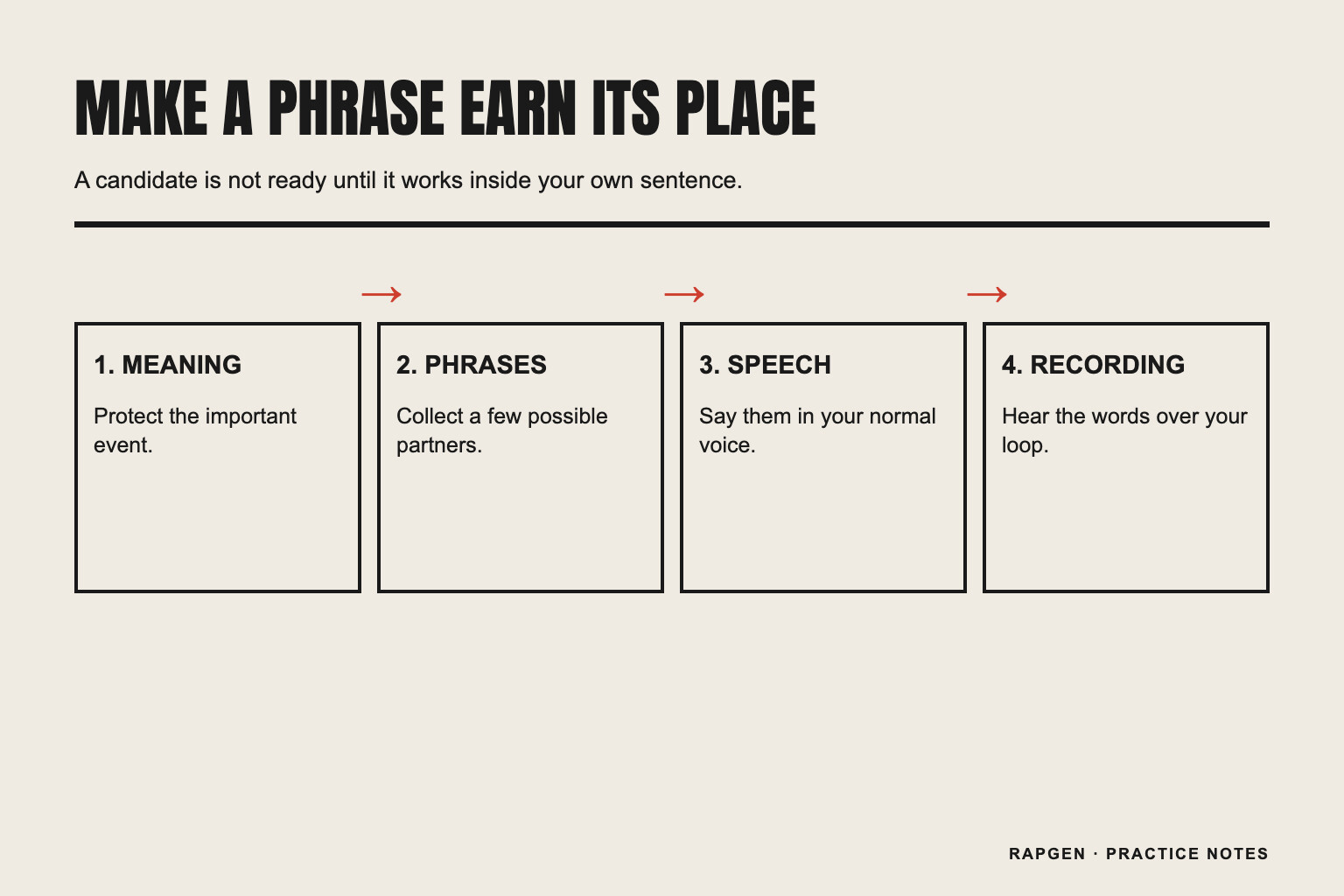
Phrase lists can hide weak writing because the surrounding logic is missing. Give each candidate an action, a person, and a reason to be present. Try this original pair of printed lines:
I watch your name go dark while I wait for the late train.
The message says, “Call when you can.” I choose the same day.
The ending sounds offer a connection, but the second sentence is unhelpfully vague. “I choose the same day” does not clearly express the refusal or explain what the traveler decides. That is a meaning problem, even if you can perform the ending smoothly.
Rewrite without protecting the candidate:
I watch your name go dark while I wait for the late train.
I type, “Tomorrow works,” then wipe the whole reply away.
Now the second line shows an action and preserves the avoided conversation. Train and away provide a partial ending connection through their stressed vowel in a common reading, with different following sounds. The phrase bank helped start a passage; the final wording did not need to preserve the entire original pair.
Keep the strongest discarded sentence
Save the first version with a note explaining why it failed. You are building a record of choices, not collecting mistakes for their own sake. “Vague decision added to reach same day” will help you recognize the same problem when a different attractive phrase tempts you next week.
5. Check stress without stretching every word
Speak the revised lines conversationally, away from the beat. Underline the words you naturally lean on. Then try them over a slow loop that gives you enough room to speak clearly. Do not speed up the whole passage just to avoid hearing an awkward ending.
For our example, you might stress NAME, DARK, LATE TRAIN in the first line and TOMORROW, WIPE, REPLY AWAY in the second. These are options to test, not a metrical analysis that every reader must reproduce. Record the version that feels natural before experimenting with stronger emphasis on the matching vowels.
Change one part of delivery at a time
First try a little more space before the ending phrase. Next try slightly less emphasis on an intervening word. Keep the words themselves unchanged during those two takes. If you rewrite vocabulary, change tempo, and exaggerate the vowels simultaneously, you will not know which change made the connection clearer.
Listen for what happened to intelligibility. Could someone still understand the sentence without a lyric sheet? A stretched vowel may make a sound connection more obvious while making the narrator sound less believable. That tradeoff is yours to assess in the recording; the spelling cannot settle it for you.
6. Use an exact rhyme as a comparison take
When a near match feels uncertain, write one version with an obvious full rhyme. This is a comparison, not a rule that the exact rhyme wins. Keep the same emotional situation as closely as the language allows.
Your name lights up the glass; I tell myself to wait.
I know you've seen me reading. Now an answer feels too late.
Wait and late give the ear a clearer reference relationship in a common pronunciation. The scene now focuses on delaying a reply rather than typing and deleting one. Note that meaning difference before declaring one version better. Your comparison is useful, but it is not perfectly controlled if the action changed.
You can also keep the original first line and replace only the second. Try several endings privately, then reject any that introduce an irrelevant fate, gate, or plate merely to reach the sound. A full rhyme can be clumsy; a partial match can be natural. Either can also be weak for reasons unrelated to rhyme.
7. Build a small bank with reasons, not a giant list
Keep only a few candidates from one session. For each, record the phrase, its possible partner, the detail it could express, and the result of your spoken test. That extra context makes the bank usable when you return to it after the scene has faded from memory.
An entry might read: “cold street / old keys — arrival outside the apartment — vowels connect in my reading, but keys ends with a z sound and street with a t sound; test inside a sentence.” Another could read: “late train / same day — rejected for this passage because same day produced a vague decision.” Rejected entries can be useful if the reason is specific.
Separate three kinds of rejection
Use sound when you cannot hear the connection naturally. Use meaning when the phrase changes or empties the thought. Use delivery when the pair seems promising alone but becomes awkward in the sentence over your loop. These labels tell you what a later revision would need to solve.
A sound rejection may deserve a different partner. A meaning rejection may fit another song. A delivery rejection may need fewer surrounding words. None of those outcomes requires declaring yourself bad at rhyming, and none is fixed by adding another hundred unrelated entries to the list.
8. Finish with a listener test and a saved decision
Choose one passage and record a plain take without announcing which words are supposed to connect. If you have a willing listener, let them hear it once without the text. Ask what happened in the scene before asking about rhyme. Their answer checks whether the writing still communicates.
Then ask which endings they noticed, if any. Avoid asking, “Did you hear the clever near rhyme?” That question supplies the verdict you want. A listener may remember the repeated vowel but not call it rhyme, or may follow the scene without noticing the device at all.
If nobody is available, return to the recording later with the notebook closed. This is not equivalent to an independent listener, but it can make a forced pronunciation easier to notice. Write down what you actually hear rather than what you intended when drafting.
Save the selected take alongside the words and one reason for your choice. For example: “Kept train / away because the deletion action stayed clear; the ending connection was audible without stretching.” That is a practical result you can build on when shaping the rest of the verse.
Three things you can stop worrying about
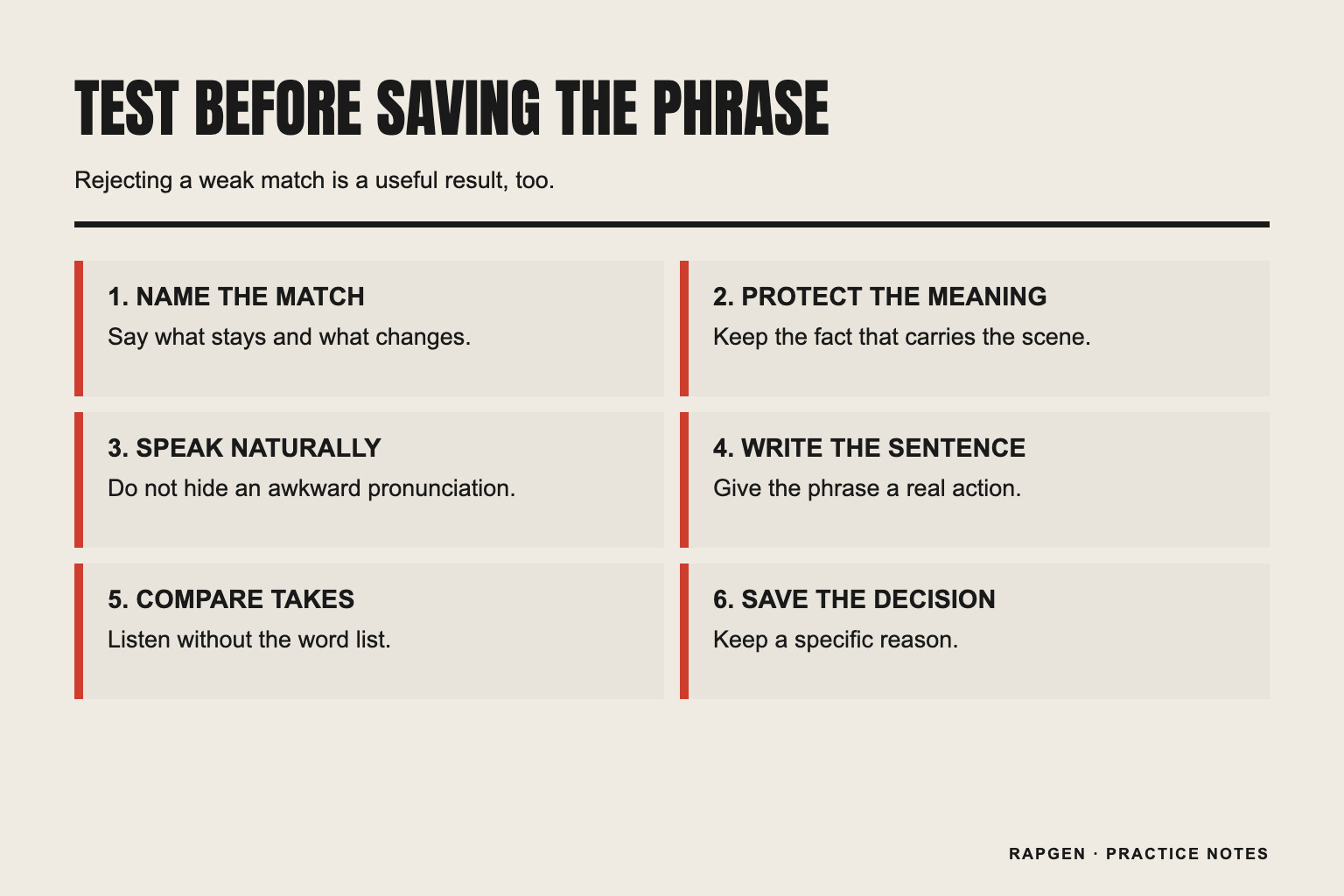
Making every candidate work. A phrase bank is a selection tool. Rejecting a pair after a clear test means the process gave you useful information.
Winning an argument over labels. Be precise about what matches, and acknowledge when you are using the broader idea of near rhyme. You can revise a passage without pretending that all terminology has one universal boundary.
Sounding identical to the examples. Your accent and natural emphasis are part of the test. A pair that needs an uncomfortable pronunciation is not an obligation to keep performing that way.
Collect alternatives without outsourcing the listening
If your own list keeps circling the same words, the Rap Bars Generator can provide alternative text lines about the situation. Describe the delayed journey and the unanswered call, then extract a few candidate endings that preserve those facts.
Generated text has not passed the spoken tests in this article. Check the meaning, say each line normally, and record promising pairs yourself. Keep your own original passage available so a smooth-looking suggestion does not quietly replace the moment you meant to describe.
The short version
A search for half rhymes rap phrases is most useful when it leads to a small, tested bank rather than a ready-made verse. Identify the shared sounds, preserve the important fact, and place each candidate inside a sentence before deciding it belongs.
Compare a natural reading with a recorded take. Keep the pair that communicates in your voice, and save a clear reason for rejecting the others. The sound connection should help carry the scene you actually wanted to write.