Horrorcore Rap: 7 Ways to Write Tension into a Verse
Horrorcore rap writing uses perspective, withheld information and recurring clues. Build an original unsettling verse without relying on graphic filler.
You record a threatening opening, play it back and hear somebody describing a costume. The voice says it is dangerous. The room in the verse has no rules, the narrator has no reason to stay and the listener has nothing to anticipate.
Writing horrorcore rap gives you room for menace, dark fictional perspectives and unsettling imagery. It does not require every line to announce violence. A verse can become disturbing because the listener notices a contradiction before the narrator does, then waits for the narrator to catch up.
There is a timely writing prompt in Chaka Boy's “The Beast Within.” Hand'Solo Records lists the DJ pack as released on October 9, 2026, credits production to The Dirty Sample and describes the subject as an internal struggle. Those are facts from the label's external release page. The label does not tag that release as horrorcore; we are using its stated conflict as a prompt, not assigning the artist a genre or pretending these exercises reproduce the recording.
All lines below are original examples. The task is to build your own small fictional world, make its tension understandable and rehearse a voice you can sustain.
1. Decide whose account the listener is hearing
Choose a narrator before choosing frightening nouns. A witness, a person hiding something and a person who misunderstands the situation will describe the same room differently. That choice determines what the verse can reveal honestly at each moment.
For this worksheet, the narrator is a caretaker locking a community hall after an event. They insist they are alone. The listener gradually notices that somebody else appears to be completing the same tasks a few seconds ahead of them. The fear comes from the gap between the narrator's certainty and the evidence.
Write the narrator's belief at the top of your page: “Nobody stayed behind.” Under it, write the fact that challenges it: “Every room is already locked when I reach it.” These sentences are your editing test. A line about a different monster may be vivid, but it belongs in another draft if it does not develop this disagreement.
Three workable perspectives
A confident narrator can keep supplying ordinary explanations until the last one fails. An anxious narrator can suspect everything, making a small reliable clue especially important. A guilty narrator can avoid describing one object, drawing the listener's attention to that omission.
Pick one for the first version. Switching perspective halfway through can work, but label the switch with a clear change of speaker or scene. Otherwise the listener may interpret a planned ambiguity as an accidental contradiction in who knows what.
2. Establish a rule before breaking it
A broken rule only means something if the audience understands the rule. “The door opened” is an event. “I locked the only door, then heard it open behind me” creates a conflict the listener can follow.
Keep the rule physically simple. The caretaker has one key ring. The hall has a front door and an internal corridor. The lights are controlled from the entrance. You can write an entire verse around those ordinary restrictions without inventing a mythology that needs a long explanation.
Our opening might be:
One ring, one switch, last chair off the floor,
I count the room, then I count once more.
The repeated count establishes a habit. A later mismatch can then carry a consequence. You have supplied a reason for the narrator to notice a missing chair or an extra place at a table.
Write down which rules are factual inside the fiction and which are only the narrator's assumptions. “There is one key ring” may be observable. “Nobody else has a key” may only be something the caretaker believes. That distinction gives you room for a reveal without cheating the reader.
3. Give the listener one clue ahead of the narrator
Tension can begin when an audience recognizes a pattern the speaker explains away. A chair is warm. A kettle has just clicked off. A coat hangs over a chair that was previously empty. The narrator treats each as a leftover from the event; the listener starts connecting them.
Use one clear clue before adding a second. If every line introduces a new inexplicable detail, the listener has no stable scene to test those details against. You can make a single object more troubling through its location, timing and connection to the narrator.
For example:
Kettle clicks twice though the socket is bare,
I blame the old pipes and I straighten a chair.
The explanation is deliberately inadequate. The action after it keeps the caretaker moving and shows their desire to restore order. The verse does not need an extra sentence telling us they are in denial; their behavior supplies that information.
Make an information ledger
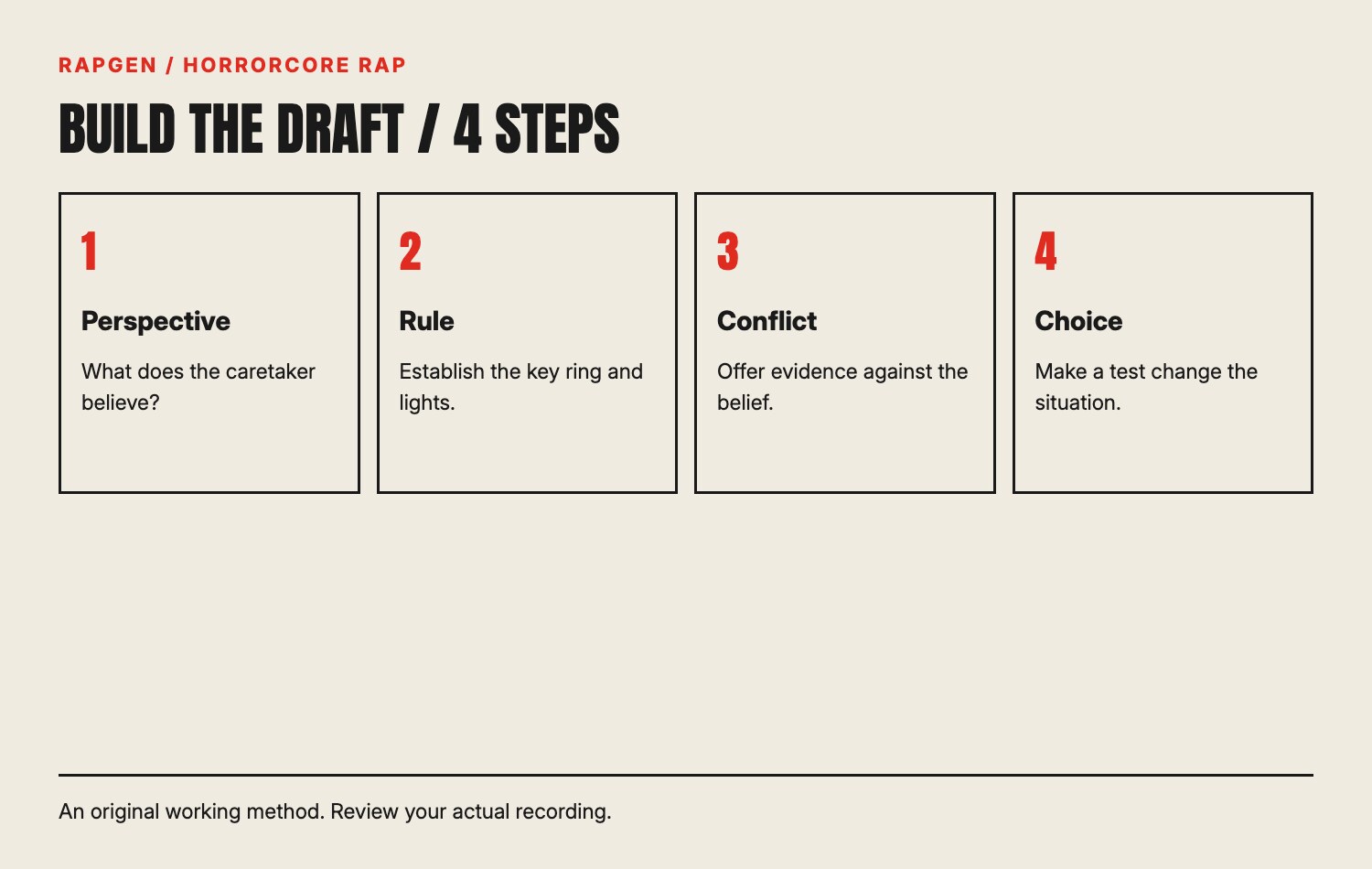
Draw two columns: narrator knows, listener suspects. After each section, write one sentence in each. If both columns contain the full reveal too early, you have little uncertainty left. If the listener's column contains nothing until the final line, the ending may feel unprepared.
This ledger is a drafting tool, not a claim that every listener will infer the same thing. Test it with an unfamiliar listener later. Their account of the scene tells you which clue actually worked and which one remained obvious only to the writer.
4. Choose an escalation that changes the problem
An escalation should narrow the narrator's options. Hearing a louder knock changes intensity. Discovering that the knock comes from the cupboard containing the exit key changes what they can do next.
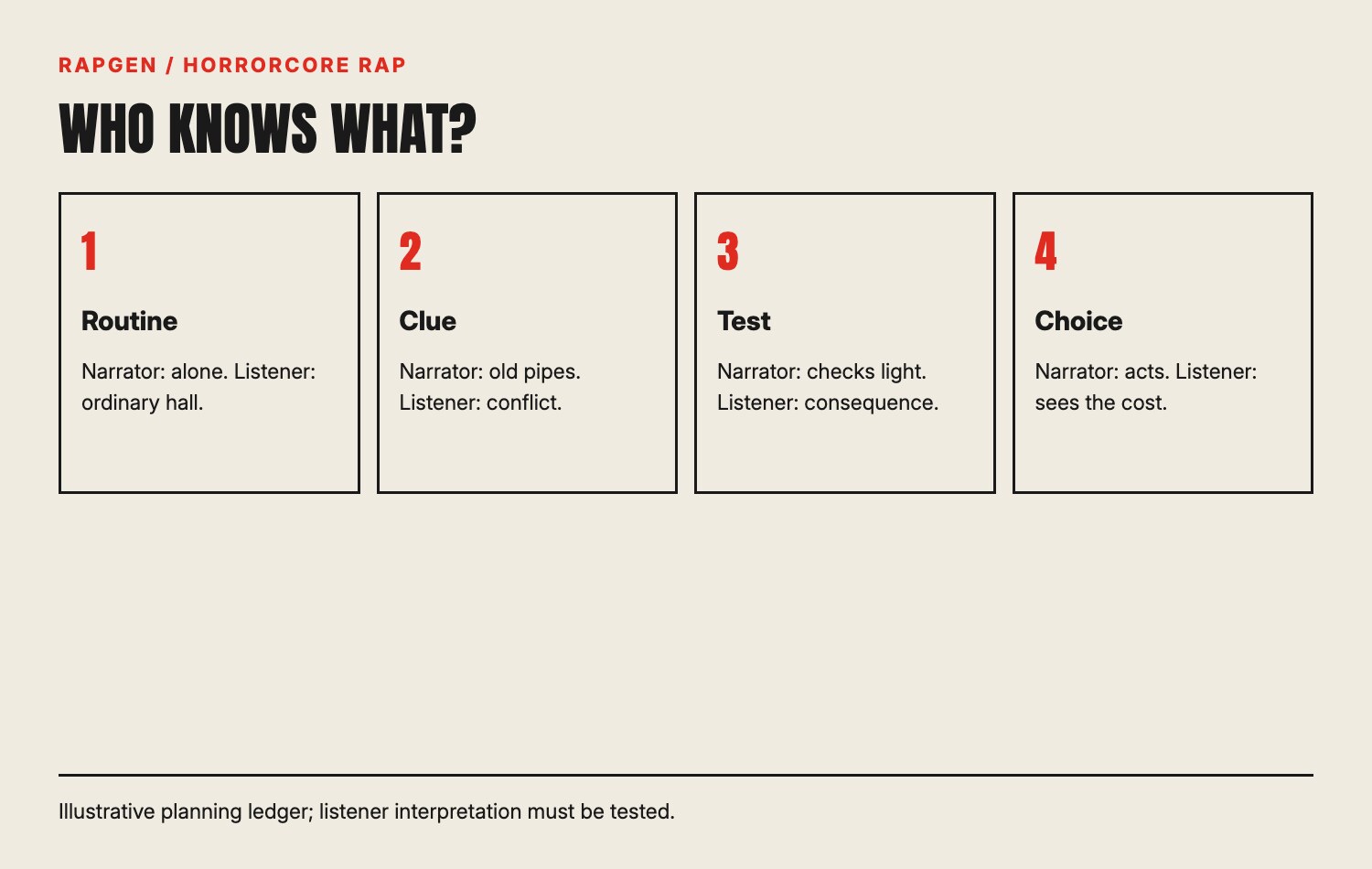
Give each stage a different job. First, a clue disrupts routine. Second, the narrator tests an explanation. Third, the test creates a cost. Finally, they must act with incomplete knowledge. This sequence makes the suspense depend on choices rather than an endless supply of ominous adjectives.
Our caretaker checks the corridor because a light is on. They switch it off. The entrance light then goes out, leaving their route back harder to see. Now the attempt to restore order has changed their situation.
| Drafting move | What it supplies | What can go wrong | Revision question |
|---|---|---|---|
| Strange detail | A reason to pay attention | It has no connection to later events | Will this detail return or affect a choice? |
| Failed explanation | A widening information gap | The narrator seems implausibly careless | Why do they want to believe the explanation? |
| Costly test | A consequence | The cost feels arbitrary | What action caused it? |
| Final choice | A route into the ending | A new solution appears from nowhere | Was the needed object established earlier? |
Keep your reveal proportionate to the premise. A hall containing an impossible echo can end with the narrator recognizing their own voice. It does not need to expand into a universe-wide conspiracy in the last two lines.
5. Let ordinary language carry the unsettling detail
Formal horror vocabulary can distance the listener from a narrator who supposedly cleans chairs for a living. Write the description in words that person would use. “The chair was warm” may land more directly than a long phrase about an ominous residual presence.
Keep one unexpected image per phrase while the scene is still being established. Once the listener understands the room, you can introduce denser associations. The useful question is whether they can still locate the person speaking and the object being described.
A short original sequence might be:
I put the coats away; my coat comes back,
Folded on the table with a fresh name tag.
I read the ink and the letters look right,
It's the name I stopped using before this night.
This example intentionally leaves the past unexplained. You could make the old name a childhood nickname, a stage name or an identity the narrator abandoned. Decide which one before writing the surrounding verse. An open detail helps interpretation; an undecided detail makes continuity difficult to manage.
Check rhyme against speech. “Back” and “tag” can function as a near-rhyme depending on delivery and accent. They are not being presented as a perfect match. If they sound unrelated in your voice, change the surrounding phrase rather than insisting a written explanation makes them rhyme.
6. Rehearse the voice without forcing a vocal effect
Record the same four lines in a conversational register, with clipped pauses and with a slower last line. Compare the recordings at similar playback loudness. A louder take can seem more dramatic simply because it is louder, hiding whether the phrasing actually changed.
The point is to hear the narrative choices. Did the pause make the coat's return understandable? Did slowing the last line give the old name enough attention? Did a growled word become harder to identify? Keep a note about the specific result rather than choosing the take with the most theatrical face.
Use comfortable volume and stop a technique that causes discomfort. There is no requirement to rasp, shout or lower your voice beyond what feels natural. A steady narrator struggling to stay calm can be unsettling without a manufactured monster voice.
Place silence after information
A pause before a clue can signal that something is coming. A pause after it lets the audience process what arrived. Try both at the same point in the beat, then listen with your draft hidden.
If the empty space makes you lose the pulse, shorten it or keep counting the measures while rehearsing. Silence still occupies musical time. The flow practice guide can help you keep that timing stable; this article's concern is what information the silence emphasizes.
7. Test clarity and boundaries before adding decoration
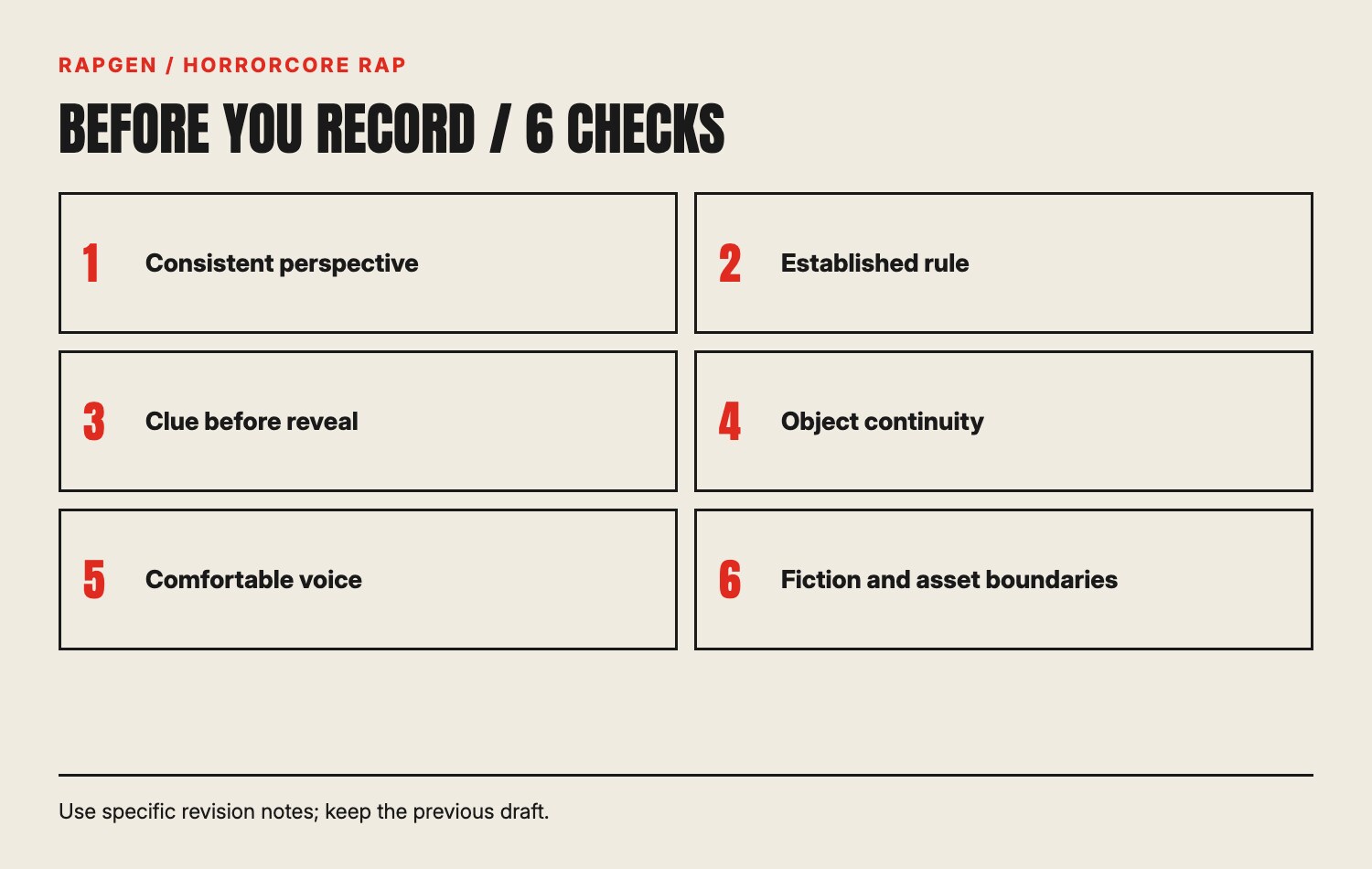
Give your rough recording to someone who has not seen the notes. Ask where they thought the narrator was, which object seemed important and what they believe happened. You are checking the story's evidence, not asking them to award a fear score.
If they cannot name the important object, make its first appearance simpler. If they guess a different ending that fits every clue, decide whether that ambiguity serves your purpose. You may keep it, but keep it intentionally. If the ending relies on information they never received, add the missing clue earlier rather than explaining afterward.
Label fictional material appropriately when sharing. Avoid realistic threats aimed at identifiable people. Do not use mental illness as a lazy synonym for dangerous behavior. A character can be mistaken, ashamed or frightened without making a diagnosis the explanation for everything they do.
Use a separate content pass
Read the lyric without the performance effects. Check what it literally says about people, consent and harm. Sound design can make a line feel less direct while leaving the same words in the transcript, caption or searchable text.
Then check any sampled audio, film dialogue and images you plan to include. Having an original lyric does not automatically give you rights to the material around it. If you cannot establish permission, use your own sound or a clearly licensed substitute and keep its license record with the project.
One clue, two revisions
Suppose your test listener remembers the warm chair but never connects it to the returned coat. In the first revision, put the coat on that same chair instead of a different table. You have changed location, not added another supernatural event. Replay the passage and ask what now seems connected.
If the listener follows the connection but still misses the old name, revise the delivery of that name rather than adding more clues. Give the reveal a shorter lead-in and a clear pause afterward. These are two different problems: connecting evidence and hearing its consequence. Fixing them separately keeps the verse from becoming longer every time somebody asks a question.
Three things you can stop worrying about
Being graphic enough. Disturbing uncertainty can come from an ordinary object acquiring the wrong owner or location. Detail should support the premise and your intended audience.
Explaining the entire fictional world. The hall, key ring and coat give this verse a sufficient frame. Save unused mythology for another track rather than requiring a listener to memorize it first.
Sounding like a particular artist. Use releases as prompts for subjects and questions, then write your own narrator and examples. A voice you can repeat consistently is useful in the recording session.
Generate alternatives only after the information map
The rap bars generator can supply separate candidate lines about the coat or the locked hall. Keep your information ledger next to the result. A striking line that identifies the hidden presence in the opening destroys the tension you have planned, so it should not survive simply because it rhymes.
The short version
Build horrorcore rap around a believable perspective, a simple rule and evidence that gradually defeats the narrator's explanation. Escalate through a costly choice, rehearse a comfortable voice and test what an unfamiliar listener understands. The unsettling part can remain unexplained; the sequence of clues should remain deliberate.