Hotel Lobby AI Trend: 7 Ways to Write Your Own Duo
Hotel Lobby AI trend ideas for an original two-person clip: write a setup and reply, plan the handoff, choose a readable gesture, and check the result before sharing.
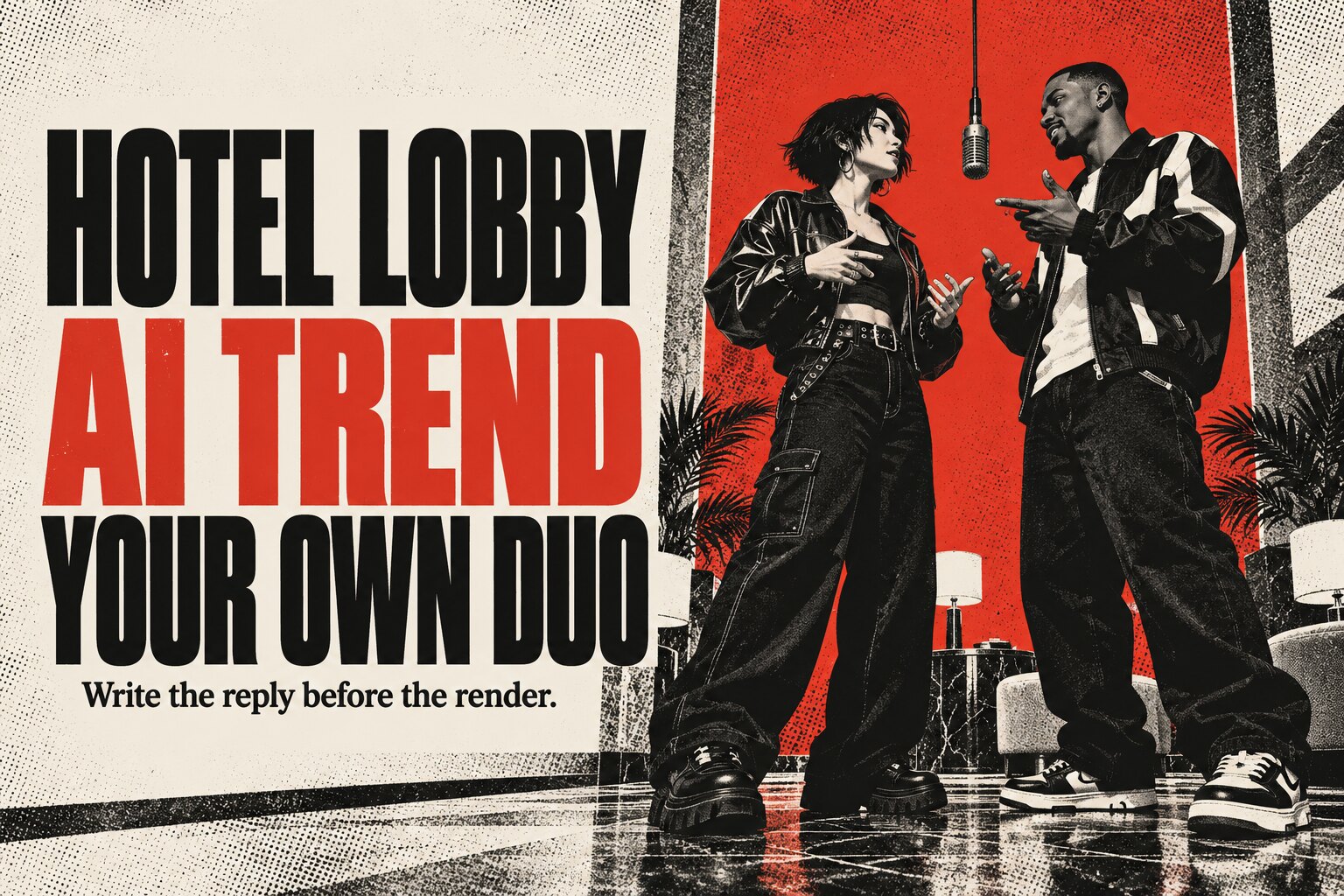
You send a friend a picture of two people beside a microphone. They reply with the obvious question: what are we supposed to say? That is where a recognizable template becomes your clip. The Hotel Lobby AI trend supplies a setting people can recognize; the exchange gives them a reason to watch your version.
Start with something the two people actually disagree about. Who always arrives late? Who says they are saving money, then orders the expensive coffee? Who takes the group photo and still manages to be missing from it? A small shared habit can carry a whole exchange. You need enough detail for the second person to answer, and enough space for the answer to land.
The examples below are original writing exercises. They borrow no lines from the song. You can speak them, shorten them, or replace the situation with one your partner recognizes. Their job is to show the shape of a miniature conversation before you spend time generating or filming it.
1. Understand what makes the reference recognizable
The external source for the visual reference is Quavo and Takeoff's official 2022 COLORS performance of HOTEL LOBBY. Look at the arrangement: two performers, a suspended microphone, a strongly colored room, and bodies that remain readable within it. Those features make the scene recognizable even in a small thumbnail.
In an interview published on October 2, 2026 by The Associated Press, Quavo discussed the performance's renewed attention through AI remixes. That dated report places this new wave around an older recording. The exercise here is to write your own exchange for the recognizable setting; none of the examples reproduces the source lyrics.
There is a useful creative lesson in that arrangement. With little scenery competing for attention, a change in posture or a glance between performers carries weight. You can build your version around a handoff: one person starts, the other reacts, and the ending makes their relationship clear. The scene gives you a frame for that exchange.
Keep three elements separate when planning. The visual reference is a recognizable arrangement. The words are the exchange you write. The recording is the audio you own, create, or have permission to use. Recognizing the first does not supply the other two. A new generated performance also needs to be checked on its own terms; resemblance to a familiar setup is not a promise of matching the source performance.
Before choosing outfits, describe the scene in one plain sentence: “Two roommates argue about who finished the cereal.” If you can understand the joke without seeing the booth, you have material that can survive outside the template.
2. Give each person a different job
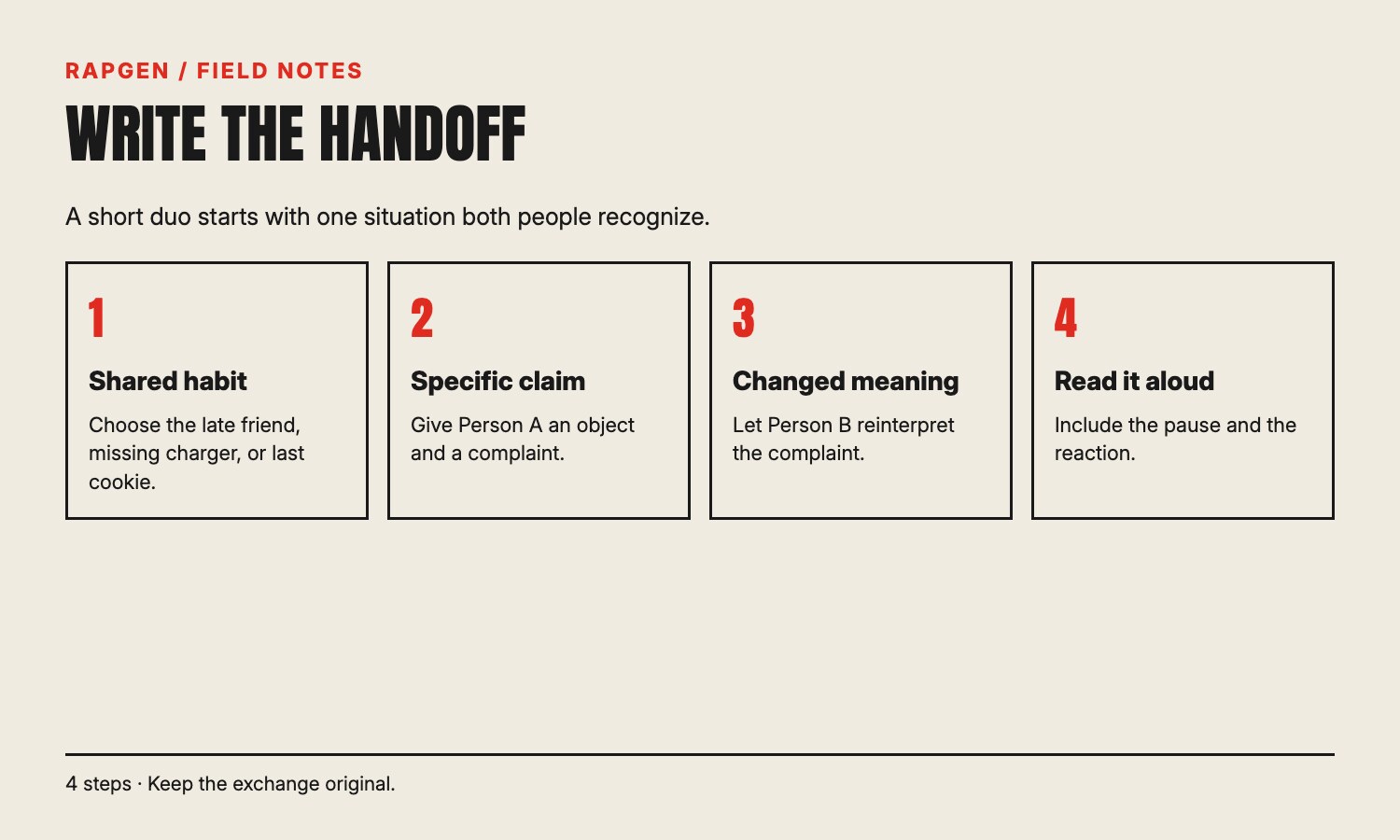
The first person establishes the problem. The second changes how we understand it. That division is useful because a short clip has little room for two introductions. If both performers announce how confident they are, the viewer gets two versions of the same information and no turn.
Write the setup as a specific claim
Try this first line: “You said five minutes; I finished my lunch.” It contains a promise, a delay, and an image. The friend has something to answer. Compare it with “You always take forever.” The second version may be true, but it gives the reply fewer handles. Which occasion? What happened during the wait? Specific objects do much of the writing for you.
Write the reply so it changes the scene
An answer could be: “I packed you a snack; now you call that a brunch.” The second person has reframed the complaint as hospitality. You may prefer a more natural spoken reply: “You ordered dessert while I looked for my keys.” The rhyme is weaker, but the relationship is clearer. Read both aloud and keep the one the actual partner would say.
Let the listener participate
A listener can raise an eyebrow, look toward the microphone, or hold a familiar object. Those reactions make the setup feel addressed to someone. Choose one visible action for each person. Three gestures in a tiny exchange make the performance hard to read and create more details to check in a generated result.
Write the role names above the lines before adding names or faces. “Late friend” and “waiting friend” tell you what each line needs to accomplish. The labels also reveal whether you accidentally gave both people the same attitude.
3. Build a pair around an object people can picture
An object gives the viewer a way into a private joke. A coffee cup, a bus pass, a cereal box, or a key ring can make a familiar situation visible. You do not need the object to appear in the generated scene. Naming it in the exchange may do enough work. If it does appear, keep it secondary to the two faces and the handoff.
Here are four starting pairs. They are drafts to adapt, rather than instructions to make a model pronounce a line perfectly.
| Situation | Person A: setup | Person B: reply | What the reply changes |
|---|---|---|---|
| The last cookie | “You left me a crumb and called that a share.” | “I saved you the plate; that's practical care.” | A small theft becomes an absurd favor |
| A missing umbrella | “You borrowed my shade when the rain came down.” | “I brought it back dry; best service in town.” | The borrower claims credit for the obvious |
| A photo session | “You took twenty shots and I blinked in them all.” | “Your eyes need a break; let the camera take the fall.” | The photographer transfers the blame |
| A kitchen beat | “Your spoon hits the pan like a sold-out show.” | “Then buy me a ticket and let dinner go.” | The noise becomes a performance |
The table contains deliberately small situations. Scale makes these exchanges playable. A friend can act irritated about a cookie without needing to perform an entire biography. A listener can understand the premise before the clip ends.
Change the object before changing the rhyme. If your partner never carries an umbrella, use the charger they borrowed. If the second line sounds too written, say the answer in ordinary speech and rebuild from that. You can get help with imperfect sound matches in half-rhymes for rap phrases, but the exchange still needs a believable reason for the reply.
4. Leave enough room for the handoff
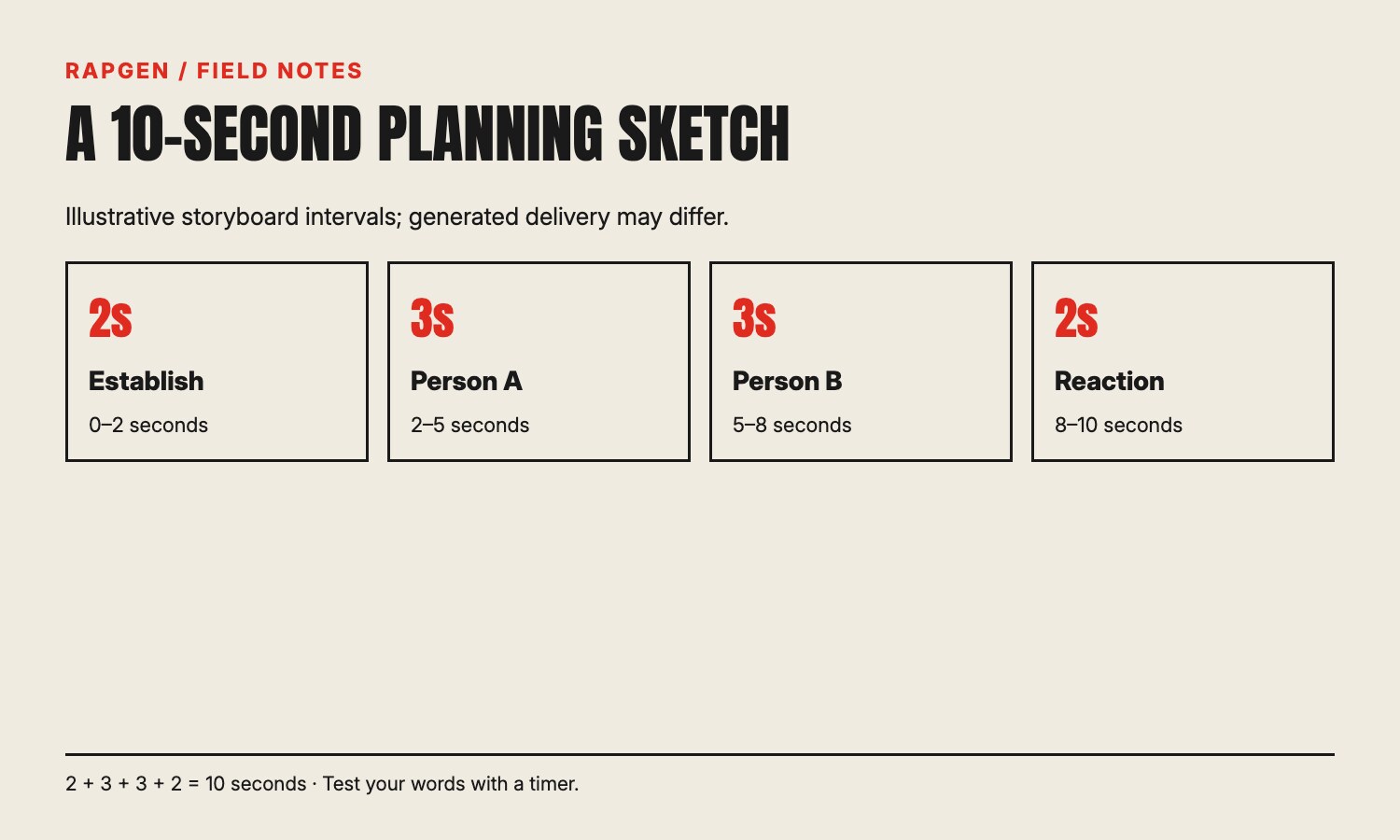
A short duration is a writing constraint. It includes the opening, both deliveries, the change of speaker, and the finish. You cannot assign every second to words and then wonder why the reply feels rushed. Try the exchange aloud with a timer. Include the eyebrow raise or the small pause you want the audience to notice.
For an imagined ten-second version, use this planning sketch: two seconds to establish the pair, three for the setup, three for the answer, and two for the reaction. That totals ten seconds. It is a storyboard budget, not a promise that a generated clip will follow those marks. Actual speech length varies with pronunciation and delivery; revise the words after hearing them.
For five seconds, the premise needs to be simpler. “You ate my fries.” “I saved the salt.” The audience can understand the complaint immediately. A joke that needs a story about last Thursday's train will probably need a longer format or a caption that carries the context.
Listen especially to the space between speakers. If the first person continues talking through the answer, the audience loses the turn. If the listener is already performing a large gesture, the second line competes with it. The cleanest draft usually gives each action a clear owner.
Record a rough voice memo before selecting a video length. When the exchange exceeds your planned time, cut a repeated idea first. Keep the object, the claim, and the changed meaning. Then shorten connecting words. Speeding up every syllable should be a conscious performance choice, because it also makes the joke harder to catch on a first viewing.
5. Match the gesture to the line you wrote
Write a gesture beside each line using a verb: points, shrugs, turns, offers, waits. A concrete action is easier to evaluate than an instruction such as “look iconic.” It also makes you consider whether the image helps the words.
For the cookie exchange, Person A might open an empty hand while Person B gives a small shrug. For the missing umbrella, A could glance toward B and B could straighten up as if accepting praise. These are performance ideas, not additional controls promised by a particular tool. If the generated result chooses a different motion, judge whether the exchange still reads clearly.
Use one main gesture per turn
An empty-hand gesture can communicate “where did it go?” without an explanatory caption. Adding a point, a wave, and a turn in the same breath makes the body busier than the joke. When testing your draft on camera, watch it without sound. You should still be able to tell who is asking and who is answering.
Keep the shared focus visible
The microphone gives both people a reason to face the same part of the scene. A shoulder turned completely away may read as disengagement. A slight turn toward the partner can carry the reply. If you use two portraits, pick clear views of each person's face and avoid relying on a tiny expression in the input to convey the entire joke.
Choose a readable relationship
“Friends trading complaints” and “siblings defending a snack theft” are different performances. The first can be dry; the second can be playful. Tell your partner what relationship you are aiming for before recording. With generated footage, review the result for that same emotional intention. A clip that makes a friendly exchange look hostile may need a new take or different words.
6. Review the result with a small scorecard
Play the first result all the way through before deciding what to change. Then inspect it in separate passes. One pass checks the story, one checks the people and movement, and one checks the audio. Dividing the inspection this way helps you avoid fixing the background while overlooking an unintelligible reply.
For the story pass, ask a person who has not read the draft what happened. “One stole the other's cookie” is enough. If they only describe two people moving, the exchange may need a more specific first line or a clearer response. Do not explain the joke until you hear their first answer.
For the visual pass, check both faces at the opening and ending, hands near the microphone, and whether the same person appears to own each turn. Pause on transitions. A good opening frame can hide a distracting change halfway through. Keep the source portraits nearby so you can judge identity consistency without relying on memory.
For the audio pass, listen on an ordinary phone speaker. Note the words you can actually hear. Newly generated audio can differ from the draft; the final description and any captions should reflect the result you are sharing. If the joke depends on a word that never arrives clearly, the clip needs revision. Writing that word in the caption does not necessarily restore the exchange.
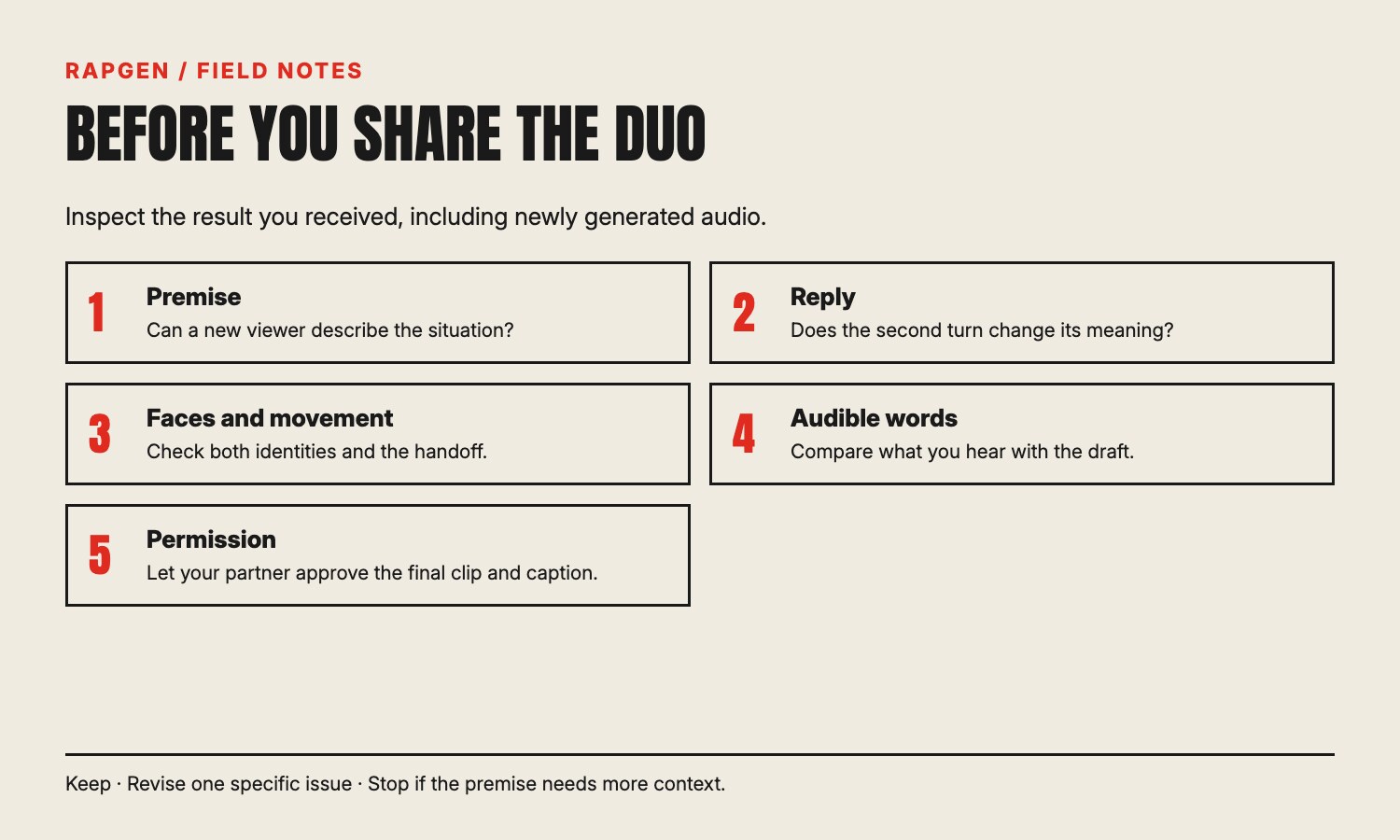
Use a simple decision after these passes: keep, revise, or stop. Keep a result when the premise and reply are understandable and the people are represented appropriately. Revise when you can name one specific problem. Stop when the concept needs more context than the format can carry. That last option protects the time you could spend on a better pair.
7. Give the clip a caption that adds context
A caption can establish a relationship before the first line begins. “The roommate who labels every shelf” is a useful premise. “This is hilarious” supplies a reaction the viewer has not had yet. Write the caption as information the clip benefits from, then let the exchange earn the response.
For a cookie version, try “When the group snack has one unofficial owner.” For the kitchen beat, try “Dinner rehearsal, apparently.” Neither needs to retell both lines. The caption sets the situation and leaves the answer for the video.
Ask the person represented in the clip to approve the actual result and caption before sharing. Permission for a source photo is not necessarily agreement with a joke or a synthetic performance. Use your own material or assets you have permission to use. A short trend clip can still imply something about a real person, so review the implication with them rather than relying on a friendly intention.
If you want this exchange to grow into a complete song, save the strongest reply as a possible hook. The repeated phrase gives you an anchor for a longer section. Rap song structure explains where that repeated idea can sit; expanding the format will require more development than simply repeating your ten-second joke.
Three things you can stop worrying about
Finding a perfect rhyme immediately. A recognizable reply is a workable first draft. Read it aloud, then adjust the ending sounds. Forcing an unusual word into the answer often makes the relationship less believable.
Filling every second. A held look after the answer can be part of the payoff. Keep it when it communicates something, and trim it when nothing changes.
Inventing a huge story. One borrowed object and two different opinions can sustain a short exchange. The viewer needs a situation they can enter quickly.
Put the exchange into a scene
When you have two portraits and an exchange you want to test, open Hotel Lobby AI. The page explains the current photo requirements, preview, video choices, and credit costs. Keep your writing draft beside the result so you can compare the intended reply with what was actually generated.
For a performance built around an existing rap recording, use the separate AI rap video generator instead. That is a different starting point: the recording already supplies the words and delivery.
The short version
Make your Hotel Lobby AI trend version about one recognizable habit. Give the first person a claim, give the second an answer that changes its meaning, and leave time for the handoff. Test the words aloud before making the clip. Review the actual faces, gestures, and audio before asking your partner to approve the version you share.