How to Write a Rap Hook: 7 Decisions Before Recording
How to write a rap hook that a listener can remember: choose a promise, test three original phrases, plan the return and compare actual recorded versions.

You finish the verse, reach the empty chorus slot and write the song title four times. It fills the space. On playback, you cannot tell whether the repeated phrase belongs to the story or was added because the arrangement needed somewhere to return.
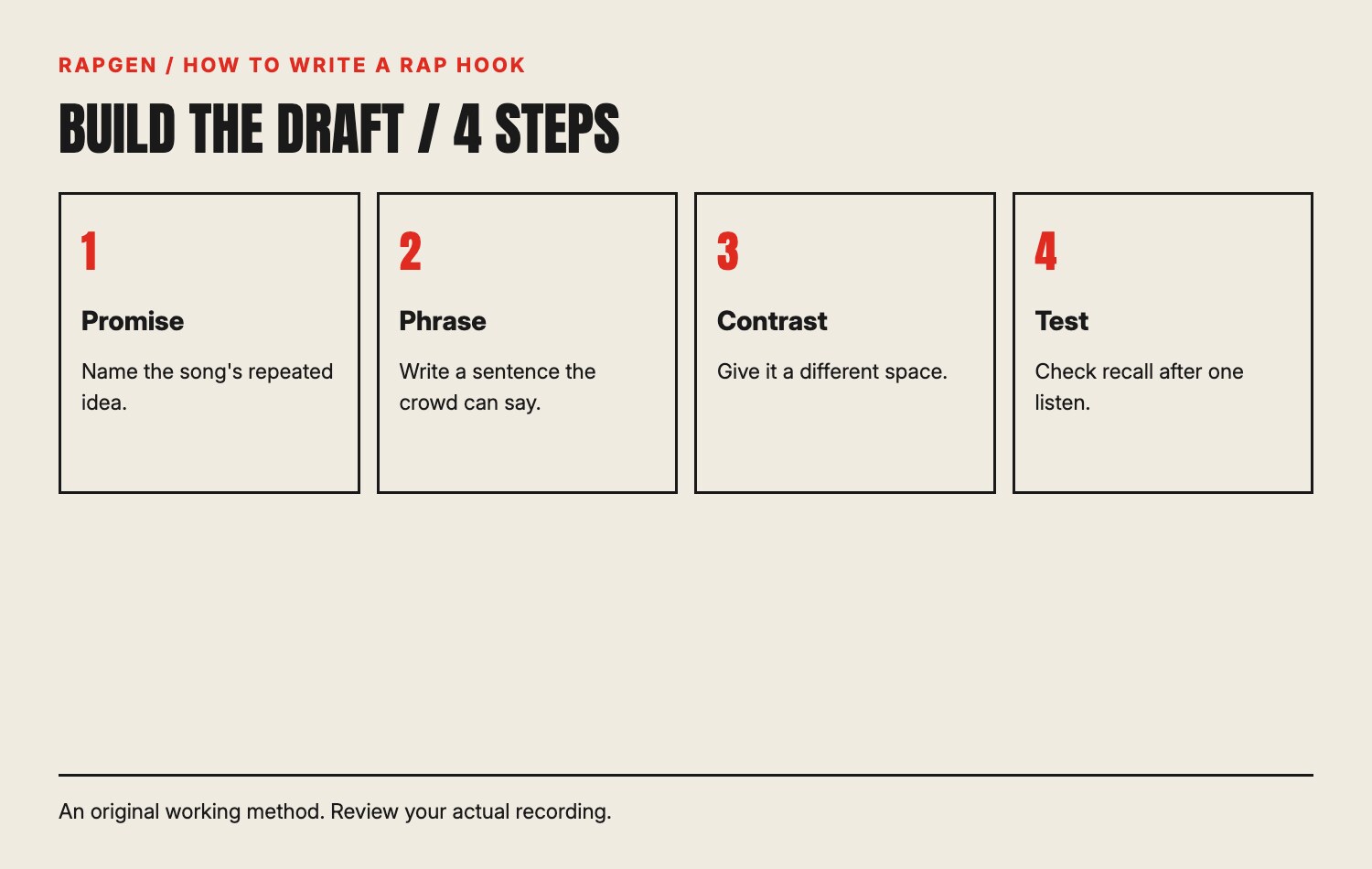
Learning how to write a rap hook starts with the promise the song keeps making. The hook gives that promise a recognizable shape: words, a rhythmic entrance, perhaps a melody and enough contrast that a listener notices its return. Repetition helps recognition, but the phrase still needs a reason to be repeated.
The Recording Academy's guide places first-round voting for the 2027 Grammys between October 12 and October 22, 2026. That current listening window is a prompt to separate writing choices from performance choices, not a reason to invent nominees or treat this worksheet as award criteria. The dates come from the Academy's external voting guide. Our subject here is a small original song about missing the last bus.
1. Name the idea that should survive the verse
Write a one-sentence account of what the song keeps returning to. “I keep missing the last bus because I refuse to leave my friends behind.” That is different from “the song is about buses.” One describes a recurring choice; the other describes scenery.
The hook can express the choice directly or point toward it through an object. A lit doorway, an empty seat or the bus driver's closing hand can carry the idea. Pick the image that remains useful after the verse adds more information.
Before rhyming, write what the listener should remember after one play. In our example, it is the speaker asking someone to keep a place for them. The verse can explain the late shift and the friend. The hook can carry the request without retelling all of that detail.
A promise check
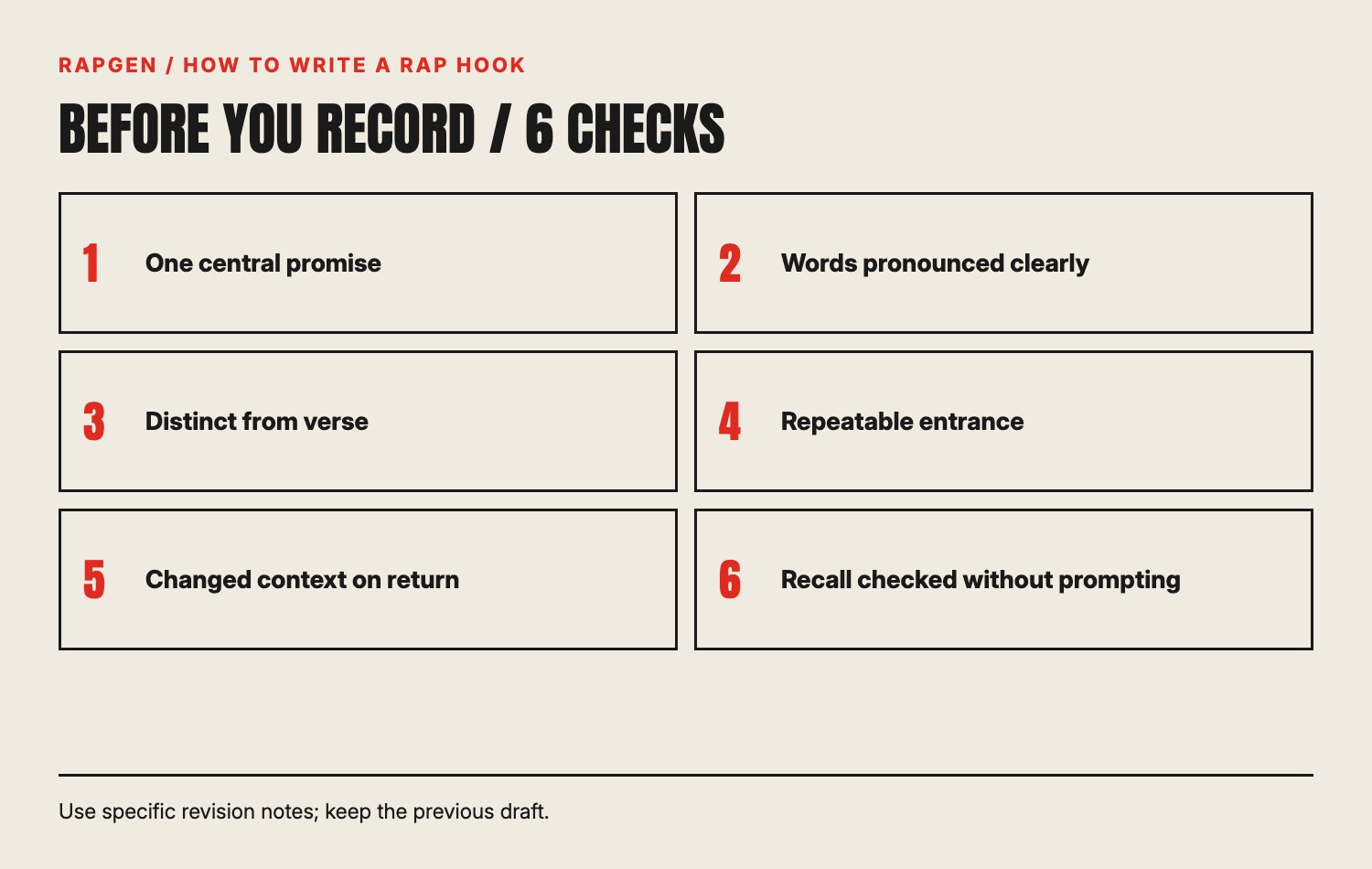
Read your draft hook and ask whether it could belong to a completely different song without changing a word. If it could, it may be too general for this particular story. Add one concrete relation: who waits, what stays open or what the speaker refuses to lose.
Do not insert every verse detail to make the hook specific. The objective is a recognizable center, not a summary paragraph. “Leave a light for me” leaves room for the verses while supplying an action and an implied relationship.
2. Write three genuinely different candidates
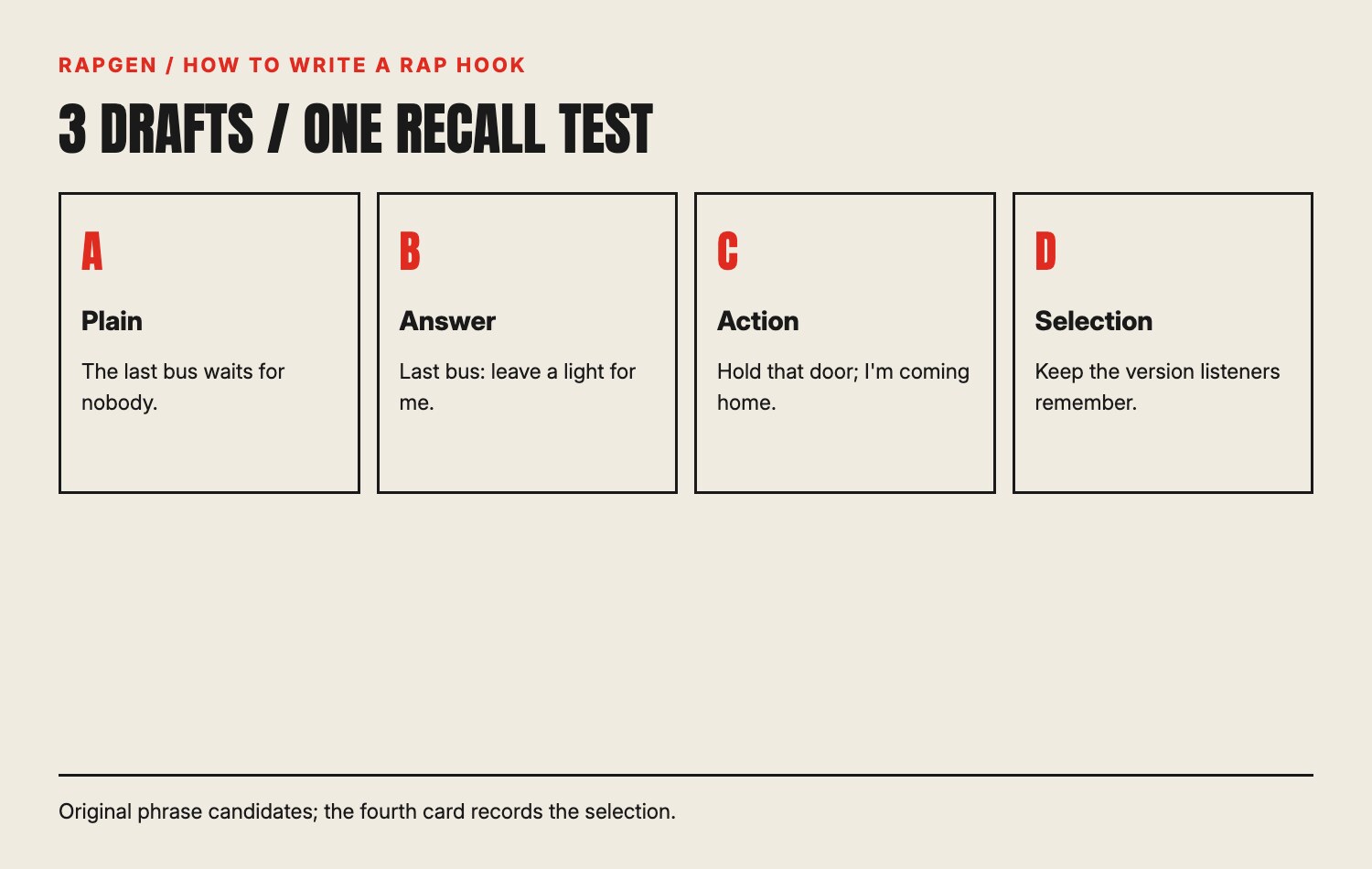
Try one statement, one request and one action. They should express the same center through different shapes. That gives you alternatives worth recording rather than minor synonyms around a phrase you already prefer.
Our original candidates are:
The last bus waits for nobody.
Last bus: leave a light for me.
Hold that door; I'm coming home.
The first sounds resigned. The second asks for something impossible or symbolic, depending on the verse. The third moves toward a person. You can decide which emotional direction the track needs by comparing these differences.
| Candidate | Form | Implied relationship | What the recording must establish |
|---|---|---|---|
| The last bus waits for nobody | Statement | Speaker against a schedule | Whether resignation matches the verse |
| Last bus: leave a light for me | Request | Speaker asking for a place | Whether the metaphor remains understandable |
| Hold that door; I'm coming home | Action and arrival | Someone waiting at the other end | Whether the entrance feels repeatable |
Record the candidates over the same section of backing. Do not give your favorite version a better beat and then claim the phrase won. Keep the comparison conditions similar enough to learn something about the words and their delivery.
3. Give the repeated phrase room to be recognized
A crowded verse can lead into a simpler repeated phrase. The contrast helps the listener recognize a change. You can create that space with fewer words, a different rhythmic entrance or a pause before the phrase returns.
Start by speaking the candidate while counting the loop. Notice where you naturally emphasize its important word. “Hold that door” focuses the object. “Hold that door” focuses the action. Either can work if the emphasis supports what the speaker wants.
Choose an entrance you can repeat reliably. A memorable phrase delivered at a different place on every return may sound like several versions rather than a stable hook. Variation can come later, after you establish what the listener is expected to recognize.
A four-line draft is a container, not a rule
Try a compact original sketch:
Hold that door; I'm coming home,
One seat empty, one light on.
Hold that door; I'm coming home,
Keep my place until the morning.
The final line changes the sound and may need editing at your tempo. Four written lines do not prove four musical bars. Perform the draft and count the measures you actually used. If the last line repeatedly spills beyond the intended space, shorten it or give it more space deliberately.
You can also reduce the sketch to the main phrase with a response. The recording, arrangement and intended audience determine what length works. Avoid adding lines simply to meet a template that no one listening to the song can see.
4. Decide what changes when the hook returns
At the first appearance, the listener may believe the speaker is asking the driver to wait. After a verse about a friend who stayed at work, the same request may sound like something the speaker now owes somebody else.
Map that change before recording. Write one sentence under each hook appearance: what the listener knows here. If the second appearance follows a verse that supplied no new relationship or consequence, the repeat may feel like the arrangement pausing rather than the song developing.
Keep the core phrase stable while its context changes. You can adjust a response, remove a backing layer or change who says the second half. The listener should still be able to identify the phrase that came back.
Our rap song structure guide covers section placement. This worksheet focuses on what the repeated words mean at each placement. A technically correct arrangement can still contain a hook that does the same emotional job every time.
5. Use a response only when someone can answer it
A call-and-response hook needs a clear invitation and a manageable answer. “Where you going?” invites a location or destination. “Home” can be answered quickly. A long question requiring private story context gives the audience too much work in the available gap.
Test the response with a person rather than imagining a crowd that already knows the track. Speak the call once, show the intended answer and try the exchange over the backing. If they repeatedly miss the entrance, the cue may be unclear or the answer too long.
An original version could be:
Where you heading? — Home.
Who's still waiting? — My friend.
These phrases do not require a particular pitch. You can speak them rhythmically while finding the timing. If you later choose a melody, keep the important words understandable and avoid forcing an uncomfortable vocal range.
Let the answer belong to the song
The response should add to the premise. A generic shout can create energy, but it may not help the listener understand why this song returns to this phrase. “Home” works because the verses are trying to get there. Choose your response with the same care as your opening image.
If there is no collaborator, record both sides as a rehearsal sketch. Label the separate parts so you can distinguish timing problems from wording problems. Do not assume your AI-generated or self-layered demo proves a live audience will enter at the same point.
6. Test recall without supplying the answer
Play a rough version to someone who has not read the lyric. After one play, ask which phrase they remember. Do not sing the hook at them before asking. That would test whether they can repeat your prompt rather than what the recording left behind.
Ask what they thought the song was about as well. A phrase can be memorable while communicating the wrong idea. If they remember the bus but miss the request to keep a place, the hook may need a clearer relationship rather than another repetition.
Record their answer in ordinary words. “They remembered ‘coming home’ but not ‘hold that door’” gives you a precise comparison for the next draft. A numerical score without the remembered phrase gives you less useful information.
Compare one changed version
Choose the problem you are solving. If the important noun is unclear, change pronunciation, spacing or wording around that noun. If the hook blends into the verse, change its density or arrangement contrast. If the listener forgets the phrase entirely, test a shorter candidate.
Repeat the test with another unfamiliar listener if available. The first person's memory, taste and familiarity with your story affect the result. Treat a small test as useful feedback, not a prediction that a track will become popular or win an award.
7. Save a repeatable hook sheet for the recording session
Write the selected wording, entrance cue, response and ending on one page. Add the beat version or session name. This keeps everyone recording the same hook instead of working from slightly different voice notes.
Mark pronunciation for names or unusual words. If the main phrase contains a compressed syllable, decide whether it remains understandable in the actual take. Do not rely on the lyric caption to repair a key phrase the audio never clearly delivers.
Keep two approved variants if you want a final return to change. Label where each belongs. A deliberate final-line variation can create development; accidental variations across copies can make editing and backing vocals unnecessarily difficult.
During comping, listen across the transition into and out of the hook. The isolated take may sound good while its entrance fails against the verse. The arrangement is the real test. Preserve a complete rough recording so you can check the song's continuity after selecting individual phrases.
Before sharing a snippet, check that it includes enough setup to make the request intelligible. A strong hook can still become a confusing clip if its first word is cut off or the response appears without the call. Export, replay and review the file you actually intend to upload.
What a failed recall test tells you
Suppose the listener remembers the word “home” but describes the track as a complaint about transport. Check the verse before rewriting the hook. If the verse never establishes the friend waiting behind the door, the hook may be carrying a relationship the rest of the song does not support. Add that relationship through one specific action in the verse, then repeat the same recall test.
If they understand the relationship but cannot recall the phrase, try reducing the candidate to “Hold that door.” Keep the longer response for a later return or remove it. Record this version against the same backing so you can compare the phrase rather than a new production treatment.
Do not tell the listener that the shorter candidate should be catchier. Play it and ask the same neutral questions. The result may favor the longer version because its story detail helps memory. That is useful evidence too. Keep the version that makes the intended phrase and relationship available, then write down what the listener actually repeated. A testing method is valuable precisely because it can disagree with the writer's favorite draft.
Three things you can stop worrying about
Singing before you have a phrase. A spoken rhythmic draft is enough to test meaning and timing. Melody can come once you know what should recur.
Using the song title as every line. The title may belong in the hook, but it does not replace the speaker's request, relationship or action.
Making the first demo predict success. A rough test can reveal a swallowed noun or a weak entrance. It cannot prove popularity from a handful of listeners.
Draft the surrounding sections after selecting the center
The rap lyrics generator supplies a complete lyric draft with verse and hook sections. Give it the song's actual situation, then compare its repeating section against your selected phrase. Keep the recall test and the final performance decisions outside the generated text.
The short version
When deciding how to write a rap hook, choose the promise, record three distinct candidates and test which words survive one listen. Give the phrase a repeatable entrance, contrast it with the verse and let its meaning develop on later returns. Save the selected version clearly before the recording session begins.