Internal Rhyme: 7 Rap Exercises That Preserve Meaning
Internal rhyme gives a rap line sound connections before its ending. Practice placement, spacing and density with original examples and a recording worksheet.
You find a rhyme for the final word and the line still sounds flat. Then you add three more matching words and the sentence becomes difficult to follow. The useful space is between those attempts: audible sound connections that support an action the listener can still picture.
Internal rhyme places a rhyme connection within a line rather than relying only on line endings. The connection can be between two words inside the same line or between an internal word and a word elsewhere in the passage. Written line breaks and musical bars are different boundaries, so decide which one your worksheet is tracking.
This guide uses written lines as its starting frame and then tests the examples in recorded delivery. All lyric examples are original. The aim is to make a sound pattern audible while preserving a plain scene about coming home, folding a coat and leaving a light on. No exercise claims a universal syllable count or a guaranteed fit at every tempo.
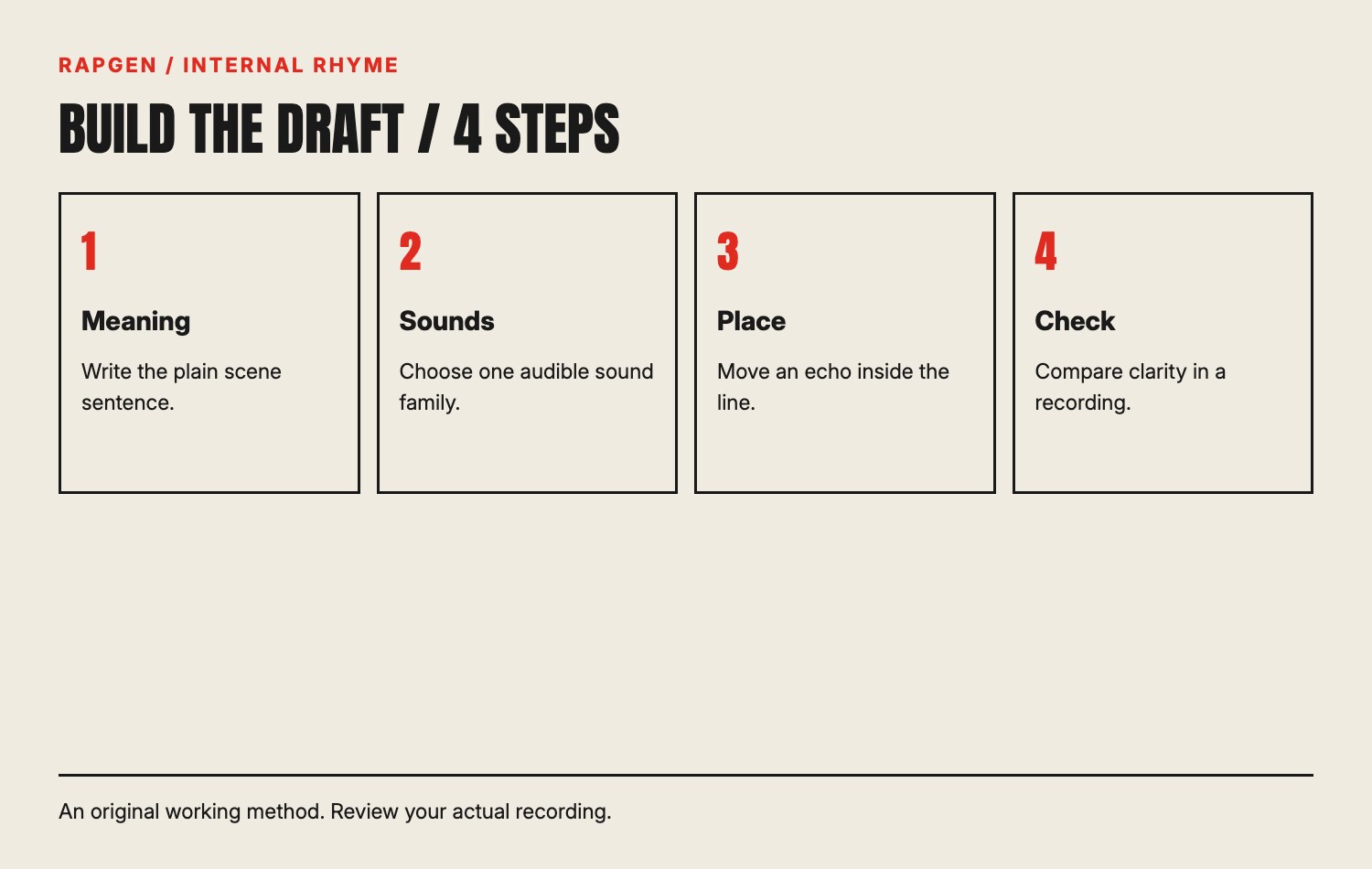
1. Write the scene without searching for sound
Begin with a plain sentence: “I come in from the cold and fold my coat on the chair.” It supplies a person, an action and an object. You can now change the wording without losing track of what the line is supposed to say.
Underline the action you need to keep: folding the coat. Circle the detail that gives it context: coming in from the cold. If a later sound experiment loses both, it is probably a different line rather than a more musical version of this one.
Read the sentence as ordinary speech. Notice which words you naturally emphasize. “Cold” and “fold” have an obvious rhyme relationship in many English accents, and the scene already gives both words a reason to exist. You do not need to insert an unrelated word merely to create a sound family.
Keep a meaning reference
Save the plain sentence above the draft. Every time you change the line, paraphrase it back into prose. If the action or perspective has changed, decide whether you wanted that change before calling the revision successful.
This protects a common failure: the writer remembers the original meaning and mentally supplies it while reading a line that no longer states it. An unfamiliar listener has no access to that remembered version. They receive the actual words you performed.
2. Place a clear pair inside one written line
Try a version that keeps both rhyme words before the line ending:
Back from the cold, I fold my coat on the chair.
“Cold” and “fold” are the tested pair. “Chair” carries the location at the end, allowing the line to convey something after the sound connection has occurred. This is a simple model you can hear before adding complexity.
Say it slowly and then at the pace of your working loop. If you swallow “fold” while rushing into “my coat,” leave more space or shorten the opening. A connection existing on paper does not guarantee that both words remain audible in performance.
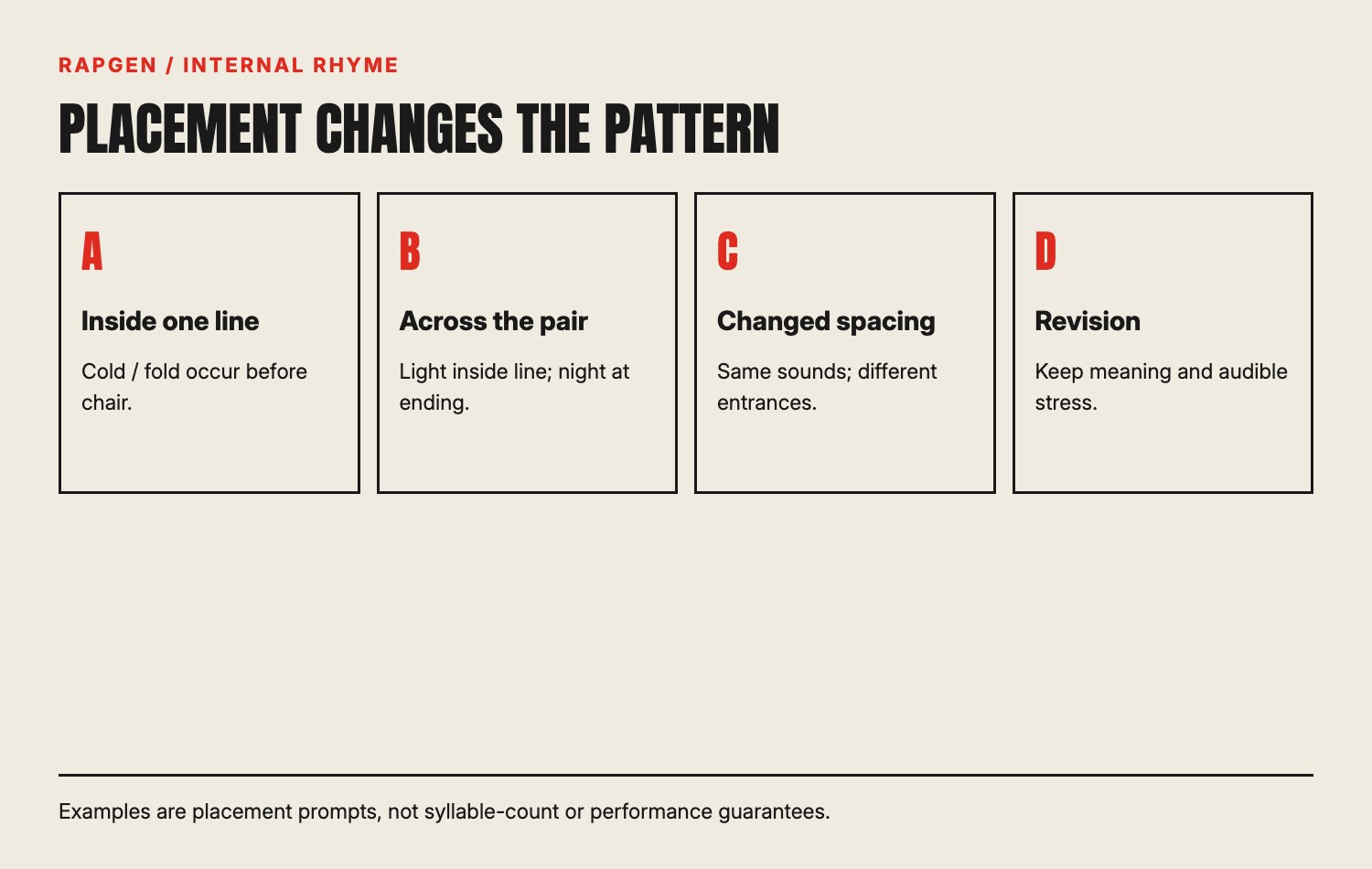
| Version | Sound connection | Placement | What stays in the scene |
|---|---|---|---|
| Back from the cold, I fold my coat on the chair | cold / fold | Both inside the written line | Arrival and coat placement |
| I leave a light by the door for the night | light / night | Internal word to ending | Leaving a light on |
| The coat is there; I clear the chair | there / chair | Internal word to ending | Moving an object to make space |
| I come home late and set the coat down | No required rhyme pair | Plain comparison | Arrival and placement |
The table illustrates placement rather than rating the versions. A plain comparison gives you a useful reference. The most rhymed line is not automatically the one that communicates the scene most effectively.
3. Let an internal word connect across a pair of lines
Move the echo across a line break:
I leave a light beside the half-open door,
You can find the room when you get back tonight.
“Light” sits inside the first written line; the stressed “night” sound arrives at the end of “tonight” in the second. The opening syllable of “tonight” adds material, so do not label the whole words an identical one-syllable pair. What you are hearing is the rhyme in their stressed ending sound.
Now try both lines over the loop. The distance between the sounds affects whether the listener notices their relationship. If the second line becomes much longer, the connection may be less apparent. You can move the sound closer without discarding the shared action.
Distinguish a written break from a musical boundary
A phrase may cross a bar line. If you want to map musical placement, record the example and mark where each rhyme word actually lands against the count. Do not assume the first written line occupies one measure because you pressed return there.
Our flow practice guide addresses timing consistency. Here, the question is whether the sound relationship remains recognizable at the distance and stress you chose. Both timing and meaning belong in the comparison.
4. Change spacing while keeping the same words
Perform “Back from the cold, I fold my coat on the chair” with a pause after “cold.” Then perform it with the words moving continuously. Keep the backing and word order unchanged so spacing is the only major variable.
The paused version may make the pair clearer. It may also make the sentence feel overly segmented. The continuous version may preserve natural speech but hide the second rhyme if you rush it. Record both and listen without reading the text.
Mark the version you can repeat consistently. A one-off attractive stumble is difficult to build a complete take around. If you want that spacing, practice its entrance and endpoint until the pause is a choice you can reproduce.
Avoid forcing unnatural stress
Rhyme words need enough emphasis to be heard, but you should not distort every surrounding word to deliver them. Compare the line as ordinary speech and as a performance. The useful version preserves a recognizable sentence while adding deliberate sound.
If a word needs an unnatural pronunciation to appear to rhyme, decide whether that distortion belongs to your voice. Sometimes an accent or performance choice creates a real match. Sometimes the writer is asking a listener to pretend a weak connection exists. Label the distinction honestly in your notes.
5. Add a second sound family only after the first works
Try a second pair with a different scene detail. “Light” and “night” can connect the doorway to the person expected home later. Keep the first cold/fold pair, then use the second pair in a separate sentence before attempting a dense chain.
An original draft could read:
Back from the cold, I fold my coat on the chair,
Leave a small light for the night you're not there.
The first line contains cold/fold. The second contains light/night. Chair/there supplies an end connection across the pair in many accents. These are sound relationships you can check aloud; the example is not a claim that every listener hears every connection equally.
Now decide what the second sentence means. Is the speaker expecting someone later, remembering an absence or making a habit of leaving the lamp on? The wording should match the song's situation. A dense sound map cannot rescue an unclear relationship between people.
Try the less-dense version
Remove one pair and compare. “I set my coat on the chair / Leave a small light for the night you're not there” keeps the second family and the end connection. You may prefer its space, especially next to a dense previous passage.
Save both versions. The right density can change when the surrounding verse changes. A line that feels plain alone may be exactly the contrast a listener needs after a tightly packed section.
6. Check near matches separately from perfect pairs
Sound relationships depend on vowels, consonants, stress and delivery. “Cold” and “fold” provide a clear conventional rhyme in many accents. “Coat” and “home” share some vowel territory for some speakers, but they do not have matching ending consonants and should not be labeled a perfect pair.
Make two lists: pairs you clearly hear and looser connections you want to test. This prevents a worksheet from becoming an authority for a sound you cannot actually deliver. Your recording is better evidence than similar-looking spellings.
Near matches can preserve a needed meaning when an exact pair would force an unrelated word. Keep the important noun and experiment with the surrounding sounds. Our half-rhyme guide explores that choice in detail; this exercise is about where the connection appears.
Use a listener's ear for the uncertain pair
Play the line without showing the text and ask which sounds seemed connected. Do not announce the supposed rhyme first. If the listener hears a different pair, that may be useful information about what your emphasis made audible.
You can choose to keep a subtle connection, but do not build the whole section's recognizability on one nobody detects. Strengthen its stress, shorten the distance or use a clearer pair at the next return.
7. Review the scene, sound and delivery in separate passes
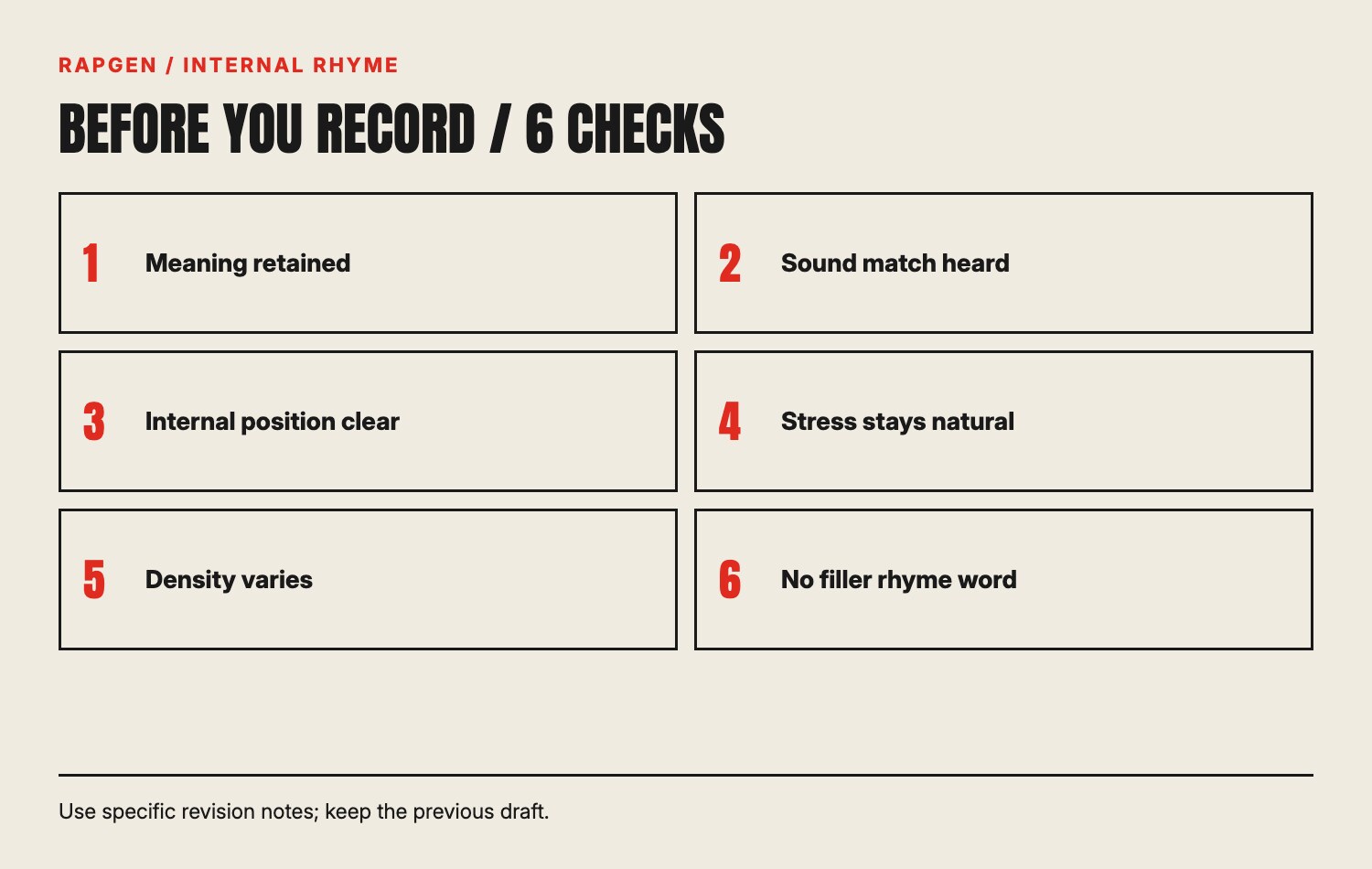
On the meaning pass, check who acts, where the coat goes and why the light stays on. On the sound pass, mark the actual rhyme words and their positions. On the delivery pass, record the chosen spacing against the working beat.
Separating these passes keeps a strong rhyme from distracting you from a broken sentence. It also keeps a plain meaningful line from being rejected before you have tried a better entrance or pause.
Read the complete passage to an unfamiliar listener. Ask what happened before asking which rhymes they noticed. If they cannot describe the arrival, coat and light, reduce the density or clarify the relationship. If they understand the scene but hear no sound pattern, inspect emphasis and distance.
Keep a small revision log with the changed phrase and the reason. “Removed ‘bright’ because it duplicated the light image” is useful later. “Made it better” does not preserve the decision that solved the problem.
Finally, compare the dense and sparse versions inside the complete verse. The surrounding lines influence how each works. A tightly rhymed pair may be valuable at a peak and tiring if every passage uses the same density. Change texture where the scene or speaker's thought changes, not merely because another matching word exists.
A before-and-after density test
Take the two-line cold/fold and light/night draft and record it three times. First keep all the sound connections. Next remove cold/fold while leaving the doorway image. Finally keep cold/fold and replace the second line with a plain sentence about who is expected home. Use the same backing and an equivalent entrance for each version.
Ask an unfamiliar listener to describe the scene and name a phrase they remember. A version with fewer connections may communicate the relationship more clearly. A dense version may make the first action more memorable while hiding the second. Those results tell you where density helps this passage rather than proving a universal preference.
Keep a note about the surrounding verse as well. If the preceding section is already crowded, the plain second line may provide needed space. If the passage begins a new section, the stronger sound return may help establish its character. Select the version for that musical context and preserve the unused recordings so a later arrangement change does not force you to rebuild the comparison.
Three things you can stop worrying about
Placing an echo on every word. One audible pair can give a sentence a clear sound relationship. Extra density should contribute something you can hear and explain.
Making spelling prove the rhyme. Stress and pronunciation determine the performed connection. Similar letters are only a prompt to test it.
Keeping every experiment. Save the alternatives, then choose the line that preserves the scene at the density the surrounding verse needs.
Collect another scene-specific alternative
The rap bars generator returns individual written candidates about the subject you provide. Give it the coat and doorway scene, then inspect its wording with the same sound and meaning passes. A returned line still needs pronunciation and spacing tested in your own recording.
The short version
Use internal rhyme by starting with a clear sentence, choosing an audible sound pair and placing the connection where the listener can hear it before the ending. Test spacing, distinguish exact and near relationships and compare dense wording with a plainer version. The scene should remain understandable after every sound experiment.