The Pencil-in-Mouth Rap Drill: An 8-Minute Routine
The pencil-in-mouth rap drill adds brief articulation resistance, but it is easy to overdo. Use this eight-minute routine and judge the clean take after it.
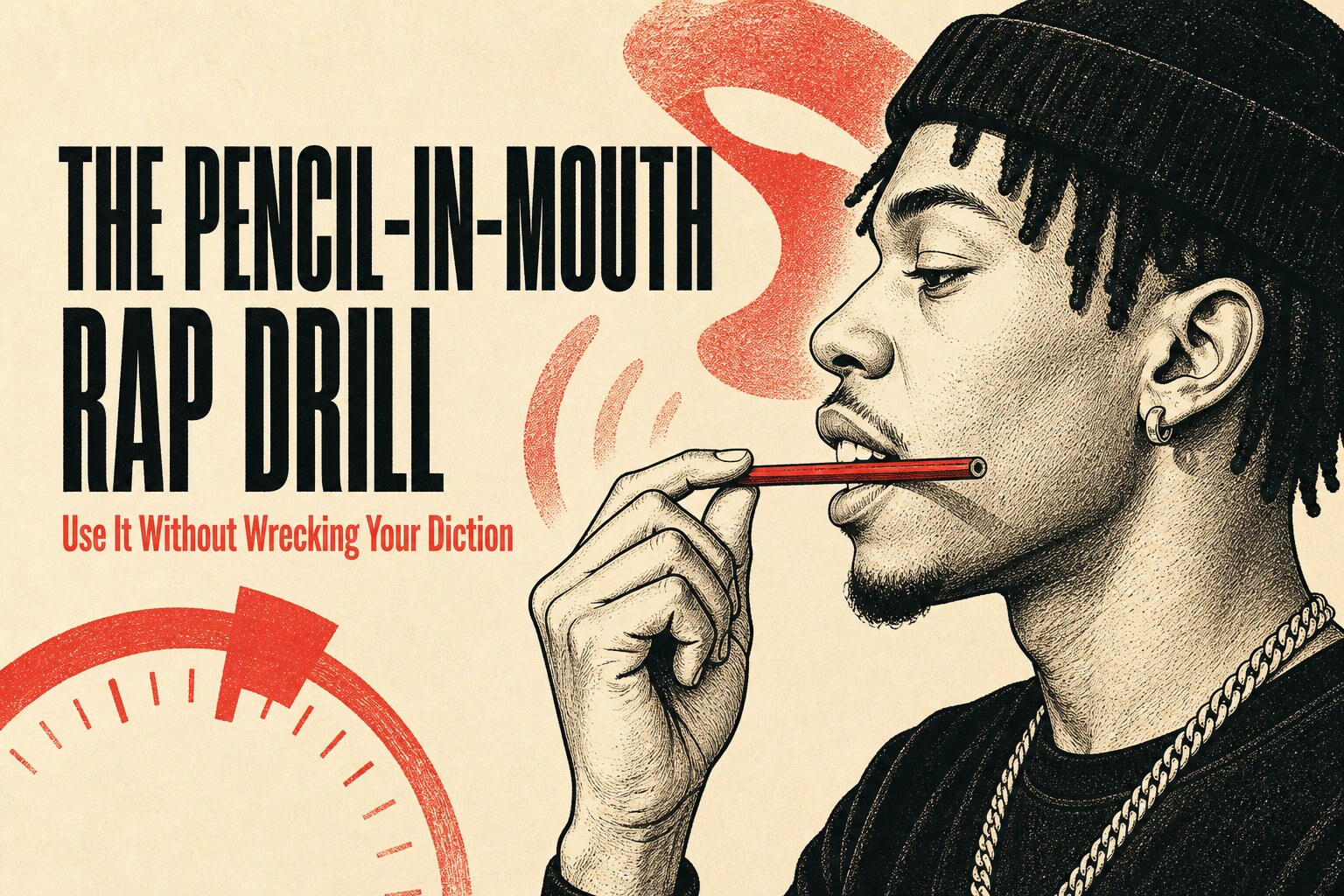
The pencil drill is simple enough to become bad advice in one sentence: put a pencil between your teeth, rap, and your diction will improve. The useful version is narrower. Brief, gentle resistance can make the lips and tongue work around an obstacle; removing it may make ordinary speech feel easier for the next take. The drill does not permanently fix pronunciation, and biting down or doing long sessions can create tension that makes delivery worse.
People searching for the pencil in mouth rapping practice usually want clearer words at speed. Use the pencil only as a short contrast exercise. The real training happens in the clean repetitions before and after it, where you can hear whether a specific consonant became more precise.
If you have jaw pain, dental work that makes the setup uncomfortable, a voice injury, or any other reason the position feels unsafe, skip the drill. Nothing about a pencil is essential to good articulation.
1. Know what the drill can train
Rap clarity depends on several moving parts:
- lips closing cleanly for sounds such as p, b, and m;
- the tongue reaching precise positions for t, d, l, and n;
- air moving without the jaw clamping;
- stressed syllables receiving enough time;
- word endings surviving the beat.
A pencil placed lightly across the mouth creates an obstacle. Speaking around it exaggerates movement. When it is removed, the same line may feel less restricted.
That contrast can increase awareness. It does not prove that the drill changes articulation better than ordinary slow-to-fast repetition. Treat it as one option inside a broader routine, not as a secret technique.
The improvement must survive the clean take
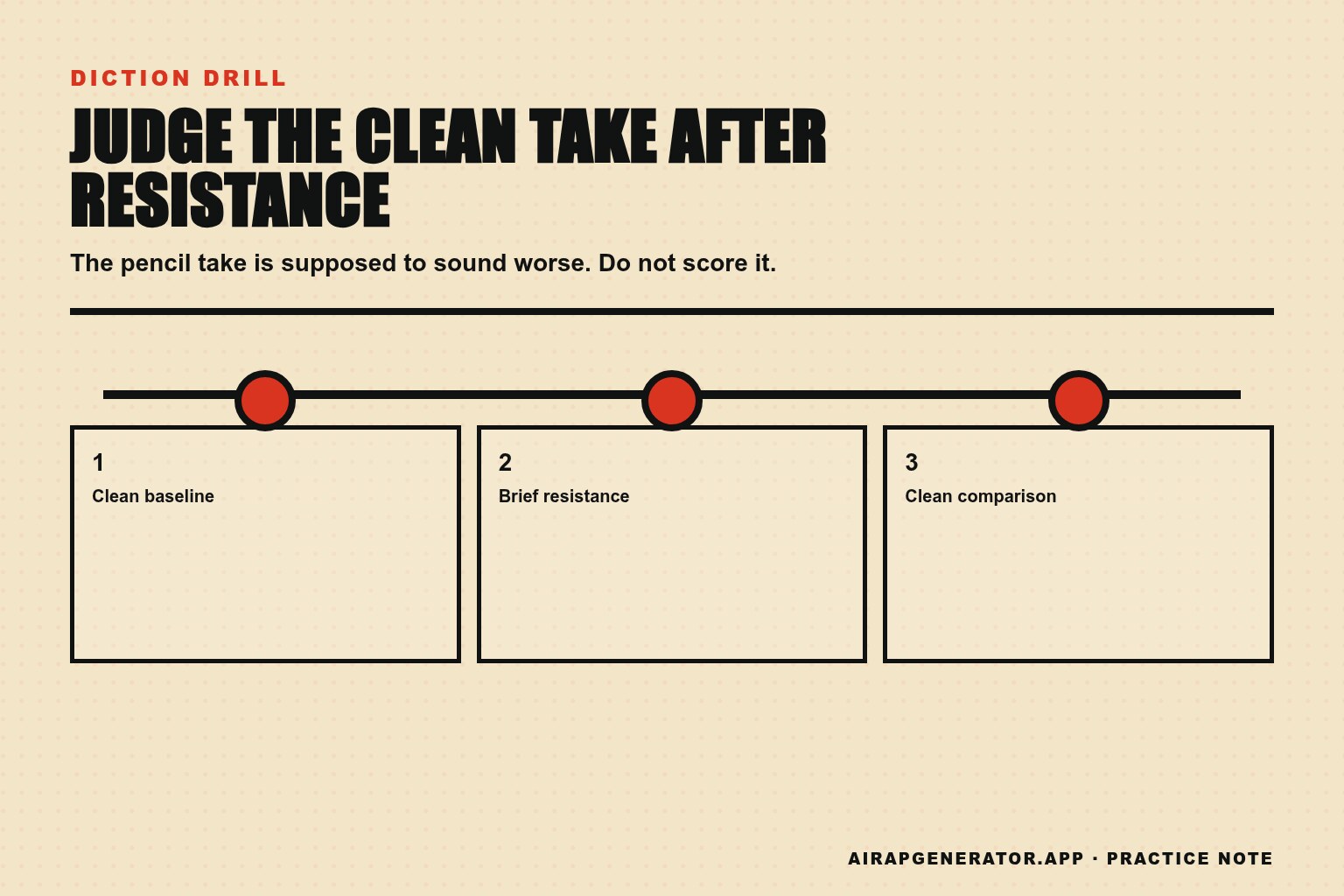
The pencil take is supposed to sound worse. Do not score it. Compare the clean recording immediately before the drill with the clean recording immediately after it. If the after take is tighter, keep the dose. If it is tense or less clear, reduce or remove the drill.
2. Set up with almost no bite pressure
Use a clean, unsharpened pencil or similarly light, smooth object. Place it horizontally across the front teeth. Hold it gently enough that it could be removed without a tug. Do not push it deep into the mouth and do not clamp the molars.
Keep the jaw loose. The drill is not a strength test. If the object slips, reset it; do not solve the problem by biting harder.
Use these setup checks:
| Check | Pass | Stop or adjust |
|---|---|---|
| Jaw | Hangs without clenching | Ache, shaking, or strong pressure |
| Teeth | Light contact | Biting or scraping |
| Breath | Quiet and normal | Gasping or throat tension |
| Duration | 20–30 seconds | Long continuous verse |
| Material | Familiar short line | Brand-new complex lyrics |
Keep your hands free and stay still. Walking around with an object between the teeth adds a pointless accident risk.
3. Choose lines that reveal articulation
A random verse may contain too many variables. Build three original two-bar tests, each emphasizing a different sound family.
Lip closures — p, b, m:
Paper bag, bus pass, map in my palm
Back block, bass knock, moving with calm
Tongue-tip sounds — t, d, l, n:
Late train, light rain, names on the door
Day turned, line learned, pace on the floor
Clusters and endings:
Crisp steps, missed texts, crossed at the light
Last breath, left kept, lost in the night
The third set is deliberately difficult. Do not begin there. Start with clean lip closures, then tongue-tip sounds, then clusters if the jaw remains relaxed.
Keep meaning secondary during the drill
These lines are test material, not a song. Their job is to expose consonants. Once a sound improves, apply it to a real verse with natural meaning and stress.
4. Record a true baseline
Before using the pencil, record each two-bar set twice over a slow or medium beat. Do not warm up for ten minutes first; that would hide the starting point you want to compare.
Name the takes “baseline A” and “baseline B.” On playback, mark only three things:
- one consonant that disappears;
- one word ending that blurs;
- one place where the jaw or tongue feels rushed.
Avoid global comments such as “my voice sounds bad.” They do not tell the next repetition what to do.
Use headphones, but do not turn the volume up to manufacture detail. If a word is only understandable because you already know the lyric, count it as unclear.
5. Use twenty seconds of resistance
Place the pencil gently and speak one two-bar set at roughly half performance speed. Exaggerate the consonants without raising volume. Rest for ten seconds. Repeat once.
That is forty seconds of actual resistance work. Remove the pencil and relax the jaw by opening and closing it gently. Do not stretch aggressively.
Now record the same two bars at the original tempo. The useful sensation is ease, not fatigue.
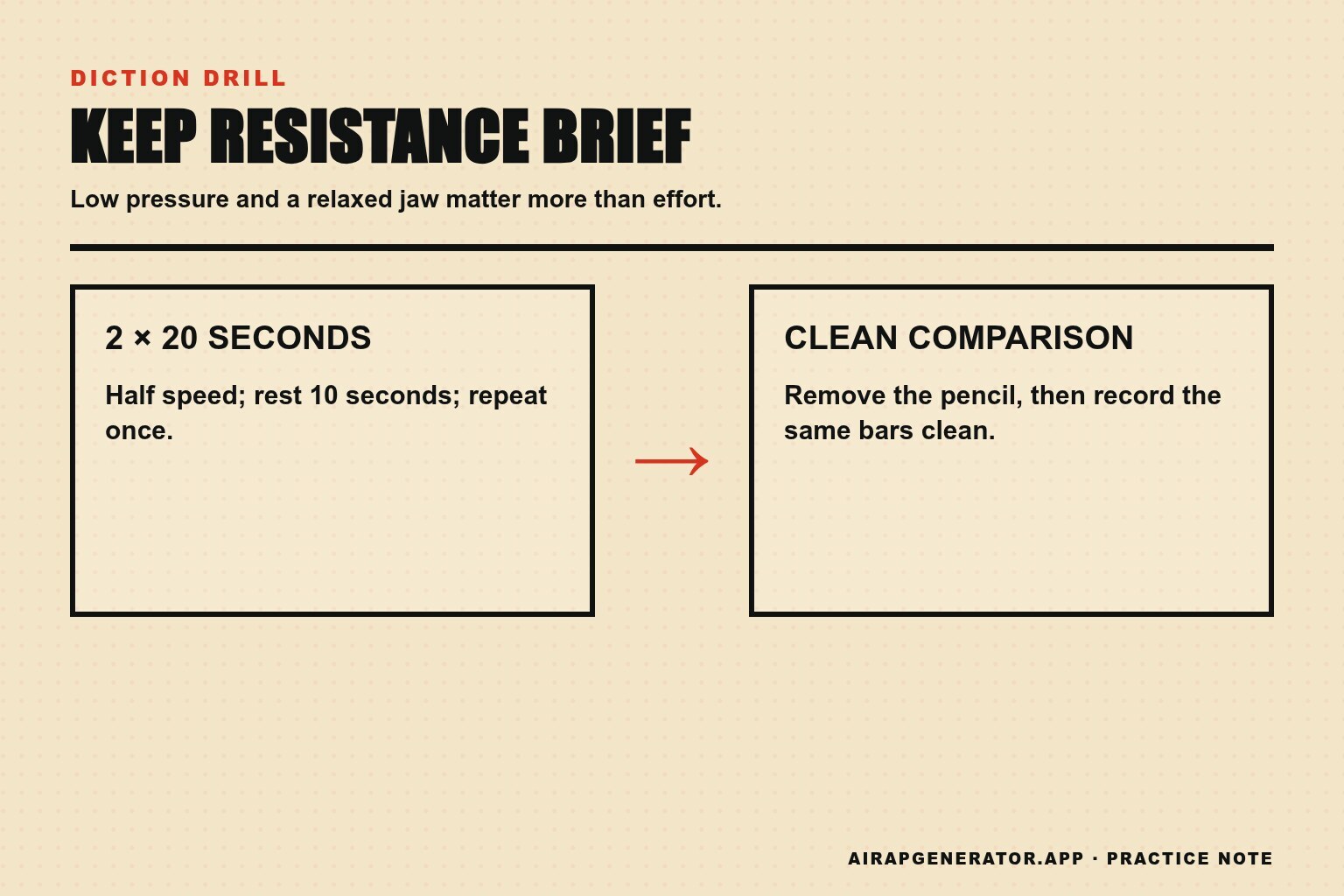
If the post-drill line sounds tighter, perform it two more times without the pencil. Those clean repetitions are what you want the body to remember. Do not keep returning to resistance after every good take.
If the line sounds worse, ask which failure appeared:
- Jaw is tight: use less bite pressure or skip the drill.
- Words are slower: shorten the resistance interval.
- Consonants are exaggerated unnaturally: lower the effort and restore normal speech.
- Breath feels high in the chest: pause and return to easy speaking.
6. Transfer clarity back to the beat
Diction can improve in slow speech and vanish at tempo. Use a three-speed transfer:
- speak the line without a beat;
- rap it at about seventy-five percent speed;
- rap it at full tempo.
At each speed, keep the same stressed words. Do not add syllables or change the line during the test.
If clarity fails only at full tempo, the problem may be density rather than articulation. Cut a low-value word, move a breath, or let the phrase cross the bar. A mouth drill cannot create more clock time.
Prioritize the word the listener needs
Not every syllable needs equal sharpness. Protect the image, action, name, rhyme turn, and final consonant that changes meaning. Connecting words can remain lighter.
For example, in “Back block, bass knock, moving with calm,” back, bass, knock, and calm carry the shape. If “moving with” is lighter but those four remain clear, the line can still read.
7. Compare recordings without guessing
Use a blind comparison if possible. Rename the clean files with neutral letters or ask someone to play them without saying which came first.
Score each line:
| Measure | Baseline | After drill |
|---|---|---|
| Key consonants audible, 1–5 | ||
| Word endings audible, 1–5 | ||
| Tempo stable, 1–5 | ||
| Jaw feels loose, 1–5 | ||
| Repeatable three times, Yes/No |
A one-take improvement is interesting. Three repeatable clean takes are useful. If clarity rises while jaw comfort drops, that is not a win; choose a different drill.
You may discover that simply recording a baseline and focusing on one consonant produced most of the improvement. Good. The pencil is allowed to be unnecessary.
8. Run the full eight-minute routine
Keep the entire exercise short:
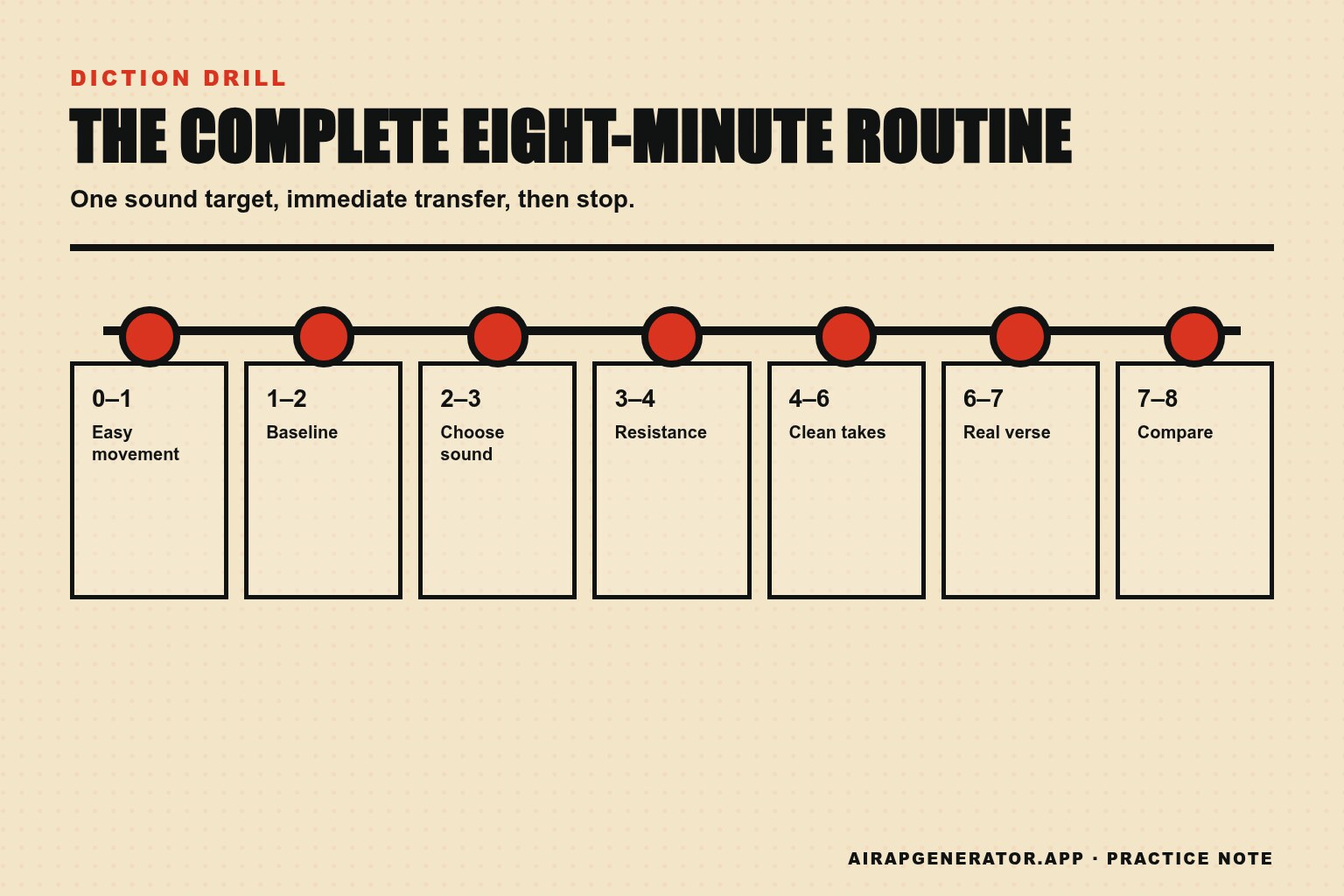
- Minute 0–1: easy jaw and lip movement; normal speech.
- Minute 1–2: record two clean baseline takes.
- Minute 2–3: choose one missing consonant or ending.
- Minute 3–4: two twenty-second pencil intervals with a rest.
- Minute 4–6: remove it and record three clean takes.
- Minute 6–7: apply the same sound focus to a real verse.
- Minute 7–8: compare files and write one observation.
Do this at most as a small part of a normal vocal warm-up. More time is not automatically better. If the jaw feels tired, stop for the day.
Treat the drill as a controlled before-and-after experiment: low pressure, short intervals, one sound target, and immediate clean transfer. Keep it only if the recording and comfort score improve together.
Train word endings without adding jaw effort
Many diction problems happen at the end of words because attention has already moved to the next beat. The pencil is rarely the best tool for this. Use an ending ladder after the clean comparison takes.
Choose one lost ending, such as the t in “late.” Build it outward:
- say “late” clearly at conversation volume;
- add the previous word: “running late”;
- add the previous phrase;
- speak the full bar without music;
- rap the bar at three-quarter speed;
- return to full tempo.
Keep the final consonant precise but brief. Over-pronouncing it can make the line sound theatrical and delay the next entrance. The goal is an audible boundary, not a separate extra beat.
For clusters, simplify the surrounding phrase before pushing harder. “Missed texts stacked” contains several closures close together. A revision such as “missed texts piled” preserves the image with a different mouth path. Articulation is partly a writing choice.
Use contrast phrases to locate the weak sound
Create two lines that differ by one sound family. If lip closures remain clear while tongue-tip endings vanish, the routine now has a target.
| Contrast | Test phrase | Listen for |
|---|---|---|
| Lips | “Big map, paper bag” | Complete p, b, and m closures |
| Tongue tip | “Late note, daylight” | Final t and d without extra force |
| Back of tongue | “Cold key, cracked gate” | Clean k and g attacks |
| Friction | “Fast shift, safe street” | S and f staying distinct |
Use only one row per session. Three clean repetitions of a narrow target transfer better than racing through every consonant while the mouth tires.
Keep a simple log with the line, the missing sound, the drill used, and the result. After a week, remove any exercise that has not improved a clean take. The log prevents the routine from becoming ceremony.
Better alternatives when the pencil is not useful
You can train the same goal without an object:
- speak the verse slowly with exaggerated consonants, then reduce effort;
- isolate the final word of each bar and rebuild the line backward;
- alternate a difficult word with an easier word using the same first sound;
- record at seventy-five percent tempo and increase in small steps;
- replace one dense consonant cluster with a cleaner synonym;
- whisper the rhythm, then add normal voice without adding tension.
For many rappers, progressive tempo practice transfers better because it preserves the real mouth position. The most effective exercise is the one that improves the actual verse without pain or ritual.
Frequently asked questions
Should the pencil go between my teeth or lips?
The common resistance version rests horizontally against the front teeth with very light contact. Do not grip it with force. If any position is uncomfortable or unsafe for you, skip it and use slow-to-fast articulation practice.
How long should I rap with a pencil in my mouth?
Use brief intervals, such as twenty to thirty seconds, followed by a clean take. The goal is contrast, not fatigue. Stop immediately if there is pain, jaw strain, tooth discomfort, gagging, or breathing difficulty.
Will this make me rap faster?
Not directly. It may increase awareness of articulation, but speed also depends on syllable density, word shape, breath, and rhythmic control. Raise tempo gradually and keep the clean recording understandable.
Can I use a whole verse for the drill?
Short two-bar passages are easier to compare and reduce the temptation to clamp down as fatigue builds. Transfer the improved sound to a full verse only after removing the pencil.
What if the after take is not better?
Drop the drill. Try a slower tempo, easier word substitutions, or focused final-consonant practice. An exercise is not valuable because it is famous; it is valuable when it produces a safer, repeatable improvement in the real performance.
Three things you can stop worrying about
Sounding good during resistance. The pencil take is deliberately awkward; only the clean comparison counts.
Using longer intervals. More resistance can add fatigue without improving transfer.
Getting faster immediately. The drill targets awareness and clarity. Speed still depends on density, word shape, breath, and timing.
The short version
The safe use of the pencil in mouth rapping practice is two gentle twenty-second intervals with a rest, followed immediately by clean recordings of the same two bars. Stop if comfort or clarity declines.
Keep reading
- How to improve rap flow when clear words still land stiffly against the drums.
- How many syllables fit in a 138 BPM rap beat when the line is simply too dense to pronounce.
- How to memorize rap lyrics when checking the page is disrupting articulation.