Posse Cut Writing: 7 Ways to Make the Verses Connect
Posse cut writing needs a shared brief, distinct perspectives and clear handoffs. Use a four-MC worksheet to turn separate verses into one coherent recording.

Four people send you four good verses. One describes a blackout, one brags about a car, one remembers school and one answers a rival who never appears elsewhere. Put them over the same beat and you have a playlist with no gaps, not yet a shared story.
A posse cut usually brings several MCs onto one track, giving each a distinct turn. The practical writing problem is keeping those individual voices while making the listener understand why they appear together. A shared beat helps. A shared brief and purposeful handoffs do more of the coordination work.
Wu-Tang Clan appears in the Rock & Roll Hall of Fame's 2026 Performer inductee list. The official announcement schedules the induction taping for November 14, 2026, with a December debut on ABC and Disney+. Those facts make group identity a timely topic; they do not confirm an onstage lineup or performance. See the Hall's external announcement. The fictional four-person exercise below is not a reconstruction of a Wu-Tang recording.
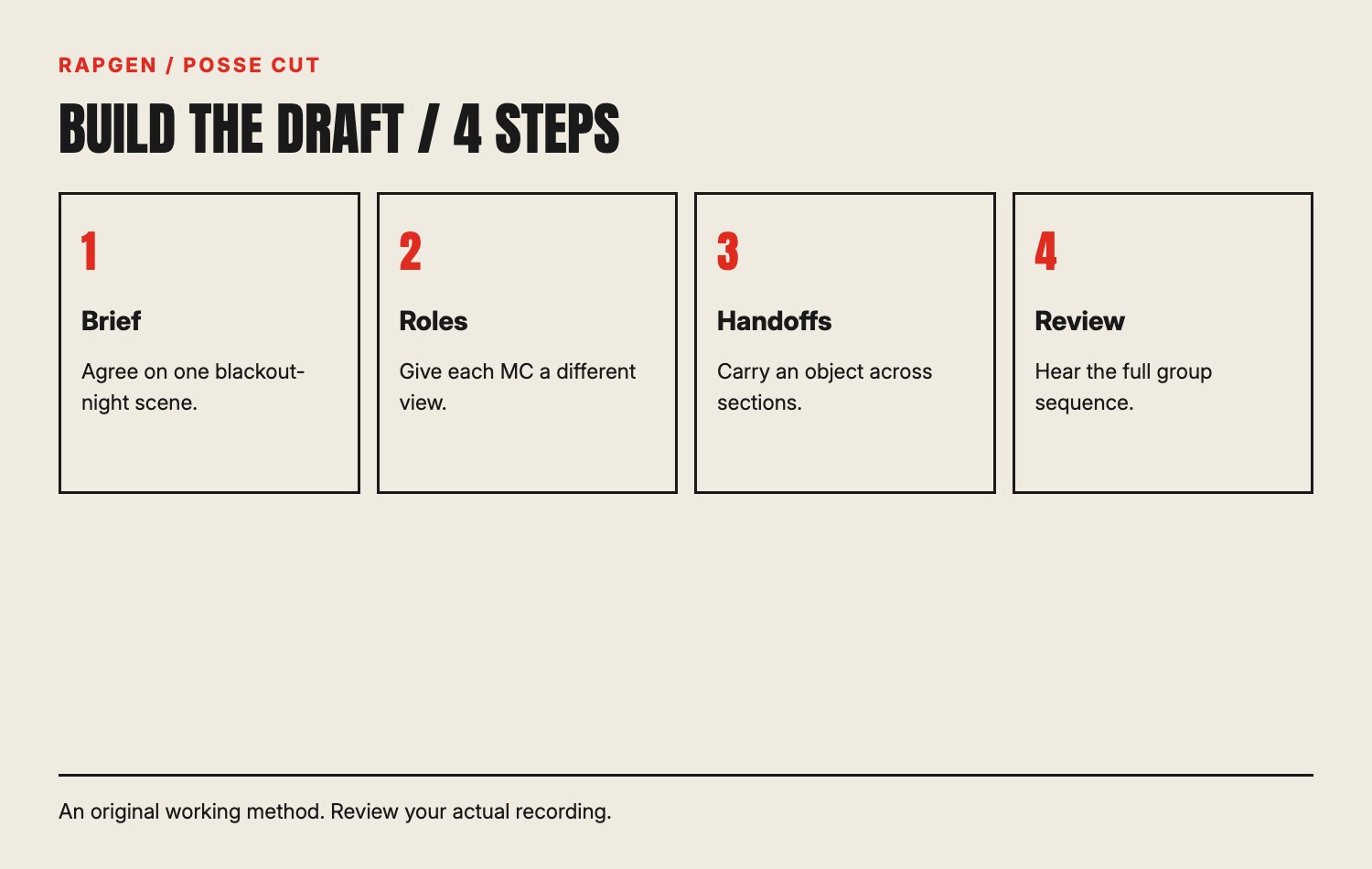
1. Agree on the track's world before dividing the bars
Write a brief everybody can read in a minute. State the scene, the tone, the facts that remain fixed and the things each writer can decide. Our exercise takes place during a neighborhood blackout on the last evening before a community shop closes.
The fixed facts are small: the power fails after dark, the shop has one portable lamp and the people know each other. Nobody should later describe a working neon sign unless their verse explains that the electricity has returned. That shared continuity makes the track easier to follow.
Decide whether each turn is a viewpoint in the same story or a separate demonstration around a common subject. Both formats can work. Problems arise when one writer expects a narrative and another expects unrelated competitive verses, and neither expectation is stated.
Put exclusions in the brief too
List the material the group does not want: real-person accusations, copied lyrics, unapproved names or a last-minute change of beat. These are collaboration boundaries, not obstacles to creativity. Writers can make better decisions when they know what other participants have agreed to release.
Share the exact backing version, tempo if known and intended section length. A written line count is not automatically a musical bar count. Ask everyone to mark the actual measure where their verse begins and ends so the arrangement can be planned reliably.
2. Give each MC a different information job
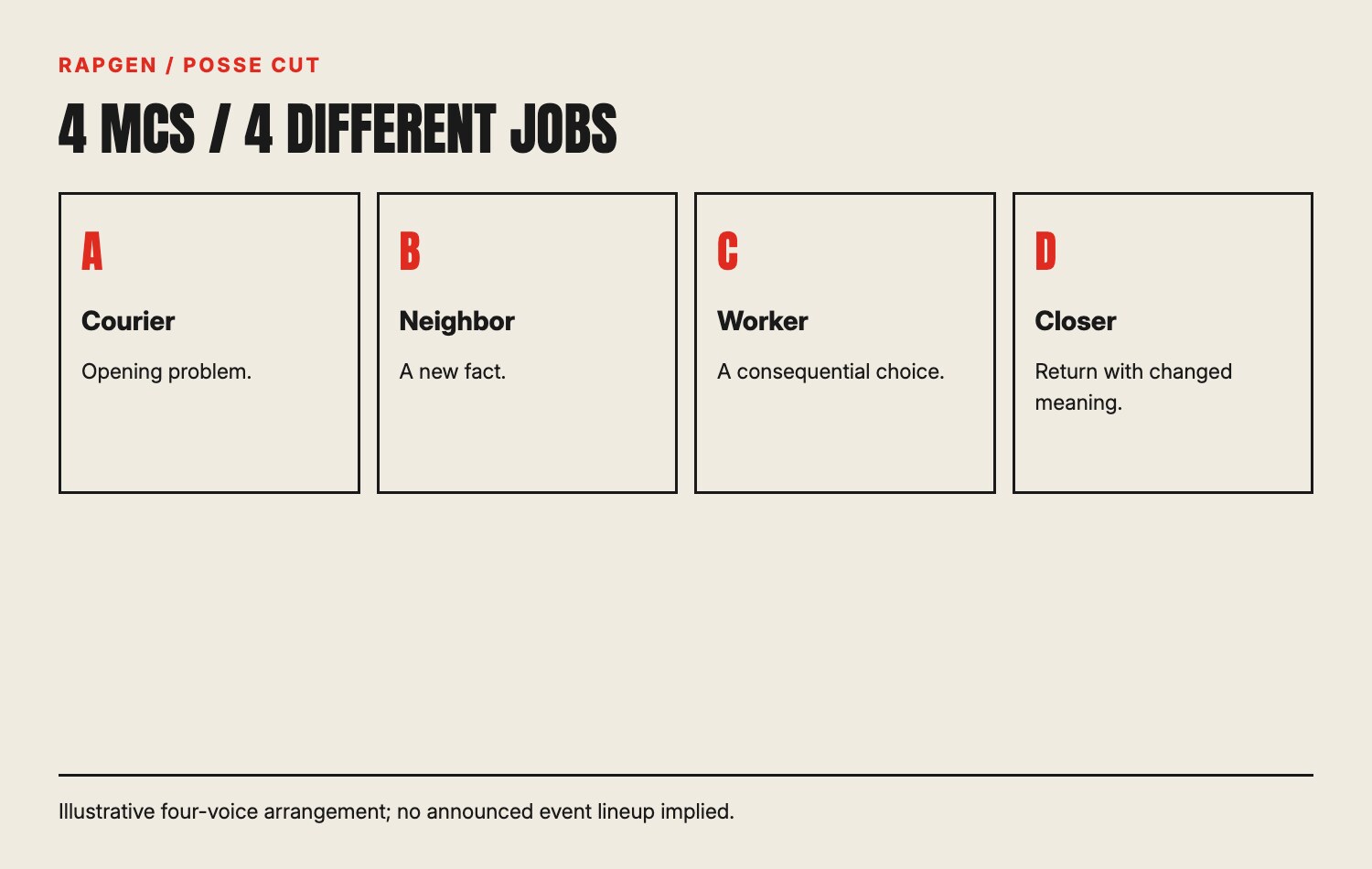
Instead of assigning four people the same prompt, assign four roles in the listener's understanding. One establishes the problem. One adds a fact. One makes a choice. One returns to the opening with a changed meaning.
In our fictional group, the courier arrives with a package and no working lift. The neighbor knows the shop is closing and recognizes the handwriting on the package. The worker opens the package under the portable lamp and discovers an old handwritten sign. The closer carries the sign outside and brings the lamp so everyone can read it together.
These roles do not require a hierarchy of talent. The opening needs clarity; the second turn needs a new perspective; the choice needs credibility; the ending needs memory. A quieter writer may be ideal for a crucial reveal rather than being placed early because someone assumes quieter means less important.
| Voice | Information job | Shared object | Question to answer |
|---|---|---|---|
| Courier | Establish the immediate problem | Package | Why stay when the route is blocked? |
| Neighbor | Add a fact the opener lacks | Shop doorway | What is ending tonight? |
| Worker | Make a consequential choice | Portable lamp | What can be shown without power? |
| Closer | Return with changed meaning | Handwritten sign | What does the neighborhood keep? |
Give each writer the row for their role and the complete table. Seeing the other jobs prevents them from accidentally consuming the ending while writing their own section.
3. Preserve different voices through concrete choices
Different voices do not need four unrelated topics. They can describe the same event through different objects, sentence lengths and priorities. The courier notices stairs and deadlines. The neighbor notices familiar faces. The worker notices tools. The closer notices what people carry away.
Ask each writer for two details their speaker would recognize. Check the details against the shared setting. A highly specific line still causes confusion if it describes a different night or location without announcing a scene change.
Original opening pairs could sound like this:
Courier: One flight, two doors, the lift won't wake,
I balance their parcel on a hand that shakes.
Neighbor: I know that shutter by the way it falls,
Been hearing that scrape since the paint was new on the walls.
The first counts obstacles; the second recognizes history. They are distinct ways of paying attention while remaining in the same scene. Neither needs to impersonate a famous MC's voice.
Share the speaker, not a biography essay
Give collaborators a short description of your viewpoint and what it knows. “I arrive from outside and do not know the shop is closing” is immediately useful. A long backstory can be saved for your own drafting notes unless another verse depends on it.
That knowledge boundary also protects the reveal. If the courier announces the shop's closure in the opening, the neighbor's assigned information job needs to change. Catch this in the draft exchange rather than after everybody has recorded final takes.
4. Build the handoff from a word, object or action
The ending of one verse can give the next voice something to pick up. A courier asks who owns the parcel. The neighbor recognizes the handwriting. The worker opens it. The closer reads the sign. Each turn enters because the previous one created a useful opening.
Keep the handoff understandable without requiring the exact same rhyme sound. You can link through an object even when the second writer changes cadence. This gives each voice room to establish itself while preserving continuity.
Our courier might finish:
Name on the parcel, lamp on the stairs,
Somebody knows why the whole block's here.
The neighbor can then answer that implied question. The pair is a loose sound relationship, not a claim of perfect rhyme. The meaningful connection is the parcel and the people waiting.
Record the transition before polishing both verses
Ask the two adjacent writers for their final and opening phrases as rough audio. Put them together over the actual backing. A handoff that looks elegant in a document can become unclear if both phrases overlap or the next entrance arrives before the listener has processed the question.
Adjust the empty space or wording while those changes remain cheap. The collaboration verse guide offers related transition work; this worksheet expands the coordination problem across several separate contributors.
5. Arrange contrasts around what the listener needs
Try an order based on information rather than alphabetical names or who sent a verse first. Put the voice that establishes the scene where it can orient the listener. Place a dense passage where the preceding section has supplied enough context to understand it.
Then test the energy. Two equally dense verses in a row may need a short recurring phrase or a more spacious next turn. An abrupt contrast can be exciting if the new voice continues a clear thought. An unclear contrast feels like the track has changed subject accidentally.
Write a section map with actual durations after receiving rough recordings. Four sixteen-bar verses would be sixty-four bars of verses, but a track with hooks and transitions will occupy more time. Do not promise a final track length from that verse count alone.
If the recording grows too long, agree on cuts collectively. Ask each writer which passage can shrink while preserving their role. Removing someone's reveal while leaving another person's repetitive setup can damage both the story and the collaboration.
6. Make recording expectations explicit
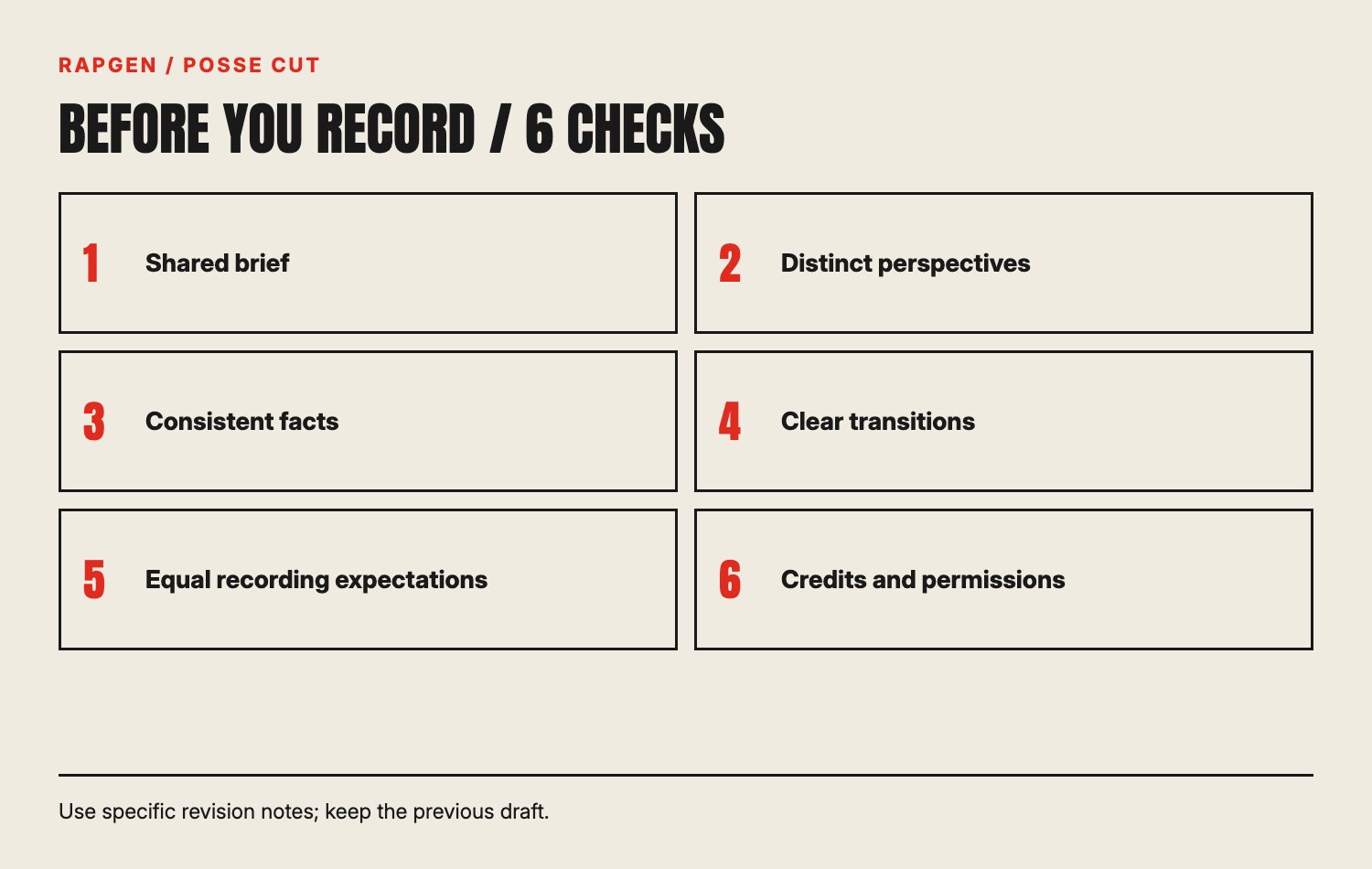
Share the expected file format, whether effects should be printed and how the files should align with the backing. A person sending a polished stereo verse and another sending a dry vocal require different editing work. Agree on what you can actually handle before asking for submissions.
Use a consistent reference for timing. Writers can include a rough mix so the intended entrance is audible, plus the requested separate vocal if available. Label the take and backing version. This avoids solving a supposed timing problem that is really a mismatch between two beat revisions.
Give specific feedback: “The word ‘parcel’ disappears under the next entrance” is actionable. “Bring more energy” may mean volume, pacing, confidence or a rewritten line. Name the problem you hear so the person can make an informed change.
Credits belong before release
Agree on artist names, writing and production credits, permission to use the recording and who can approve changes. If there is a revenue arrangement, document it clearly with the appropriate professional help rather than treating a chat reaction as a complete agreement.
Check rights for the beat, samples and any artwork. Each collaborator having permission for their own voice does not automatically clear the backing. Keep the relevant records together so the eventual upload is based on the same approved version everybody heard.
7. Review the entire sequence with fresh ears
Play the assembled rough track to someone outside the group. Ask them what happened, how many distinct viewpoints they noticed and where they lost the thread. Do not explain the role table first; the listener should receive the needed relationships from the track.
Check the opening and ending together. Our opening courier arrives carrying something the neighborhood needs. The sign travels from the package to the people outside, while the lamp lets them read it. If the ending only contains general bragging, the track may have lost the story everybody agreed to tell.
An original closer could be:
We take the little lamp where the front step ends,
Read the old sign out to the names of our friends.
That image depends on the sign being introduced before this turn. If the worker's verse never supplies it, add the missing setup rather than expecting a listener to infer a prop that was only discussed in the group chat.
Finally, ask every participant to approve the assembled version and its credits. Approval of an isolated verse is different from approval of its placement, edits and surrounding context. Save the file everyone approved so release preparation does not quietly introduce another change.
Repair a duplicated reveal
Suppose the neighbor and worker both mention the handwritten sign. Ask what each mention adds. The neighbor may know that the sign exists, while the worker reveals what is written on it. That distinction can preserve both turns, provided the first does not already quote the full message.
If both verses supply identical information, decide collectively who carries the reveal. The other writer can develop a different observation: why the shop mattered, who gathered outside or what the worker had been fixing. This changes an information job rather than merely replacing a rhyme.
Record the revised handoff before requesting a complete new take. The neighbor can end with the closed parcel, and the worker can enter by opening it under the portable lamp. Now the transition creates a reason for the new voice to appear. Check that the closer still has a meaningful return available; repairing the middle should not consume the final action. Share the revised section map so every contributor knows what changed and which facts remain fixed.
Three things you can stop worrying about
Making every MC sound alike. Agreement on facts and purpose leaves room for different cadences, vocabularies and perspectives.
Giving the loudest voice the ending automatically. The closing job is a meaningful return. Choose the writer whose material delivers that job.
Solving every production detail before rough audio. You need a shared backing and clear expectations first. Rough transitions can reveal which later decisions actually matter.
Generate within one role at a time
The rap bars generator can return separate candidates for the courier or neighbor. Review them against the shared brief and the speaker's knowledge. A line that consumes someone else's reveal is wrong for that role even if it is individually impressive.
The short version
A coherent posse cut starts with one brief and gives each MC a different job in the listener's understanding. Link verses through an object or question, test transitions with rough audio and agree on recording terms and credits. The final group review should establish both a clear track and a version every contributor approved.