Spoken Word Rap: 7 Ways to Keep Your Speaking Voice
Spoken word rap can keep the shape of a sentence while finding a musical pulse. Use original examples, a timing worksheet and a practical recording test.

You tell a friend what happened at the appointment and the story sounds like you. Then you put the same account over a loop, force a rhyme onto every ending and hear a stranger reading a poem in a borrowed accent.
Spoken word rap lets you work with the cadence of speech while maintaining a musical relationship to the beat. The boundary between spoken word, poetry and rap is flexible. For this worksheet, the useful question is whether your sentences remain understandable while their entrances, stresses and silences become deliberate.
Rhys Langston's artist page lists to live and die in E.U.L.A. as released on October 9, 2026 and includes both hip-hop and spoken-word tags. That current release supplies a reason to revisit the relationship; it does not establish one compulsory technique for the artist or the genre. The external artist release page is the source for the date and tags. This guide uses an invented waiting-room story rather than quoting its lyrics or claiming to transcribe a performance.
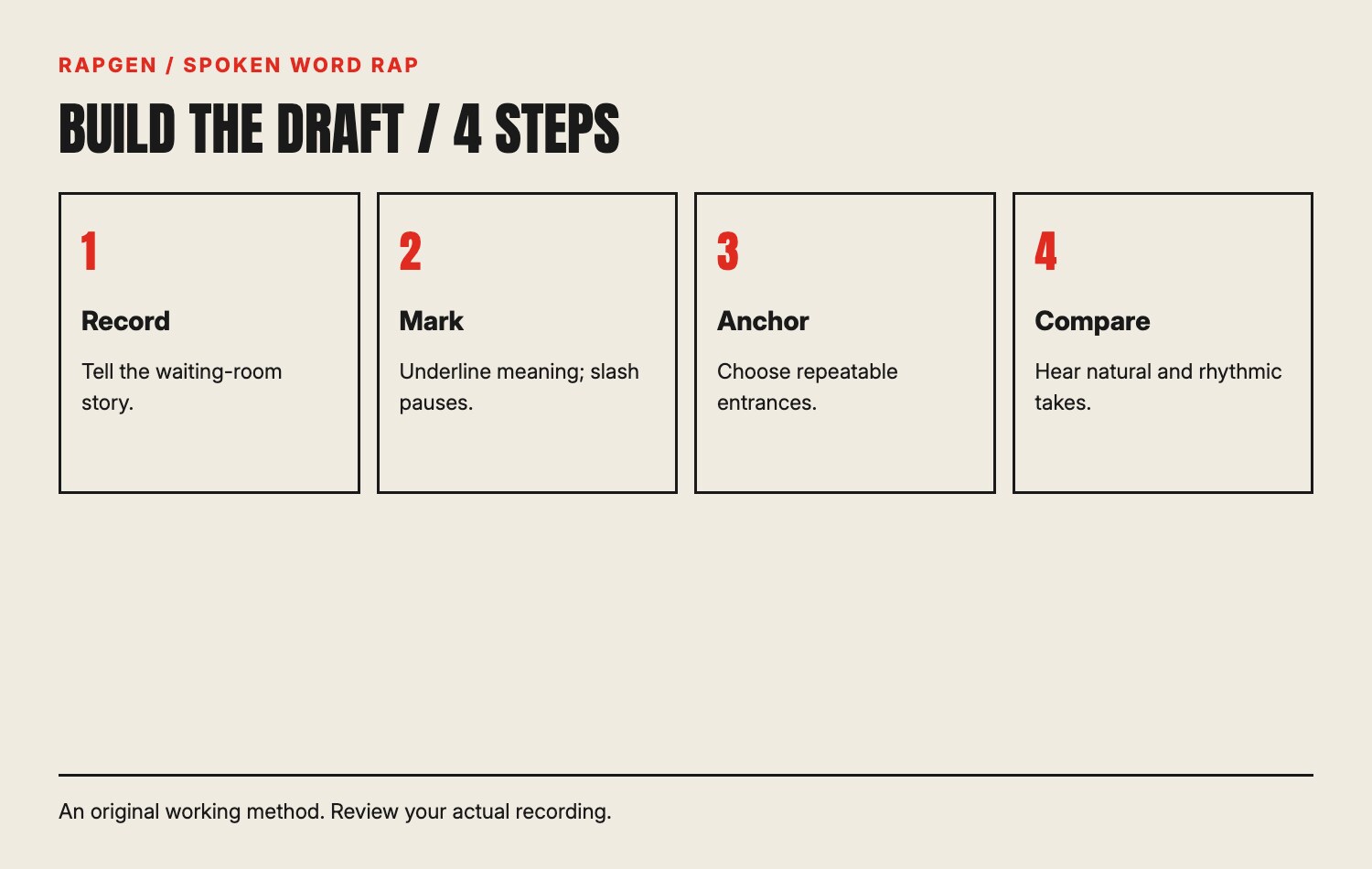
1. Record the story before writing the verse
Tell the account into your phone in the words you would use with a friend. Keep the recording short enough to replay without losing attention. You are collecting phrasing: the point where you hesitate, the sentence you repeat and the word you instinctively emphasize.
Our fictional speaker is waiting to correct a misspelled name on an appointment form. They have arrived early, the screen keeps showing other numbers and the receptionist thinks they are asking for something more complicated. It is an ordinary problem with enough pressure for a verse.
Transcribe one section, keeping its awkwardness visible. A first version might be: “I was there before the screen came on. Still had my coat zipped. They called a number, then another, and mine was apparently a different kind of number.” The last phrase has an angle worth keeping; the rest can establish place and pace.
Find your spoken hinge
Listen for the moment where your account changes direction. “And then,” “except” and “apparently” often carry this job. You can retain that hinge even while cutting everything around it.
Underline a phrase you would genuinely say. Do not replace it merely because a more literary version contains an easier rhyme. The phrase is evidence of the speaker's voice. Build the rhythm around that evidence before deciding which technical devices to add.
2. Map emphasis separately from rhyme
A sentence already has stresses that communicate meaning. “They called my number” differs from “They called my number” because the emphasized word changes what the listener compares. Write the sentence with one main stress and explain what that stress accomplishes.
Try three spoken readings of “I only wanted my name back.” Stress “only,” then “name,” then “back.” The first minimizes the request. The second identifies the thing being disputed. The third suggests it was taken away. These are performance choices, not interchangeable decorations.
Choose the meaning first, then look for rhyme if you want it. A rhyme placed on an unimportant word can pull attention away from the sentence's point. Leaving a sentence unrhymed can be a useful contrast when a later phrase returns to a sound the listener recognizes.
| Choice | What to mark on the page | What to listen for | Common revision |
|---|---|---|---|
| Main emphasis | One underlined word | Whether its meaning is audible | Remove a competing stressed adjective |
| Entrance | A cue before the phrase | Whether the listener knows a new thought began | Start after a stable count |
| Pause | A slash at the thought boundary | Whether it helps comprehension | Move it away from the middle of a name |
| Sound return | Matching letters beside related sounds | Whether a connection is heard | Use fewer, clearer returns |
Use marks you can read quickly while standing. An elaborate notation system is unhelpful if you need to decode it during the take. One underline, one slash and a simple count are enough for the first session.
3. Choose a pulse without filling every subdivision
Play a simple loop and count its main beats. Speak the same sentence across it several times while keeping the count steady. At first, let the words occupy different amounts of space. You are finding a repeatable relationship, not proving that every syllable belongs in a separate numbered cell.
For an ordinary four-beat measure, you can mark the first beat as an anchor and allow the sentence to continue beyond it. A phrase may cross a bar line. If you can repeat its entrance and endpoint consistently, the crossing can sound intentional.
Keep a version with fewer words. Suppose “They called a number, then another, and mine was apparently a different kind of number” repeatedly loses you. Try “They called another number. Mine was a different kind.” The idea survives; the shorter form gives the voice time to make “different” meaningful.
Silence has a place in the count
Mark empty time as deliberately as spoken time. If you wait through two beats, keep counting those two beats rather than restarting whenever the next word feels ready. The count gives a collaborator something reliable to follow.
These counts are rehearsal choices for your draft, not descriptions of Rhys Langston's recording. A listener can hear a spacious performance without knowing the worksheet behind it. The worksheet matters because you need to reproduce the performance when recording or rehearsing with somebody else.
4. Keep one sentence plain enough to orient the listener
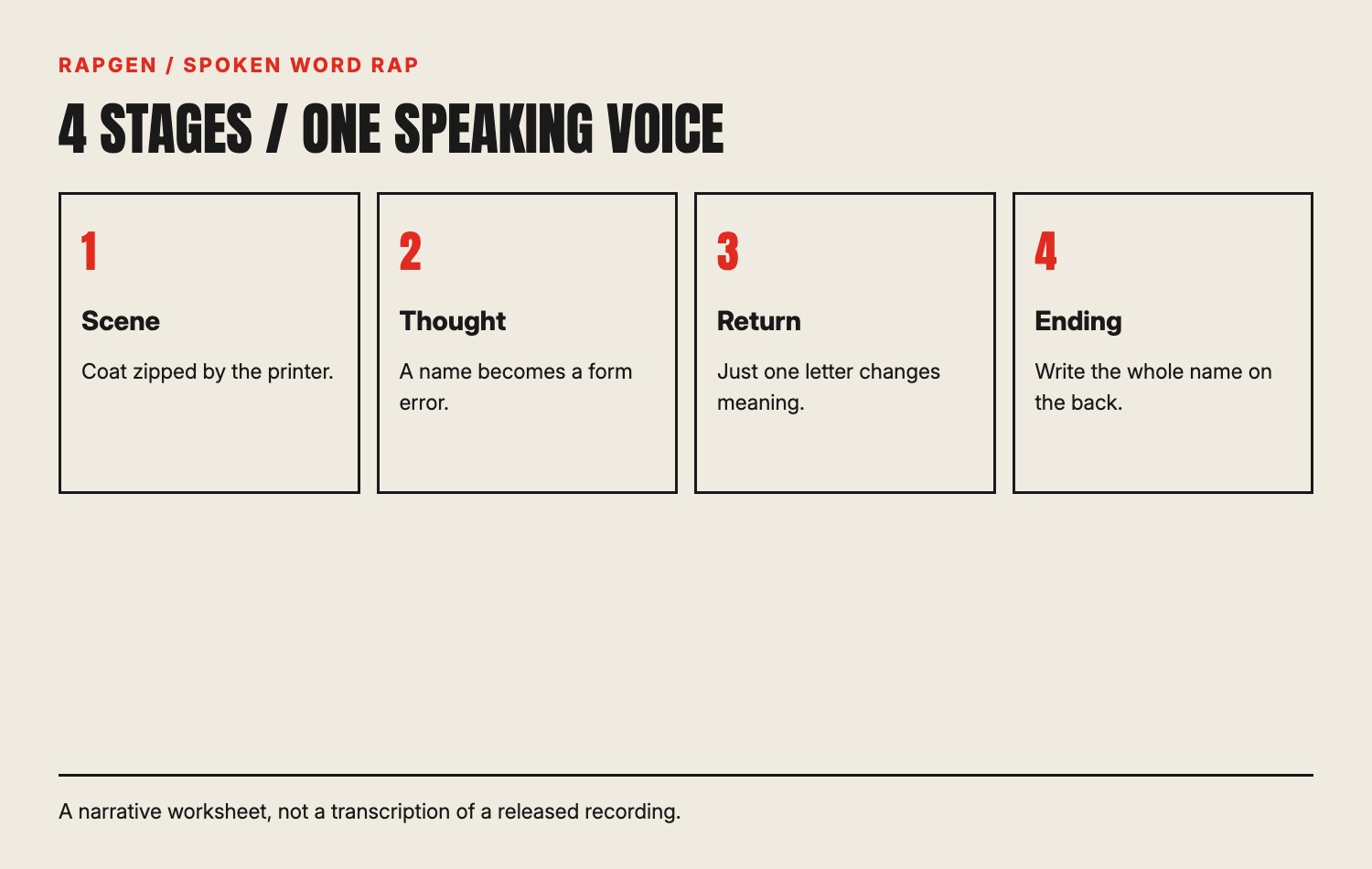
If every line is surreal, the listener may lose the physical situation. Give them an ordinary sentence they can picture: “I sit by the printer with my coat still zipped.” That line can support stranger associations around it because the person speaking remains somewhere recognizable.
Our original draft might begin:
I sit by the printer with my coat still zipped.
The screen changes names; mine stays clipped.
One missing letter, one chair, one form.
They ask if I've been here before.
The fourth ending breaks the sound established by the first two lines. That can give the receptionist's question a different role. You do not need to force “before” into the same rhyme family to make the section legitimate.
Write the plain line first when revising a dense passage. Ask what physically happened during the paragraph. If the answer is “the narrator imagined several things,” decide where their body was and what triggered the association. The concrete anchor makes the associative section easier to enter.
Avoid turning every plain detail into a symbol in your notes. The coat can remain a coat. A listener needs room to experience a scene before being told what each object supposedly represents.
5. Make recurring language do a different job on its return
Choose a short phrase the speaker could use more than once. “Just one letter” works for the name correction. At first it describes the request. Later it describes how an institution has reduced the speaker's identity to a technical error.
Try placing it after different details:
Just one letter on a form by the door.
Just one letter; still I'm waiting for more.
These examples are prompts, not a complete hook. You can change the second phrase so it says precisely what your speaker wants: recognition, an appointment, an explanation or simply the correct spelling. The point of the return is that its surroundings add meaning.
Separate repetition from filler
Copy the recurring phrase onto its own page. Under each appearance, write the new information the listener has acquired since last hearing it. If you cannot name a change, try removing that appearance and see whether anything is lost.
A repeated phrase can also hold timing when the rest of the verse is conversational. Rehearse its entrances consistently, then let the spoken sections vary around those anchors. The song structure guide is useful if you later expand this into several verses and a repeating section.
6. Edit the page for your mouth and the recording for a listener
Read a draft standing up, at the volume you intend to use. Highlight the spots where you repeatedly swallow a word, run out of comfortable air or lose the next entrance. A problem that repeats at the same phrase is a useful editing target.
Change one thing at a time. Remove a subordinate clause, replace an unfamiliar word or move a pause. If you simultaneously change the beat, phrasing and wording, you cannot tell which change helped. Keep the previous take for comparison.
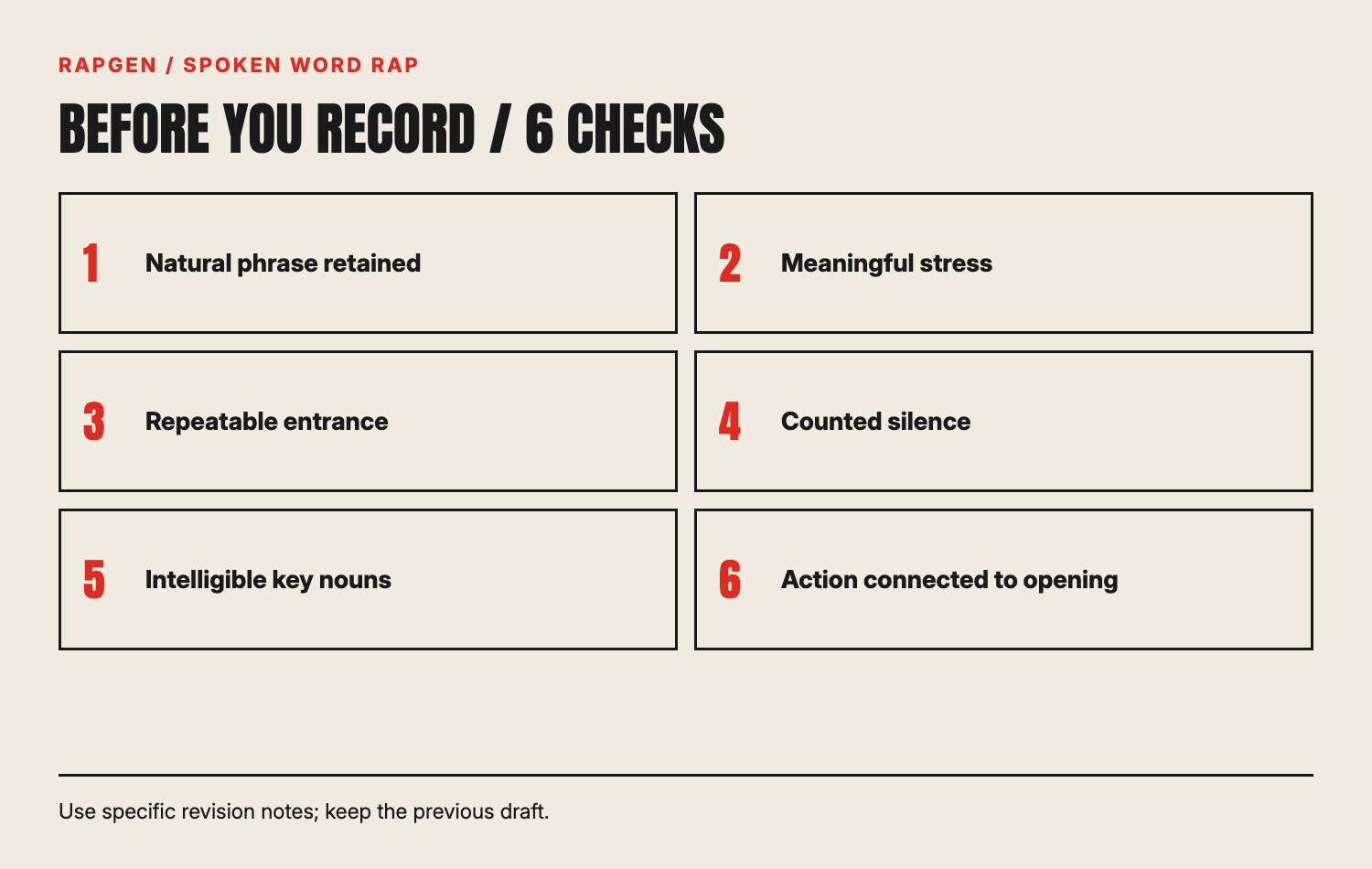
The listener's task is different from yours. You know what the form says and why the missing letter matters. They only receive the information you pronounce. Check proper names and critical nouns especially carefully; a small unclear word can hide the entire premise.
Do not use excessive backing volume to rescue a performance that feels exposed. A spoken passage may depend on subtle emphasis. Turn the loop down during review and check whether the sentence has enough shape on its own. Then bring the backing into balance with the voice.
A useful two-take comparison
Record one take using your natural spoken version and one using the edited rhythmic draft. Match their playback loudness as closely as you can. Ask someone which version makes the request easier to understand and where each loses attention.
You may keep the speaking version's first sentence and the rhythmic version's return phrase. There is no requirement to select an entire take as if it were a contest. The comparison should produce an actionable choice about a passage, not a verdict about your identity as a rapper.
7. Build an ending from the speaker's changed position
An ending does not need to solve the appointment problem. It needs to show where the speaker has arrived emotionally or practically. They may correct the form themselves, stop apologizing for the request or realize they have been rehearsing a complaint to the wrong person.
Bring back an object established at the opening. The coat gets unzipped. The printed slip is folded differently. The speaker writes their name in large letters on the back. That action can make the change visible without a concluding slogan.
An original ending might be:
I turn the slip over, let the blank side speak,
Write my whole name where the paper was clean.
“Speak” and “clean” are not a perfect rhyme. You can rehearse them as a loose sound relationship or choose different wording. Their main purpose here is the action: the speaker makes room for their name. Keep that action when revising the sound.
Test the ending with the opening played immediately before it. Does the last action belong to the same person and problem? If it sounds like general advice about life, try replacing the abstraction with an object already present in the scene.
A correction you can hear
Imagine the first listener thinks the speaker wants a new appointment rather than a corrected name. The printer and screen may be vivid, but the request is missing. Add the plain phrase “spell my name the way I wrote it” before the more associative passage. Record the section again with the same backing and entrance.
If that fixes the misunderstanding, keep the phrase even if it does not rhyme. You can supply a sound return elsewhere. This is a useful example of a plain sentence earning its space: it tells the listener which problem the speaker is actually solving. It also lets the later act of writing the whole name feel like a consequence instead of a new subject introduced at the ending.
Three things you can stop worrying about
Qualifying for a single genre label. You can describe your working method without declaring a final boundary between poetry and rap. The recording still needs deliberate timing and an intelligible voice.
Rhyming every sentence. Recurring sound is one available device. A clear unrhymed sentence can establish a place or emphasize a turn that deserves different treatment.
Sounding polished on the first voice note. That note is raw material. Its pauses and ordinary phrases can help you identify a voice worth preserving through later edits.
Collect alternatives without outsourcing the cadence
Use the rap bars generator for separate lines once you have chosen the speaker's request. Compare the returned wording with your original voice note. A line can contain an attractive idea and still be wrong for this person's mouth. The tool produces text; you decide its stress, silence and entrance.
The short version
Begin spoken word rap with a real speaking rhythm, mark the words that carry meaning and choose a few repeatable musical anchors. Keep a plain scene-setting sentence, let recurring language change its purpose and finish with an action connected to the opening. Your own recording is the test of whether the page preserved your voice.