Storytelling Rap: 7 Ways to Make Each Scene Matter
Storytelling rap works through clear goals, causal choices and concrete scenes. Build an original lost-camera verse with a continuity map and listener test.
You write a verse about the afternoon you lost something. Every line describes how annoyed you were. At the end, the listener knows your mood but cannot tell where you went, what you tried or why the final discovery mattered.
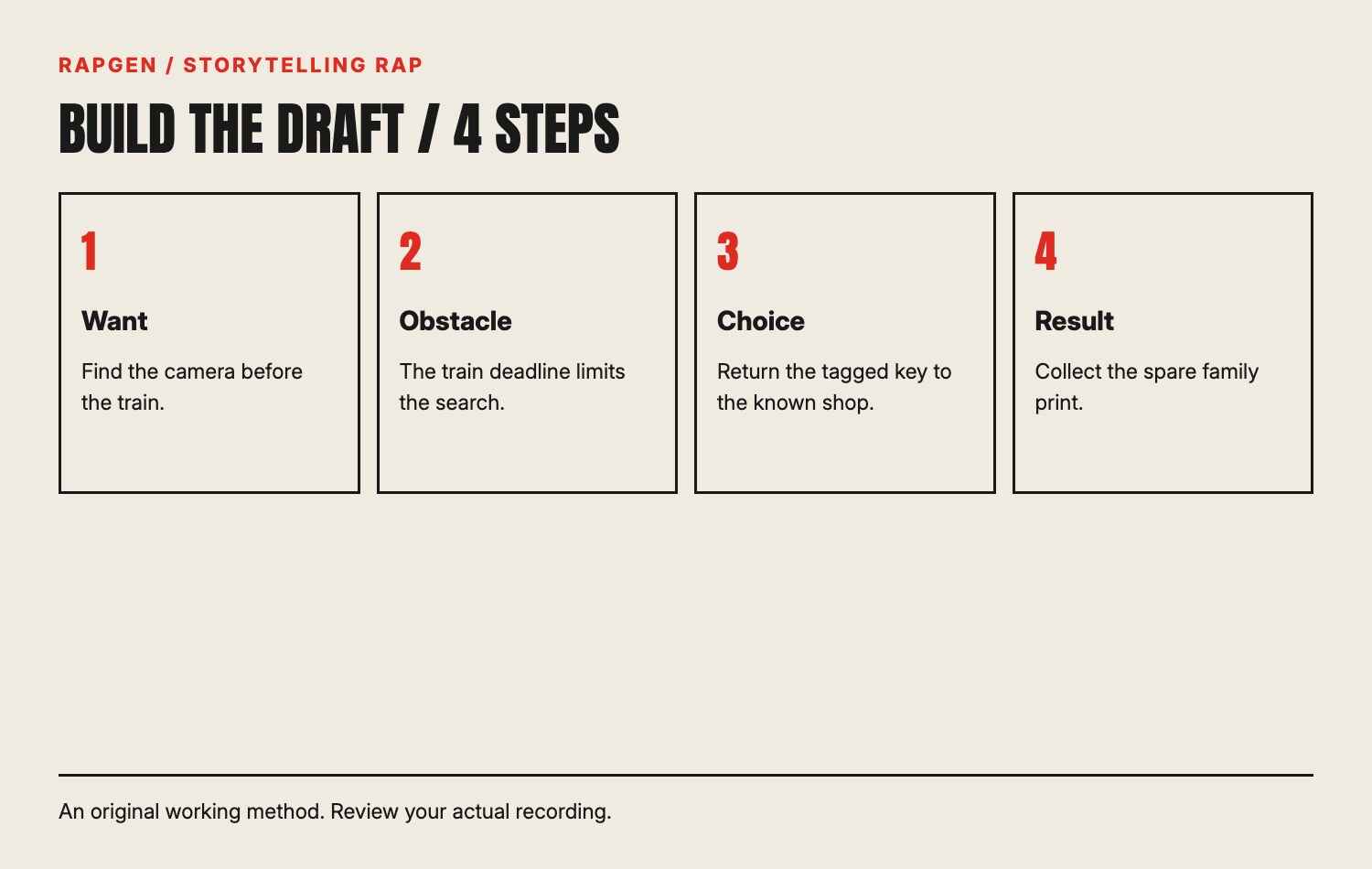
Storytelling rap gives the listener a sequence of wants, obstacles, choices and consequences. You can tell a complete small story without a dramatic crime, a famous name or an elaborate fictional universe. A missing object before a train departure supplies enough pressure if each action changes what the speaker can do next.
This worksheet follows an original fictional story about a lost camera. The speaker begins wanting the camera back and ends receiving a photograph that changes what they thought they had lost. All example lines are newly written. The technique applies to real memories too, but distinguish what you remember from details you invented, especially when identifiable people appear.
1. Give the speaker a goal and a deadline
Write the want in a plain sentence: “I need to find my camera before the train leaves.” The camera gives the speaker something to search for; the train gives the search a limit. Both details can produce actions you can describe.
Then decide why the object matters. The camera contains photographs from a family visit. Earlier that afternoon, the speaker had one of them printed at the corner shop, leaving a spare copy there to dry while they hurried to the station. Establish that visit briefly near the opening: the speaker is focused on recovering the camera, but the shop already has an image that matters. You do not need the equipment's entire history to prepare this consequence.
Keep the deadline simple. If the speaker also needs to meet three people, settle an old argument and save their job, the opening can become a list of obligations. Begin with the pressure the listener must understand to follow the next action.
Start after the routine has changed
The story can open when the speaker notices the empty strap. You do not have to narrate breakfast, packing and walking to the station unless one of those actions causes the loss.
An original opening pair is:
Ticket in my pocket, empty strap in my hand,
I stop by the board where the departures stand.
The physical mismatch makes the problem visible. The departure board puts the deadline in the same scene. A listener can now imagine what the speaker will inspect or ask about next.
2. Choose details that change the available action
A useful detail does more than decorate the location. A locked locker prevents a search. A found key offers a new route. A ticket with the wrong departure time changes how much time the speaker has.
For the first draft, give each scene one detail with a practical consequence. You can add atmosphere later where there is space. This keeps the lyric from becoming a travel description with a story vaguely happening somewhere behind it.
Our speaker finds a key beneath the bench where they last used the camera. The key has a shop tag. Following it means leaving the station, which risks missing the train. That detail creates a choice with a cost.
Write a note beside each proposed image: “because of this, the speaker can or must do what?” If the answer is nothing, you may keep it for atmosphere, but do not let several such images replace the action the section needs.
| Detail | Immediate effect | Story job | What to establish |
|---|---|---|---|
| Empty camera strap | Speaker recognizes the loss | Opening problem | Where the camera was last seen |
| Departure board | Search has limited time | Pressure | Which journey matters |
| Key with a shop tag | Speaker chooses to return it | New route | Why returning the key leads to the known shop |
| Printed photograph | Goal acquires new meaning | Consequence | Why this image matters to the speaker |
The table does not prescribe a twist. It checks that the ending's objects appeared for a reason. Change the objects completely if your own story needs something else; keep the cause-and-effect questions.
3. Make the central choice cause the next scene
The speaker sees the key and must decide whether to return it. If the next scene simply appears because the verse needs variety, the listener may feel transported rather than carried through a sequence.
Write the choice as a verb: return, hide, ask, wait, leave. Then write its consequence. Returning the key brings the speaker back to the shop. The owner recognizes the earlier printing customer and brings out the spare photograph left to dry. The speaker receives the image because returning the key brought them back to an established place; it does not mysteriously arrive from the missing camera.
This does not require a moral lesson. A selfish choice can create a story too. The practical requirement is that actions have effects the listener can trace. An ending feels more connected when it grows from the speaker's behavior instead of arriving as an unrelated surprise.
Use “because” in the outline
Before rhyming, summarize the draft with “because” between scenes. “Because I found the tagged key, I went to the shop. Because I returned it, the owner showed me the print.” If you can only connect scenes with “and then,” inspect whether a meaningful cause is missing.
This is an editing test, not a ban on coincidences. A coincidence can start a plot. Repeated coincidences solving every problem can remove the speaker's agency, especially in a short verse where the audience has little time to invest in a person making decisions.
4. Track where the objects and people actually are
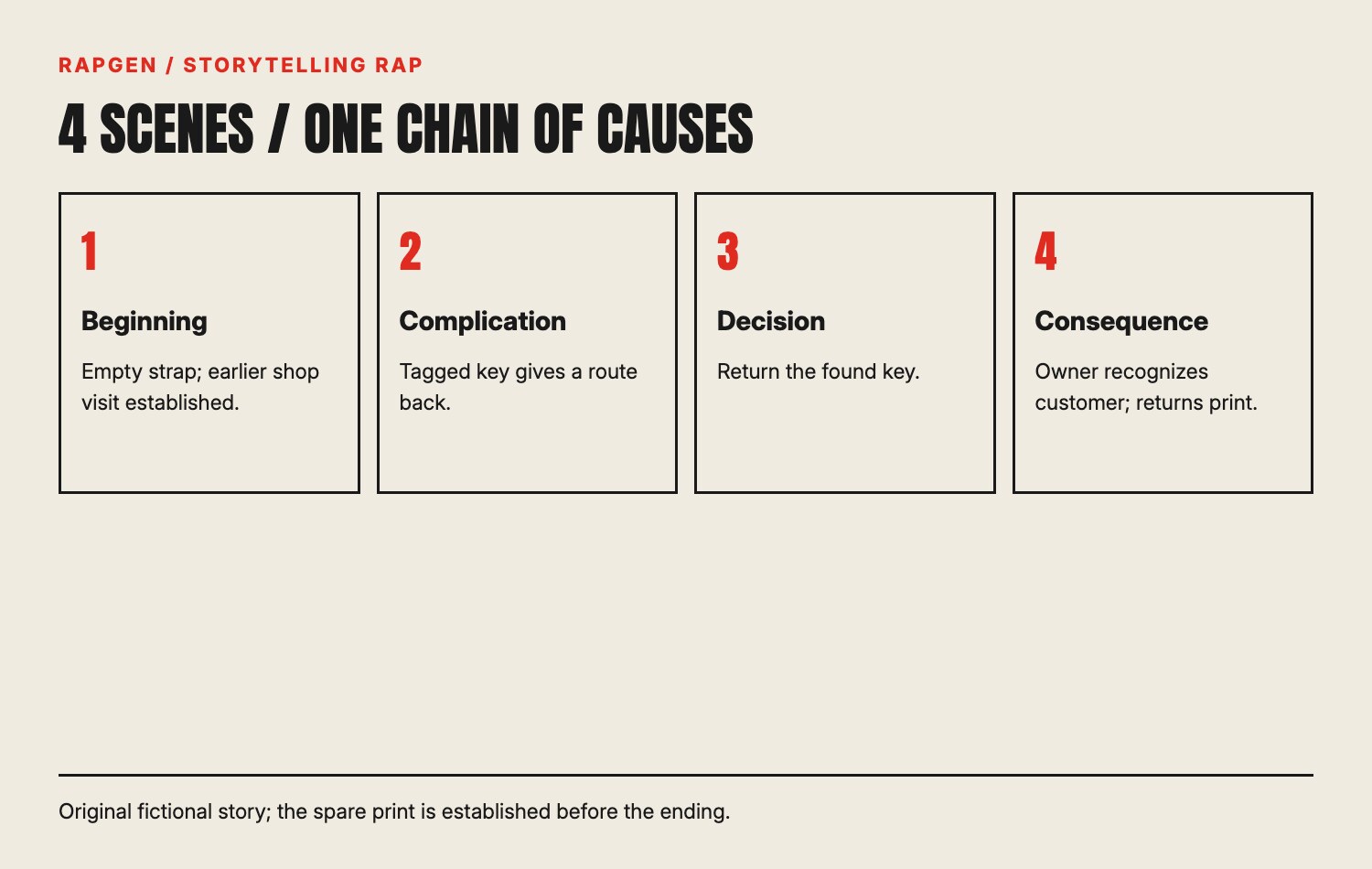
Write a continuity map for the strap, ticket, key and photograph. Mark who holds each at the beginning of a scene and who holds it at the end. A returned key should not reappear in the speaker's pocket later unless another action put it there.
Check people too. If the shop owner is behind the counter, the next line should not have them waiting at the station without a scene change. You can compress travel in a lyric, but supply a cue that tells the listener the place has changed.
Names and pronouns deserve their own pass. Two people described as “he” can make a simple exchange confusing. Repeating “the owner” once may preserve clarity better than a pronoun that forces the listener to guess.
Build a transition from the moving object
Carry the key across the cut. The station scene ends with its tag; the shop scene begins with the same tag on the counter. The object gives the listener a connection while the location changes.
Shop name on the tag, train time on the board,
I take the small key through a half-open door.
The lines are a loose sonic pair rather than an exact rhyme claim. The key information is the competing directions: the board points toward the train, the tag points toward the shop. The speaker's movement makes their choice visible.
5. Let sound support the order of information
Choose the action and necessary noun first. Then search for sounds that keep that information understandable. If your rhyme forces the shop to become a school or changes the key into a coin, you may be changing the plot to solve a sound problem.
Work with a small set of scene words: strap, map, tag, back; board, door, floor; light, print, ink. Not every item in a set is a perfect rhyme. Say the pairs in your own accent and label which relationships you actually hear.
Use an internal sound when the sentence ending needs an important fact that does not fit the current rhyme family. A line can carry sonic texture without putting every new piece of information on the same ending sound.
For example:
Tag on the counter, bag by my feet,
The owner turns a photograph toward me.
The second line prioritizes the new object. You could revise its ending for a stronger sound connection, but keep the act of turning the photograph toward the speaker. That is the information needed for the next section.
Read the story with the rhymes removed
Paraphrase every couplet as prose. Does the sequence still make sense? If the prose contains a missing decision or unexplained movement, polishing the rhyme will not supply it.
You can consult the half-rhyme guide when a clear noun needs a more flexible sound relationship. This worksheet's priority is that the sound choices preserve the story the listener is trying to follow.
6. Decide what the ending changes
Our speaker does not get the camera back in the first ending. They collect the family print they had overlooked while chasing the camera. The practical goal remains partly unresolved, but the emotional goal changes: the image mattered more than the equipment.
Establish that emotional importance before the reveal. One early mention of the family visit may be enough. Without it, a random photograph at the shop cannot carry the meaning you have assigned in your notes.
An original ending could be:
Camera still missing, but the faces came through,
I fold the print gently; there's a train I can lose.
That final action shows the speaker reprioritizing. It does not declare that losing a train is always wise or that objects never matter. It belongs to this person's particular afternoon and the image they recovered.
Avoid adding a new rule in the last line
If the ending relies on a previously unmentioned person, special ability or secret location, give it earlier support or simplify it. Surprise works better when the listener can look back and see how the draft prepared it.
Play the opening and ending together. The empty strap should connect to the folded print through a recognizable want. If the ending could close any song about hardship without alteration, replace the general statement with an action involving an established object.
7. Ask a listener to retell the sequence
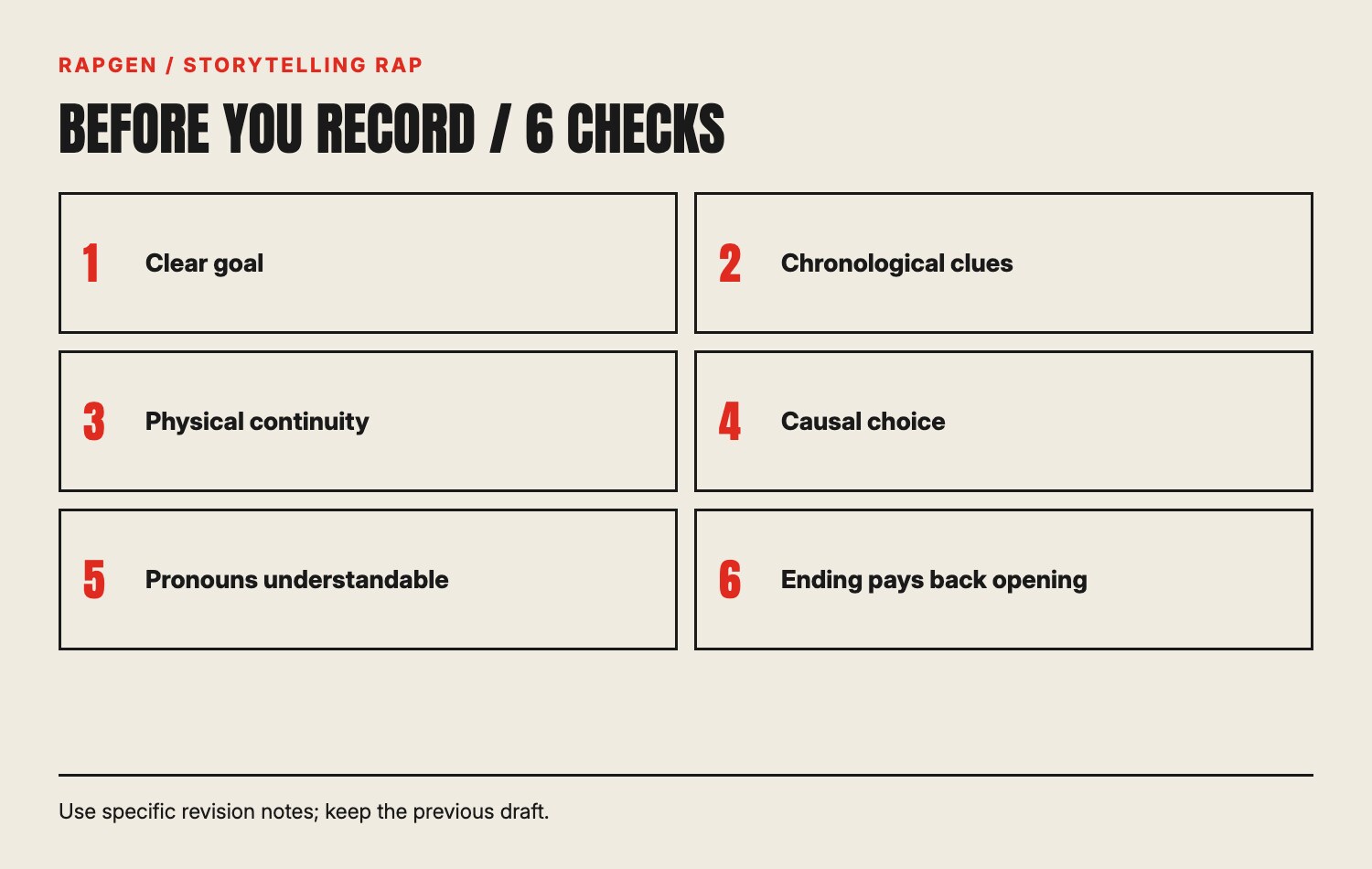
Play a rough recording to someone unfamiliar with the story. Ask what the speaker wanted, which choice changed the search and what they received at the end. Their retelling identifies missing information more directly than a broad question about whether they liked the verse.
If they miss the key's connection to the shop, state the tag more clearly. If they think the camera was found, distinguish the print from the equipment. If they cannot tell who shows the photograph, repeat the role instead of relying on an ambiguous pronoun.
Check delivery after correcting the information. A crowded line can hide the clue even when the words are present on the page. Rehearse the revised passage over the intended backing and leave enough room for its critical nouns.
Save the plot version with your recording notes. A later performance revision can accidentally remove an early setup because it seemed less quotable than the reveal. The rap writing guide helps with a complete draft; your continuity map protects this draft's specific sequence.
If you adapt a real event, check names, dates and what you actually witnessed. Avoid presenting invented dialogue or motives as established fact about identifiable people. You can change names and clearly frame a composite story, but do not use that framing to hide a recognizable false accusation.
Keep the clue specific after a timing cut
Suppose a faster take makes you remove “shop name” from the key line. The sound may improve while the route into the next scene becomes unexplained. Keep the tag's identifying detail and shorten another phrase, then replay the transition with the lyric hidden.
This is why the continuity map belongs beside the recording notes. A word can be rhythmically expendable but narratively necessary. If you genuinely cannot fit it, change the delivery space or introduce the same information elsewhere before the speaker leaves the station. The listener needs a reason for that movement, even when the performance compresses the journey.
Three things you can stop worrying about
Having an extraordinary life event. A small object, deadline and choice can supply a complete story. The listener needs consequences they can follow.
Explaining every minute of the day. Include the actions that establish or change the search. Compress routine travel with a clear location cue.
Ending with a universal lesson. A folded photograph is enough to show a changed priority. Let the listener understand that action without adding a slogan afterward.
Generate for one scene rather than the whole plot
The rap bars generator returns separate written candidates. Give it the key-on-counter scene if that passage needs alternatives, then inspect every result against your object map. A generated line cannot know which clue you removed in a previous revision unless you supply the relevant context.
The short version
Build storytelling rap around a clear want, an obstacle and a choice that causes the next scene. Track objects and pronouns, preserve information while rhyming and make the ending change the speaker's position. An unfamiliar listener's retelling is the practical check that the story made it out of your notes and into the recording.