Southern Rap BPM Guide: Tempo, Pocket, and Key Choices
Southern rap has no single correct tempo. Start with these practical BPM zones, then use drum feel, vocal space, and a short audition to choose.
“Southern rap” is an umbrella, not a metronome setting. A slow Memphis-influenced crawl, an Atlanta trap bounce, a New Orleans club rhythm, and a Houston-inspired spacious groove can all belong in the conversation while behaving differently under a verse.
The search query whats a good southern rap beat bpm has no single numeric answer. A practical starting zone is roughly 65–80 BPM for slow or half-time writing, or the doubled project-grid equivalent of 130–160 BPM. The right choice is the tempo where the intended drum relationship, bass movement, and vocal phrase all remain convincing.
This guide uses tempo zones as audition points rather than genre laws. It also explains why the key matters less than the register and note relationships you actually choose.
1. Decide whether you are counting full-time or half-time
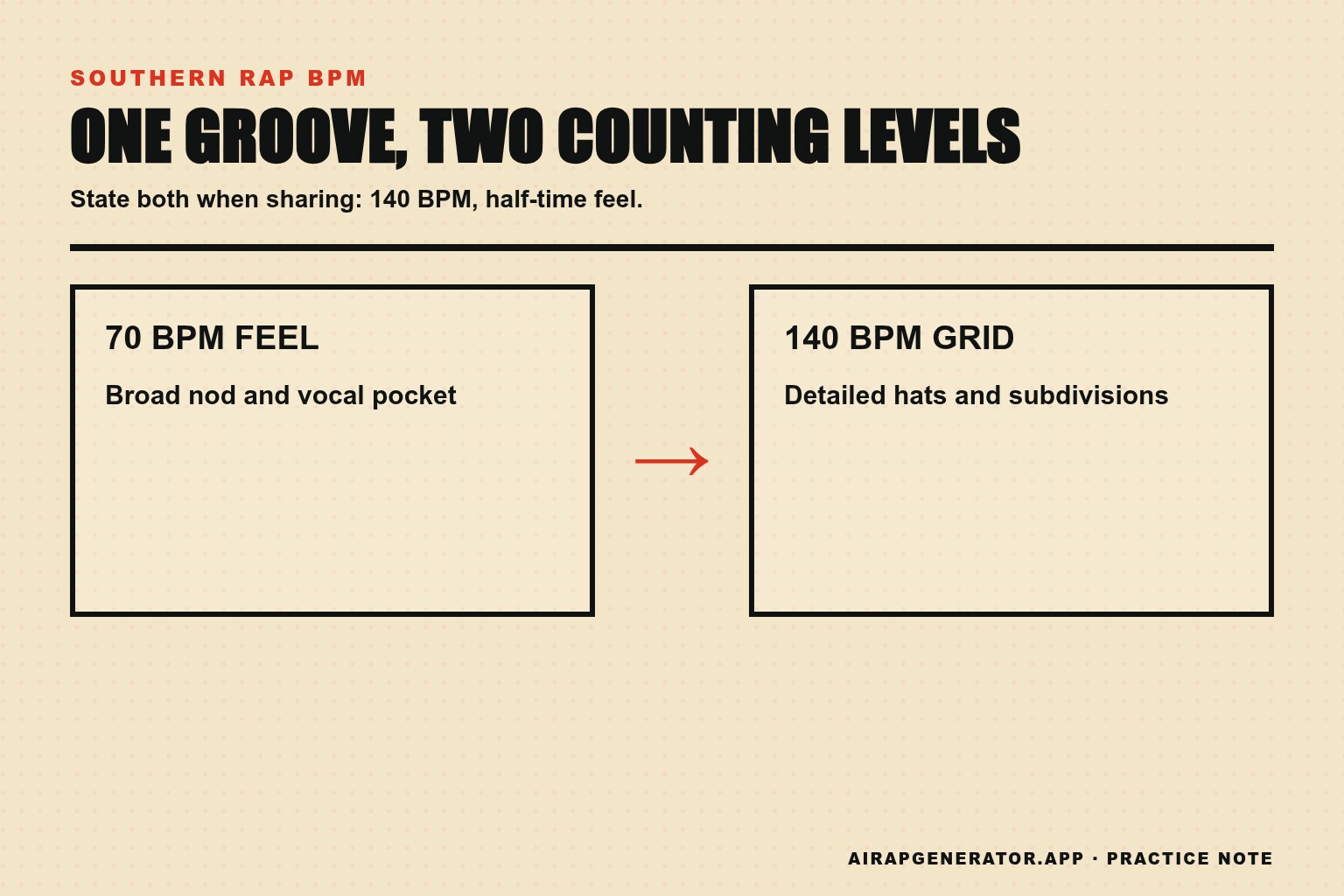
A project set to 140 BPM can feel like 70 BPM when the main snare and body movement happen every other quarter-note pulse. Both numbers describe the same clock at different counting levels.
Before comparing tempos, identify:
- where you naturally nod;
- where the main snare or clap lands;
- whether the hi-hats express the fast grid;
- whether the vocal phrases feel like four broad beats or eight smaller ones.
If a collaborator calls the beat 70 and your DAW says 140, you may not disagree at all. State both when sharing: “140 BPM, half-time feel.”
Why the doubled grid is common
A faster grid makes detailed hat rolls and subdivisions easier to program and view. It does not force the rapper to deliver twice as many syllables. The vocal can still occupy the broad half-time pocket.
2. Start with three useful tempo zones
Use these ranges to create first drafts, not to police style:
| Feel | Half-time view | Doubled grid | What it tends to offer |
|---|---|---|---|
| Slow and heavy | 62–70 BPM | 124–140 BPM | Long vocal tails, open bass movement, stark space |
| Central bounce | 70–76 BPM | 140–152 BPM | Flexible trap pocket, room for triplets and pauses |
| Urgent and bright | 76–84 BPM | 152–168 BPM | Shorter phrases, active hats, forward motion |
The words “tends to” are important. Drum placement can make 68 BPM feel restless and 80 feel relaxed. Sound decay, swing, and the bass rhythm alter perceived speed.
Choose one reference feeling in plain language: dragging low, rolling bounce, or urgent lift. Then audition the middle of the corresponding zone.
3. Let the snare relationship choose the pocket
Tempo alone does not create a regional feel. The kick, snare, hats, and bass have to imply a relationship a voice can inhabit.
Build a simple two-bar drum loop before adding melody. Try three versions:
- Anchored: dependable snare, sparse kick, few hat changes.
- Rolling: same snare, syncopated kick, one hat acceleration.
- Broken: one expected kick removed and one late answer added.
Rap the same two lines over all three. The best version is the one that makes a vocal decision obvious. If you constantly search for where to enter, the loop may be interesting but not yet supportive.
An original test couplet:
Porch light buzzing, whole block holding its breath
Trunk line rolling, let the low note finish the sentence
Keep the words identical. If the delivery changes naturally with the drums, the groove is doing real work.
If none of the three versions gives the vocal a stable landing, use the kick and snare listening checks before changing tempo again. A level or masking problem can make a usable pocket feel absent.
4. Choose tempo with the bass decay in mind
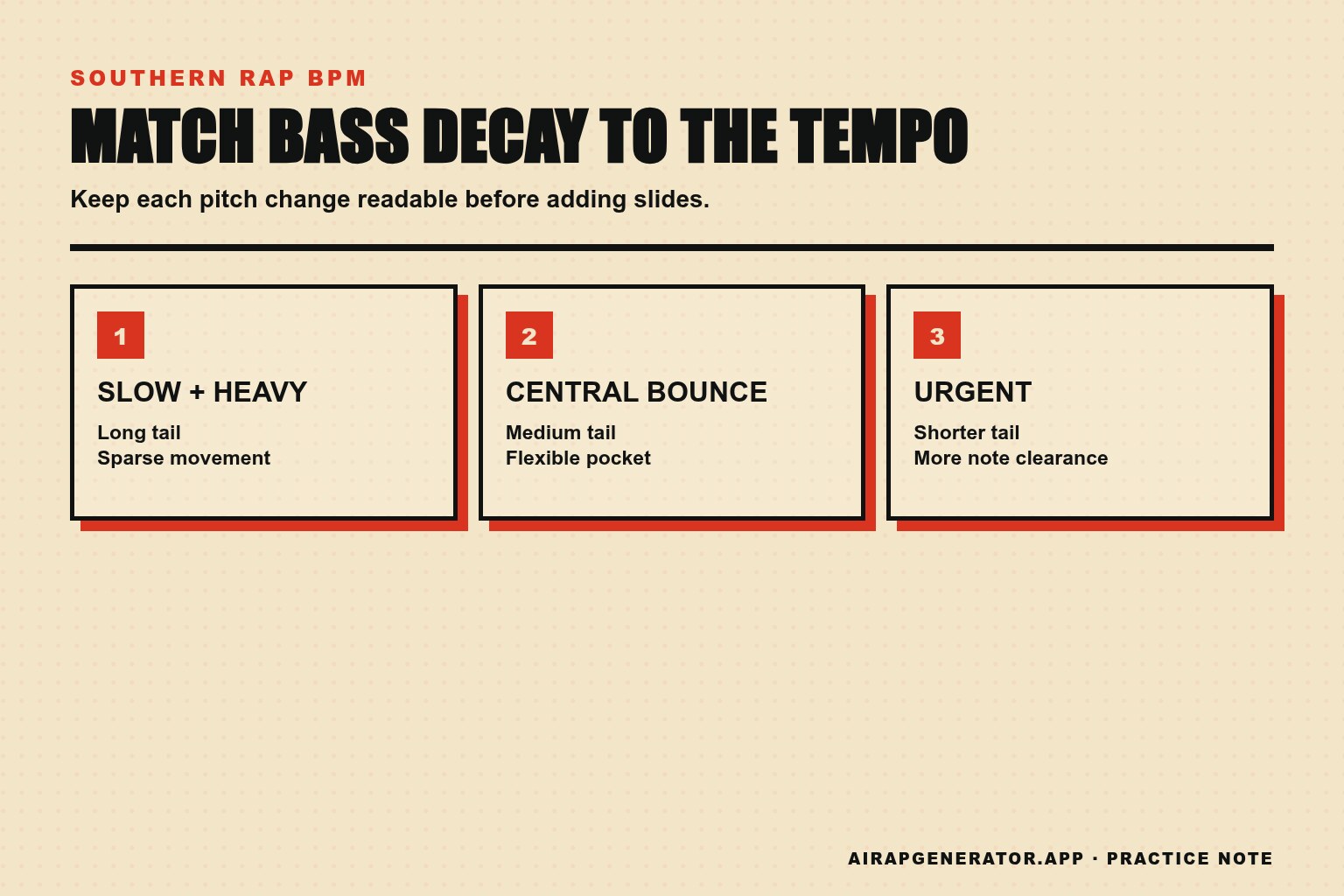
Southern-leaning production often gives the low end a large role. At a slower tempo, a long bass or 808 tail has time to develop. At a faster tempo, the next note may arrive before the previous one clears.
That does not mean fast tempos require short bass. It means overlapping notes must be intentional and controlled.
Use a four-step bass test:
- Program only the root movement and one transition note.
- Listen to the tail at the section's busiest kick pattern.
- Shorten notes until each change is readable.
- Add slides only where they announce a phrase or transition.
If the bass loses identity when shortened, lower the tempo a few BPM or simplify the rhythm. If the track feels empty at the slower tempo, add a rhythmic answer rather than filling every gap with another bass note.
5. Treat key as a vocal-space decision
There is no required “Southern rap key.” Minor tonal centers are common across many rap styles because they support tension, but choosing “minor” does not create a genre. Register, interval, sound, and rhythm matter more than the label alone.
Start by asking where the vocal will sit. A dark bell pattern in a high register may leave the midrange open. A thick chord stack around the speaking range can compete even when the key itself seems appropriate.
A fast key audition
Create a two-note or three-note motif. Transpose the whole idea through several keys while keeping the rhythm and sound. Rap the hook each time.
Score:
- whether the bass still carries weight on available speakers;
- whether the main motif avoids masking the voice;
- whether the vocal feels forced too low or too high;
- whether the mood survives without extra layers.
If you are sending the beat to another vocalist, include the key only when known and verified. Do not guess from the bass note alone if the harmony is ambiguous.
6. Audition the vocal before committing
A beat can feel perfect instrumentally and become crowded the moment a verse arrives. Use a scratch vocal before polishing.
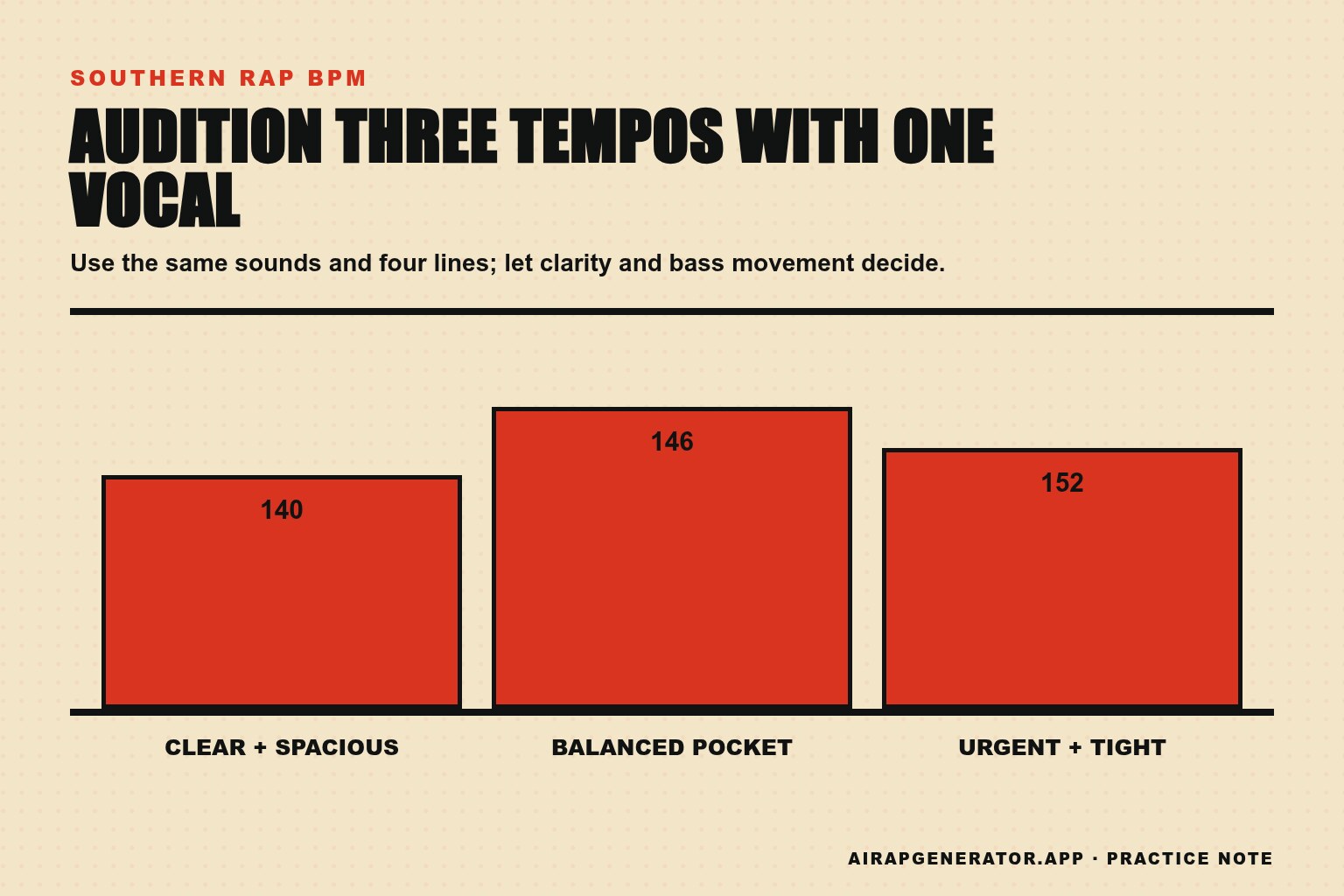
Write four plain lines and record them at three tempos: the chosen BPM, six BPM slower, and six BPM faster. For example, test 140, 146, and 152 on the doubled grid.
Keep the same drum sounds and lyric. Rate each version:
| Question | Slower | Middle | Faster |
|---|---|---|---|
| Can the consonants stay clear? | |||
| Is there space after the rhyme? | |||
| Does the hook feel distinct? | |||
| Does the bass finish its movement? | |||
| Can the take repeat three times? |
The fastest version may sound exciting on the first pass and become tiring by the third. The slowest may sound heavy alone and empty under a short hook. Repeatability reveals the useful middle.
7. Build arrangement contrast without changing BPM
Once the tempo works, do not automate speed changes to create every energy shift. Arrangement can make one BPM feel like several levels.
Use this map:
| Section | Drums | Bass | Musical layer | Vocal space |
|---|---|---|---|---|
| Intro | Hat or texture only | None | Filtered motif | Maximum |
| Verse | Core kick and snare | Simplified | One main layer | Wide |
| Hook | Full pattern | Full movement | Added upper response | Moderate |
| Break | Snare removed | Tail only | Fragment | Dramatic pause |
At 146 BPM, the verse can feel slow when the hats simplify and the bass leaves long tails. The hook can feel quick when subdivisions and responses arrive. The clock did not change; information density did.
Do not confuse activity with lift
Adding more notes raises density, not necessarily energy. A one-beat stop before the hook can create more lift than another hat roll because the return has contrast.
8. Run a thirty-minute BPM audition
Use this process before building the full production:
- Minutes 0–5: create one kick, snare, hat, and bass loop at 146 BPM.
- Minutes 5–10: duplicate it at 140 and 152 BPM.
- Minutes 10–15: adjust bass note lengths, not the composition.
- Minutes 15–20: record the same four scratch lines over all three.
- Minutes 20–25: listen away from the screen and score the matrix.
- Minutes 25–30: choose one tempo and write the reason.
Good reasons sound like this: “146 keeps the bass tail but lets the hook consonants land.” Weak reasons sound like “146 feels professional.” The first can guide the arrangement. The second cannot.
After choosing, keep the other two bounces. A vocalist may reveal that the phrase needs more air, and returning to a tested slower version is faster than rebuilding from memory.
A compact decision tree
Start at 146 BPM on the doubled grid, then listen:
- Vocal endings rush: try 140 or reduce syllables.
- Bass overlaps blur: shorten decay, simplify notes, or try 140.
- Groove drags: try 152 before adding more percussion.
- Hook lacks lift: change arrangement density before tempo.
- Verse feels crowded: remove a musical layer before changing key.
- Voice and motif compete: transpose or move the motif's register.
The practical answer is a small audition range, not a magic preset. Begin around 140–152 BPM with a half-time feel, test the real vocal, and let clarity, bass movement, and repeatability choose the number.
Avoid four tempo-selection mistakes
Choosing from the hi-hats alone. A rapid hat pattern makes the project feel fast even when the kick, snare, bass, and voice occupy a broad pocket. Mute the hats and decide whether the underlying body movement still works.
Changing BPM to repair a crowded arrangement. If the verse feels rushed because four melodic layers compete with it, slowing the clock may only create a slower crowded beat. Mute parts before touching tempo.
Copying a reference number without its feel. Two tracks at 146 BPM can have different swing, note decay, snare placement, and vocal density. Use a reference to describe relationships—open bass tails, clipped snare, late vocal entrance—not merely to import one number.
Picking key and tempo in isolation. Transposing a bass sound changes how long and powerful it feels on many playback systems. A tempo that works in one key may need shorter notes after transposition. Recheck the bass-and-kick relationship after the key is chosen.
Make a one-page handoff for the rapper
A useful beat handoff removes technical guessing while leaving creative room. Include:
- project BPM and whether the intended feel is half-time;
- verified key, or “key uncertain” rather than a guess;
- a version name and export date;
- section timestamps;
- whether the intro contains a clear count;
- a note about any planned stop or unusual bar length.
Do not prescribe the entire flow in the handoff. “Verse begins at 0:18; one-beat stop before hook” is useful. “Rap exactly like this reference artist” closes the space the performer needs.
Before sending, play the exported file from a normal music player rather than the DAW. Confirm that the first downbeat, tempo label, and arrangement notes match the actual bounce. A perfect session file does not help if the shared export is the wrong version.
A seven-day production experiment
To learn the range rather than memorize one preset, make seven thirty-minute sketches. Alternate 136, 142, 148, and 154 BPM, then revisit the three most promising zones with different drum relationships. Use the same core sound palette all week.
At the end, compare only bounced audio. Mark which tempo produced the clearest vocal, strongest low-end motion, and easiest arrangement contrast. You may discover that your preferred Southern-leaning pocket is a range of four or six BPM rather than one number. That is a reusable production decision grounded in your own material.
Frequently asked questions
Is 140 BPM good for Southern rap?
It is a useful audition point, especially with a half-time feel equivalent to 70 BPM. It is not a rule. Test nearby tempos with the same scratch vocal and bass pattern.
What BPM is trap music usually in?
Trap is often produced on a doubled grid in a broad fast range and felt in half-time, but releases vary well beyond any neat boundary. For your beat, the relevant number is the one that supports the intended pocket and arrangement.
Should a Southern rap beat be in a minor key?
It can be, but “minor” alone does little. A sparse motif, register choice, bass relationship, and sound design create more of the mood. Audition the hook over several transpositions.
Do I need to tell the rapper both BPM numbers?
One project BPM is enough for technical exchange, but adding “half-time feel” prevents phrasing confusion. For example: “146 BPM, half-time pocket.”
Can I change BPM after recording vocals?
Small changes may be possible, but time-stretching can alter delivery and audio quality. Make the three-tempo audition with a scratch take before recording final vocals.
Three things you can stop worrying about
Finding the official genre BPM. Southern rap contains several feels; a tested range is more useful than one inherited number.
Choosing a minor key by default. Register, motif density, bass movement, and sound design shape the mood more directly.
Adding busy hi-hats to create energy. The vocal, kick, snare, and bass must establish the pocket before decoration helps.
The short version
For the search query whats a good southern rap beat bpm, the working answer is to audition a small half-time range—such as 140, 146, and 152—with the same drums, bass, and scratch vocal, then keep the clearest repeatable version.
Keep reading
- How long it takes to make a rap beat for turning the chosen tempo into a finished session.
- How many syllables fit in a 138 BPM rap beat for calculating vocal density on a nearby grid.
- How to improve rap flow for comparing pockets without rewriting the verse.