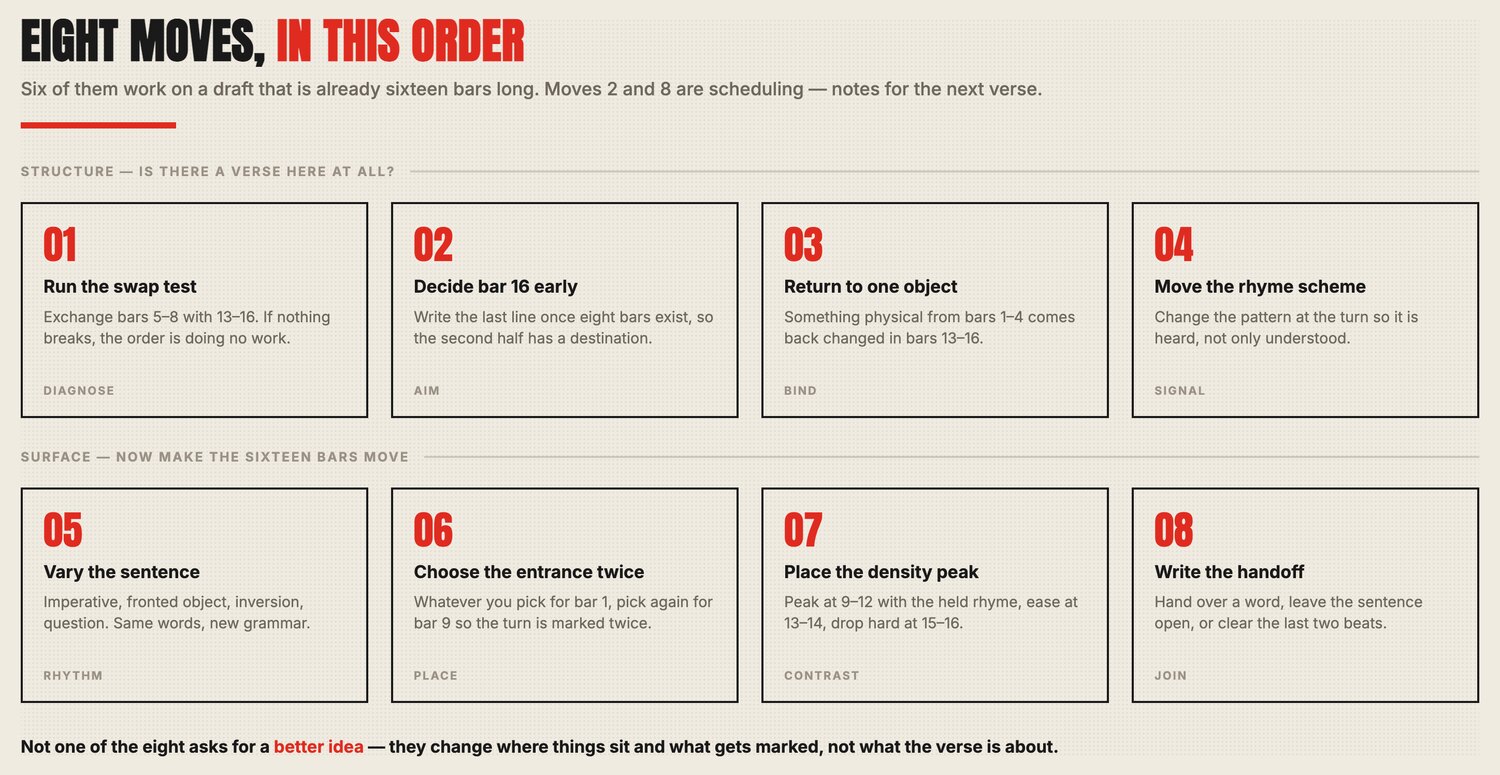
How to Write a Rap Verse: 8 Moves That Give It Shape
How to write a rap verse that reads as one thing instead of sixteen good lines: run the swap test, move the turn, change the rhyme, and hand off to the hook.
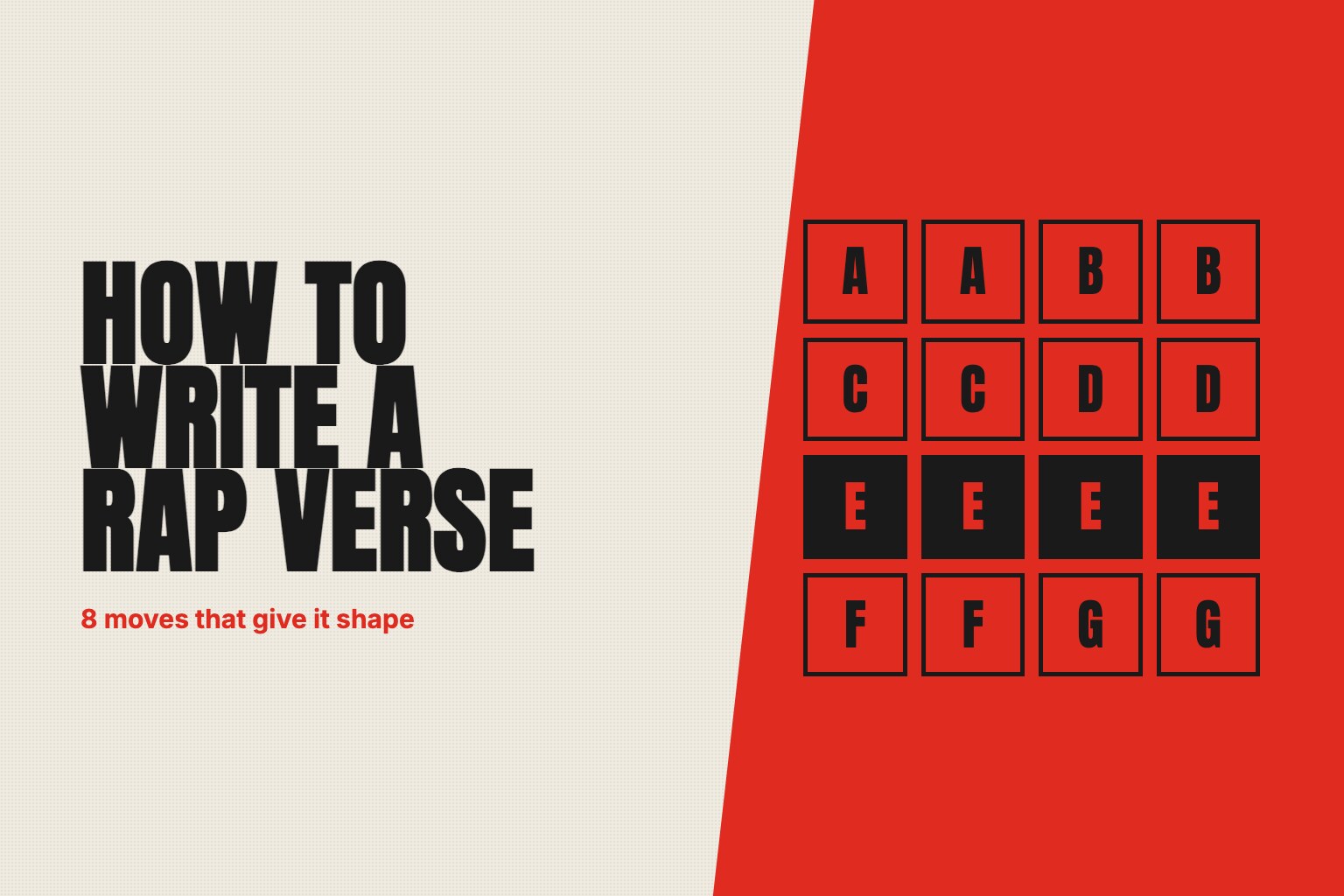
Sixteen bars, all finished, none of them bad. You read them back and somewhere around bar nine your attention slides off the page, and when you go looking for the line that lost you, there isn't one. Every bar survives on its own. The verse still doesn't.
That gap is the whole subject of how to write a rap verse, because the skill is not the same as writing bars. Bars are a line-level job. A verse is an ordering job, and the two fail in completely different ways — which is why a folder full of good lines almost never turns into a verse you want to perform.
What follows are eight moves. Six of them work on a draft that is already sixteen bars long. Two — move 2, and the hook decision behind move 8 — are scheduling changes you can only really use on the next verse, which is worth saying up front rather than at the end.
Read the symptom before you pick the move
Verse problems tend to announce themselves as a feeling: bored, flat, fine. This table maps the five complaints I hear most onto what is usually underneath them.
| What you notice reading it back | What it usually is | The move |
|---|---|---|
| Every line works, but I drift around bar 9 | The four-bar blocks are interchangeable | Swap test (1) |
| It sounds like a list | Every sentence has the same grammar | Vary the sentence (5) |
| The ending doesn't land, it just stops | The last bar was written last | Decide bar 16 early (2) |
| Fine on the page, wrong over the beat | Density is flat across all sixteen | Place the density peak (7) |
| The hook feels like an interruption | Nothing hands off to it | Write the handoff (8) |
1. Run the swap test before you change a word
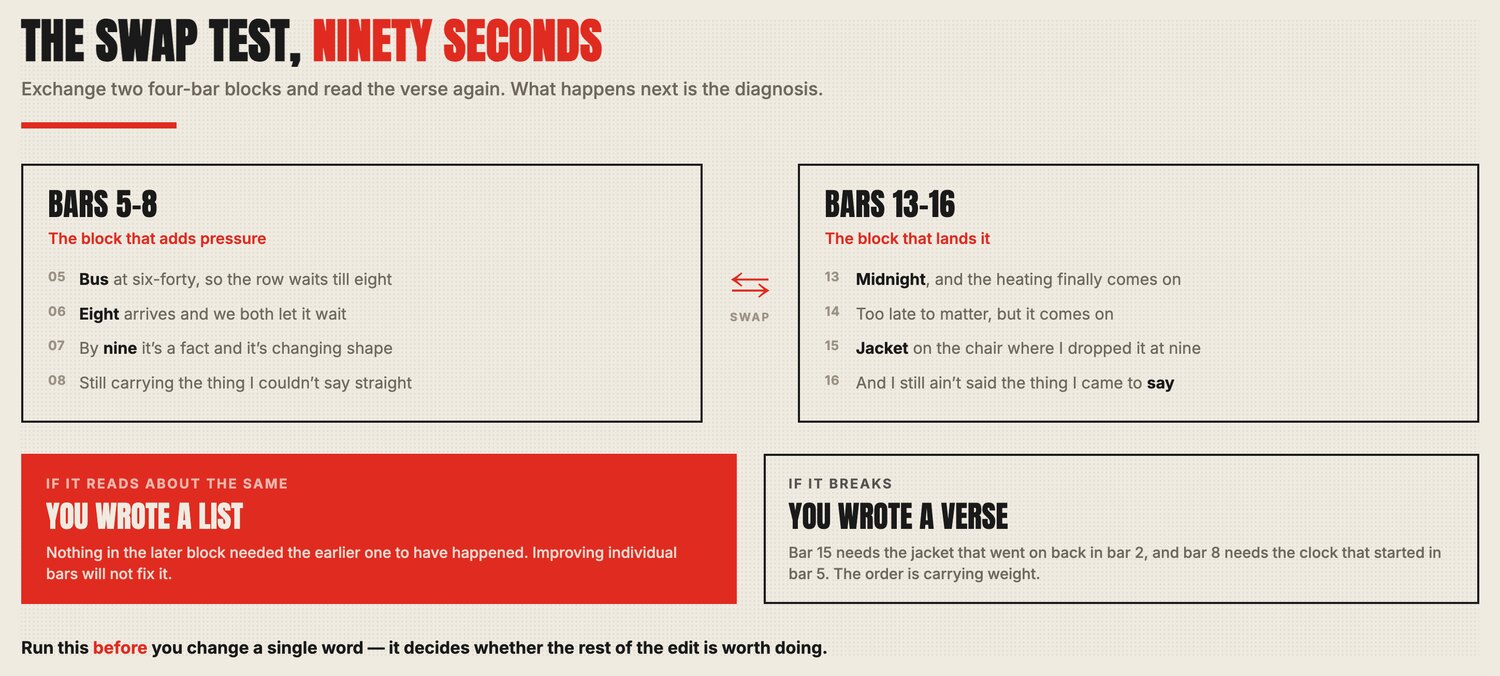
Take bars 5–8 and bars 13–16 and exchange them. Read the verse again.
If it reads about as well as it did — maybe the rhymes need repairing at the seams, but nothing has actually broken — then the order of your verse is carrying no weight, and you have written a list. Sixteen lines about a subject is a list. A verse is sixteen lines where each block changes what the next block is allowed to say.
This is worth doing first because it is quick and because it decides whether you have an ordering problem at all. Plenty of drafts pass — and a draft that passes can still end flat or run at one density, which is what the other moves are for. The ones that fail cannot be repaired by improving individual bars, which is what everybody tries next and why the draft sits open for three weeks.
Here is a block that fails it:
I been up since the sun was a rumor, Same jacket, same route, same humor, They ask what I do and I just show 'em, Ain't no speech in it, ain't no poem.
Four lines, each one a standalone claim about the speaker. Deal them in any order and nothing is lost, because nothing in line three needed line two to have happened.
Now the same material with the order load-bearing:
Sun's still a rumor when the alarm goes off, Jacket on first 'cause the radiator's soft, Bus at six-forty, so the row waits till eight, By nine I'm just carrying what I couldn't say straight.
Alarm, jacket, bus, nine o'clock. Time moves in one direction across the four bars, so the last line cannot be the first — it depends on an argument that got postponed two bars ago. Same voice, same street, and now the sequence is doing work.
You do not need a clock to get this. Cause, escalation, a narrowing, a growing consequence — anything where bar 7 knows something bar 5 didn't will pass the test.
2. Decide bar 16 before you write bar 9
Almost everyone arrives at bar 16 with whatever was left over. That is a scheduling problem, and it has a scheduling fix.
Once the first eight bars exist, stop and write the last line — one line, not the last four. You are not committing to keeping it. You are giving the second half a destination, so bars 9 to 15 have something to walk toward.
What changes immediately is your cutting. When you know where the verse ends, a bar that doesn't move you closer is visibly a bar that doesn't move you closer, and it comes out without an argument. Drafts written without a destination end up with four or five bars that exist because they were written, and those are exactly the bars a listener drifts through.
Two practical notes. Write it down somewhere separate from the draft, or you will start editing it. And expect to replace it — about half the time the real ending gets discovered in bar 12 and the line you parked was scaffolding. That is a success, not a waste.
3. Give the verse one object to come back to
A verse that mentions eleven different things reads as a tour. A verse that mentions one thing three times reads as being about something.
Pick a physical object from your first four bars and put it back in the last four, changed. In the block above, the jacket goes on in bar 2 because the flat is cold. If that block grew into a sixteen, the jacket's job in bar 15 would be to still be on the back of a chair at midnight — same object, nothing explained, and the listener does the connecting. That return is the whole move.
It is the cheapest structural thing you can do and it is almost never done, because most drafts get their images by association: you write "bus", which suggests "rain", which suggests "hood up". Association spreads outward. Coming back is a deliberate act against the grain of how the draft got written.
Rules of thumb: one object. Something physical — a jacket can return, "pressure" cannot. And it should have changed by the second appearance, or the return reads as forgetting you already said it.
4. Change the rhyme scheme where the verse turns
Your sixteen already has a turn around bar 9 — the rap lyrics generator page lays out the four-block shape it sits inside. What that page does not tell you is that a turn marked only in the meaning is a turn half your audience will miss, because on a first listen people track sound long before they track argument.
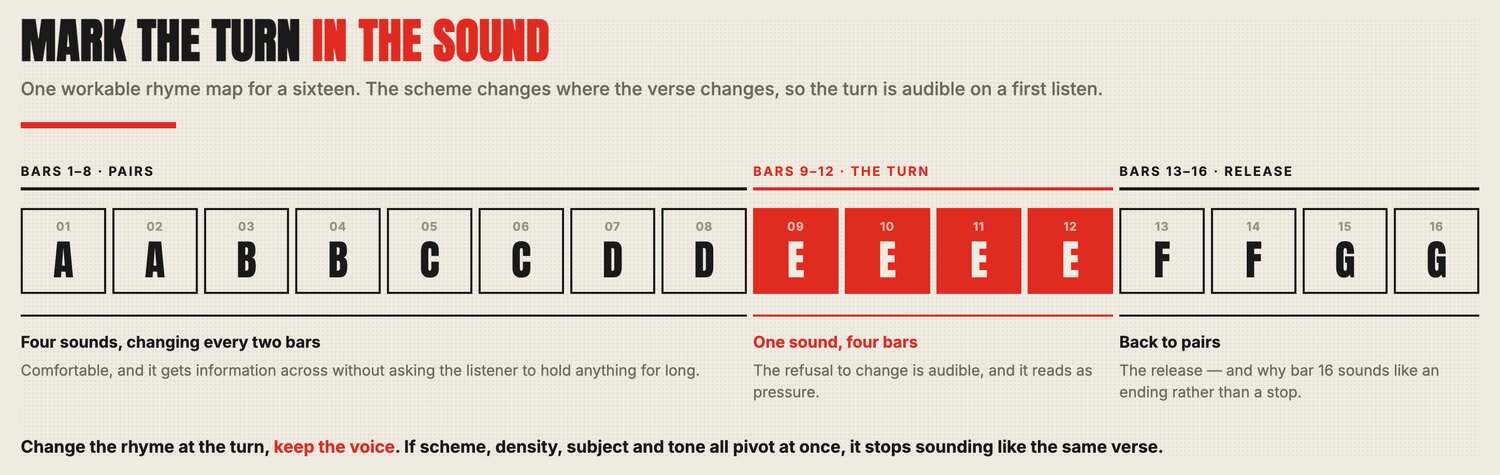
So mark it in the sound. One workable map:
- Bars 1–8 in pairs: A A B B C C D D. Four sounds, changing every two bars, which is comfortable and gets information across.
- Bars 9–12 on a single sustained sound: E E E E. Four bars that will not let go of one rhyme. The refusal to change is audible, and it reads as pressure. This is also where the syllable count should be at its highest — see move 7; the crowded bar and the stuck rhyme are one pressure marked twice.
- Bars 13–16 back to pairs: F F G G. The release, and the reason bar 16 sounds like an ending rather than a stop.
That is one option, not the option. Inverting it works too: dense chains through the first eight so the ninth bar dropping to a bare couplet lands like the floor giving way. What matters is that something changes at the turn, and that it changes in the sound rather than only in the sense.
Rhyme and density can peak together, as above, because they are two ways of marking one pressure. Subject, tone and persona are a different matter: pivot those at bar 9 as well and the listener hears a different verse rather than a turn inside this one. Mark the turn, keep the voice.
5. Vary the sentence, not just the vocabulary
This one is invisible on the page and obvious out loud, and it is the most common reason a technically fine verse sounds like a list.
Count the grammatical shape of your lines. Here are four bars with only one shape:
I wake up early, I take the long way, I count the change, I know what it don't say, I keep the receipts, I remember the date, I show up on time, I still end up late.
Eight clauses across four bars, every one of them a flat declarative statement, every one of them opening with I. The vocabulary is varied. The sentence is not, and the sentence is what the ear tracks. By bar three the listener has the pattern and stops receiving anything new from the rhythm of the language.
Now the same eight pieces of information, same words wherever possible, in four different shapes:
Wake up early, take the long way, The change — I count it, I know what it don't say, Receipts I keep. Dates I remember. Show up on time and still end up late?
Imperative, then a fronted object, then two inversions, then a question. No image has been added, no line has become more concrete, and the reader can check that: every noun in the second block appears in the first. Only the grammar moved, and the four lines now make four different demands on the listener.
The diagnostic takes a minute: write the first two words of each of your sixteen bars in a column. If more than half the column is the same word, you have found the problem, and it is not a vocabulary problem — the older how to write rap lyrics covers the filler-word version of the same symptom.
6. Start somewhere other than the downbeat
Most drafts start on beat one because the bar starts on beat one, which is a decision nobody made.
Where to put the entrance — on the drum, just behind it, just ahead of it — is a delivery control rather than a writing one, and how to improve rap flow has the three-pocket drill that settles it for a given passage.
The verse-level note is the one that drill does not cover: whatever you choose for bar 1, choose again for bar 9. A turn that changes its rhyme scheme and keeps the same entrance placement is marked once when it could be marked twice, and the second mark is free — you are not writing anything, you are starting in a different place.
Along with move 7, this is one of the two decisions on the list that cannot be made on paper — you have to run the drill and listen. Skip it and you are guessing, and the guess is almost always the downbeat, which is where the draft already was.
7. Put the density peak where the turn is
That syllable counts should vary rather than sit flat is settled elsewhere: how many syllables fit in a 138 BPM rap beat works out the real number for your tempo and the contour that fits it, with the out-loud test that decides it.
The verse-level decision is narrower, and it is one that article does not make for you: where the peak goes. Most drafts peak wherever the writer got excited, which tends to be bar 9, immediately after the turn arrives.
Put it with the turn instead, not after it. If bars 9–12 are already holding one rhyme, that is the pressure point of the verse — so let the syllable count top out across the same four bars. The sustained rhyme and the crowded bar then say the same thing at the same time, and the listener registers one event rather than two competing ones.
Which gives a contour that agrees with the rhyme map above: bars 1–4 roomy, the count climbing from bar 5 into the peak at 9–12, easing back at 13–14 as the scheme returns to pairs, and a hard drop at 15 and 16 so the last line has space around it. That drop is most of why closing bars sound like closing bars.
The trap is peaking twice. A verse with a crowded passage at bar 9 and a second one at bar 14 has no peak at all, because the second one has nothing to be louder than.
8. Write the handoff into the hook
That the last bar before the hook is a handoff is covered in how to write your first rap song. What follows is how to actually build the join, which is three specific techniques rather than an instruction to try harder.
- Hand over a word. End bar 16 on a word or sound the hook's first line picks up. If the hook opens with "say it", end the verse on say — the repetition does the joining and nobody consciously registers it.
- Leave the sentence open. End on a clause the hook completes grammatically. The listener's ear finishes the thought on the hook's first beat, which is exactly where you want their attention.
- Clear the last two beats. Say nothing over the second half of bar 16. Silence before a hook is the loudest available introduction to it, and it costs you two beats of writing you did not need.
Whichever you use, the hook has to already exist for this to work, which is the practical argument for writing it first.
When the draft is nineteen bars
Almost every honest first pass runs long. Cutting three bars out of nineteen is a better problem than padding sixteen out of thirteen, and there is an order that makes it quick.
Two rules, applied in this order, and always cutting a two-bar pair rather than a single line — how to write rap lyrics explains why the phrasing punishes you for cutting one:
- The bar you would skip reading it aloud to a friend. You already know which one it is.
- The second-best line in the block. The worst line is usually doing a job. The second-best is competing with the best one four feet away, and cutting it makes the best line louder.
If you are still over after that, the verse has two subjects in it and one of them is a different song.
Frequently asked questions
Does a rap verse have to be sixteen bars?
No, but it is the default for a reason: at most rap tempos sixteen bars is roughly thirty to forty seconds, which is long enough to develop something and short enough to hold attention. Twelve and twenty-four are both common. The moves above are about proportion rather than length — a twelve-bar verse still has a turn, it just arrives around bar 7.
Should I write the hook or the verse first?
The hook, if the song has one — move 8 is unbuildable otherwise. How to write your first rap song makes the full case and walks through getting a usable hook down quickly.
How long should writing one verse take?
Highly variable, and the number is less useful than the split. Expect the first eight bars to come much faster than the second eight — that asymmetry is normal and it is a material problem rather than a discipline problem. Why rappers don't write second verses covers the same shortage one level up, at the song.
Three things you can stop worrying about
Rhyme complexity. Internal and multisyllabic rhyme are worth real work, and the rap lyrics generator page argues that case properly. It is just not what is wrong with a verse that reads as a list — no chain fixes an order problem.
Writing in order. Bar 16 before bar 9, the hook before either. None of it shows in the finished thing.
Getting all eight right on this verse. Moves 2 and 8 are scheduling, so on a finished draft they are notes for the next one. That is the honest thing to say about them.
If you want the four-block shape a sixteen writes into, the rap lyrics generator page lays it out under the tool, and the generator returns two sixteen-bar verses and a hook with the section tags already in place — useful here mostly as something to run the swap test on, since an interchangeable block is far easier to spot in writing that isn't yours. For raw lines to build a density contrast from, rap bars gives you four, eight or sixteen individual lines to keep or discard rather than a finished verse.
The short version
How to write a rap verse, reduced to one sentence: swap two blocks to find out whether your order is doing anything, decide the last bar before the ninth, return to one object, change the rhyme where the verse turns, vary the sentence shape, choose the entrance twice, put the density peak on the turn, and write the join into the hook.
Not one of the eight asks you for a better idea or a bigger vocabulary. That is usually the surprise: they change where things sit and what gets marked, and the verse that finally works is built out of material you already had.
Keep reading
- How to write rap lyrics for the line-level job underneath this one, from a genuinely blank page.
- How to improve rap flow for the delivery side of entrances, density and space.
- How to write your first rap song for the level above the verse, where the sections get arranged.